


Engineering capacity rarely keeps up with the SaaS growth.
New feature demands pile up, customer expectations increase, technical debt grows quietly, and release cycles slow down. The natural reaction is to hire more developers. Yet, shortcomings with hiring are:
- Slow process.
- Expensive to sustain..
- Operationally heavy.
- Ineffective at improving delivery velocity.
Modern SaaS leaders are now looking for ways to scale output, not headcount. They want sustainable delivery without carrying the overhead of recruitment, training, management, and extended onboarding cycles. This shift has pushed a new model forward: flexible, senior-led engineering pods built for fast, predictable throughput.
Before exploring how you can scale engineering team with this model, let us understand why traditional scaling methods fail for SaaS businesses.
Why Traditional Scaling Models Fail In SaaS?
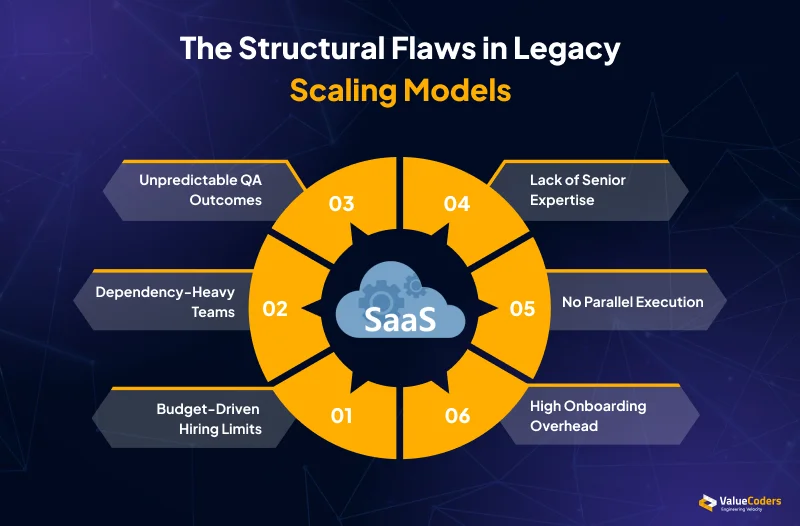
SaaS products grow faster than internal engineering systems can support. Across fast-growing SaaS teams, these failure patterns repeat regardless of product category or tech stack. When demand increases, but team capacity stays fixed, delivery breaks down in predictable ways.
1. Budget-Driven Hiring Limits: Hiring full-time engineers consumes the budget quickly. The cost does not stop at salary. It extends into onboarding time, management overhead, compliance, benefits, and shadow time before productivity stabilizes.
2. Dependency-Heavy Teams: As products expand, internal teams become interdependent. Design waits on engineering. Engineering waits on QA. QA waits on DevOps. These bottlenecks slow down the cycle. Adding more developers does not solve dependency issues; team augmentation services can.
3. Unpredictable QA Outcomes: In many teams, QA is stretched thin. Testing happens late. Bugs slip into production. Releases become unpredictable. Without dedicated and consistent QA capacity, engineering velocity stays low regardless of team size.
4. Lack of Senior Expertise: Apart from coding, SaaS engineering requires an intellect able to conduct architectural analysis. Scaling engineering teams alone can’t fix everything. Absence of experience makes the companies susceptible to slow deliveries, reworks, and sub-optimal quality.
5. No Parallel Execution: A single team handling multiple priorities becomes overloaded. Everything moves sequentially. Feature development, maintenance, integrations, and technical debt all compete for attention. As a result, timelines stretch and velocity drops.
6. High Onboarding Overhead: Every new hire requires onboarding, context sharing, tooling access, documentation review, and cultural alignment. This onboarding friction delays productivity. In fast-growing SaaS environments, these delays accumulate quickly.
Traditional hiring adds headcount. It does not add scalable output. This is why SaaS companies are moving toward a pod-based SaaS team scaling model.
Use senior engineering pods that deliver higher throughput while keeping your operating cost predictable and lean.
The Modern Solution: Flexible Engineering Pods
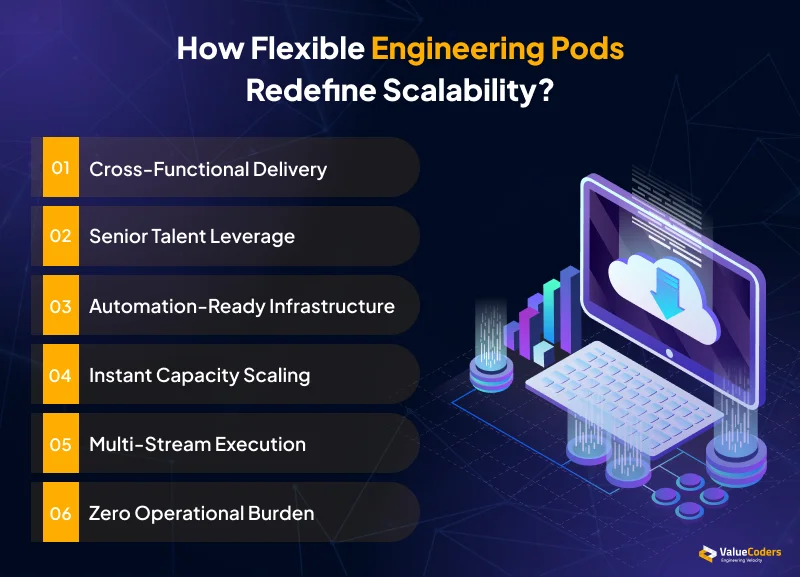
SaaS teams now need a Scalable engineering processes that apply instantly without adding operational burden. Flexible engineering pods solve this by providing a senior, self-contained unit that moves work from idea to deployment without friction.
1. Cross-Functional Delivery
- Contains dedicated development teams, including developers, QA, DevOps, and a delivery lead.
- Work flows without delays because every function exists inside the same unit.
- Removes dependency blockers and creates fast, predictable cycles.
2. Senior Talent Leverage
- Engineers contribute higher output per sprint.
- Code quality improves, rework drops, and product stability increases.
- Senior professionals require less oversight and deliver cleaner builds from day one.
3. Automation-Ready Infrastructure
- Come equipped with CI pipelines, test automation, coding standards, deployment scripts, and monitoring setups.
- Shortens release cycles and reduces manual effort across the board.
4. Instant Capacity Scaling
- Can scale capacity up or down within days to match product priorities.
- Removing hiring delays, onboarding cycles, and long-term commitments.
- Keeping engineering output tightly aligned with shifting roadmap demands.
Accelerate delivery with cross-functional pods that remove dependency delays and maintain continuous product momentum.
5. Multi-Stream Execution
- Advances core development, integrations, modernization, and maintenance in parallel.
- Eliminates dependency slowdowns across simultaneous workstreams.
- Accelerates delivery by keeping the entire roadmap continuously unblocked.
6. Zero Operational Burden
- Functions as a self-sustained unit and eliminates recruitment, performance management, infrastructure, and compliance workload.
- Removes the burden of HR processes and ongoing delivery governance.
- Keeps SaaS leaders focused solely on the product roadmap, not operational overhead.
This model gives SaaS teams the speed of a high-performance engineering unit without the cost or burden of expanding full-time staff. It makes it the best among SaaS engineering scaling strategies.
Also Read: How to Bootstrap a SaaS Startup in 2026?
When Should SaaS Leaders Move To A Pod-Based Model?
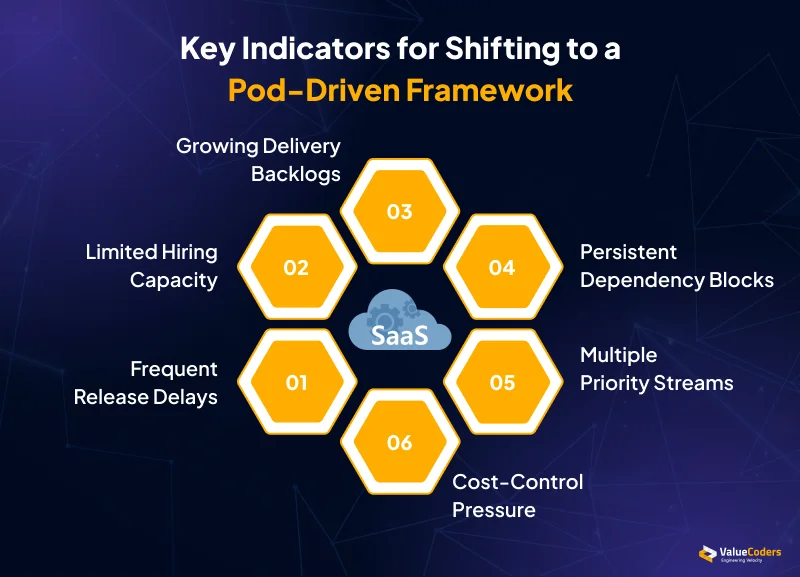
Not every SaaS company needs pods immediately, but certain signals make the need obvious. When internal teams cannot keep pace with product goals, pods restore stability and accelerate progress.
1. Frequent Release Delays
If your engineers are always busy but delivery remains slow, pods restore momentum by keeping all roles inside a single, autonomous unit containing top software developers.
2. Limited Hiring Capacity
Hiring freezes, budget restrictions, or recruitment delays often stop SaaS companies from expanding. Pods offer instant senior capacity with no hiring cycles.
3. Growing Delivery Backlogs
If your backlog grows faster than your team can deliver, pods accelerate throughput and move multiple priorities in parallel.
Also Read: SaaS Development Secrets for Modern Business Products
4. Persistent Dependency Blocks
If tasks keep getting stuck between design, development, QA, and DevOps, pods eliminate these gaps through cross-functional execution.
5. Multiple Priority Streams
SaaS products often require feature development, integrations, modernization, and maintenance at the same time. Pods support parallel execution for each stream.
6. Cost-Control Pressure
Pods reduce payroll load, eliminate management overhead, and offer predictable monthly billing. This ensures high output at controlled operational cost.
If any of these conditions exist, pods become a strategic scaling advantage.
Scale pods up or down based on priorities so your product team never slows down due to changing demand.
What ValueCoders Offers to SaaS Companies?
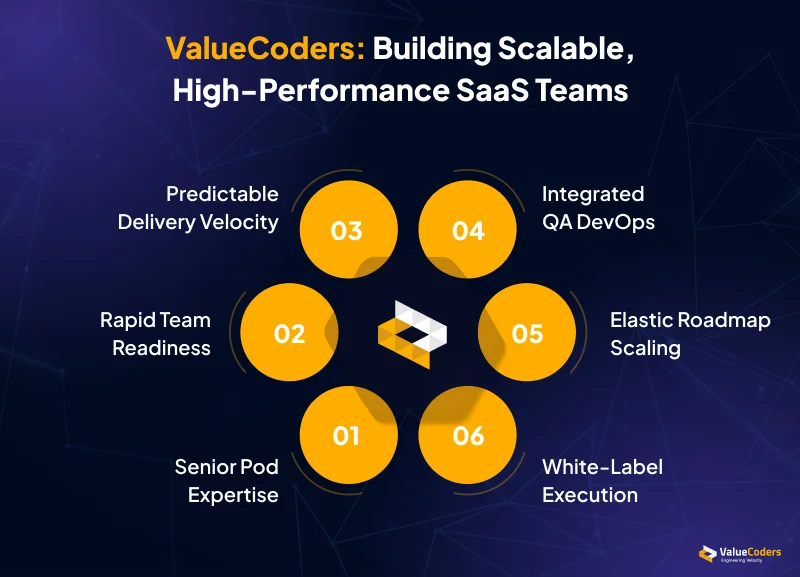
ValueCoders, a leading SaaS consulting and development services provider, helps SaaS companies increase engineering output quickly without expanding internal headcount. Our pod-based delivery model is designed for predictable velocity, clean execution, and seamless integration with in-house product teams.
1. Senior Pod Expertise
- Each pod is composed of senior, battle-tested engineers who understand SaaS complexity, enabling consistent and high-quality output.
2. Rapid Team Readiness
- Pods become operational quickly. SaaS companies skip recruitment, onboarding, and slow team formation. Work begins in days, not months.
3. Predictable Delivery Velocity
- Pods operate in structured sprints with defined capacity, clear ownership, and measurable delivery metrics, giving SaaS leaders consistent visibility into progress and throughput.
4. Integrated QA DevOps
- Every pod includes QA and DevOps capacity so that builds remain clean, deployments remain stable, and releases happen without friction.
5. Elastic Roadmap Scaling
- SaaS companies can expand pods during peak demand or scale down after launch without affecting team morale or product momentum.
6. White-Label Execution
- Pods operate under your product leadership and integrate with your workflows. Your SaaS brand retains full ownership of delivery and client experience.
Want to scale your engineering capacity? Contact us to receive consistent delivery and measurable sprint outcomes.