


Build or extend? That may be the wrong question entirely.
Most CTOs focus on the build vs extend development team decision, but the better question is what supports delivery right now.
Scaling engineering teams is not just about adding people. It is about removing what slows delivery and choosing the right approach for the situation.
Each option solves a different problem.
- Building gives control.
- Extending gives capacity.
- Modernisation fixes hidden bottlenecks.
This guide breaks down when to use each approach. It helps you decide based on your current challenges, instead of just assumptions.
Why Scaling Engineering Teams Is Harder Than It Looks
Scaling a team looks simple on paper. Add more engineers and move faster. But in reality, most teams do not slow down because of a lack of people.
They slow down because of how work is structured.
Most CTOs try to solve delivery problems by hiring faster. Often, the real issue is unclear ownership or slow systems, not team size.
In many cases, software team scaling creates new problems instead of solving old ones. More people mean more coordination.
Without clear ownership, even strong teams struggle to deliver.
There are a few common reasons why scaling engineering teams becomes difficult:
- Work is not clearly defined
- Systems are outdated or hard to work with
- Communication breaks as teams grow
- Hiring takes time, but delivery pressure stays
This is why CTOs need to look beyond hiring. The real goal is not just scaling engineering teams. It is improving how the team delivers work.
Once this is clear, choosing between build, extend, or modernise becomes much easier.
Add the right skills and delivery support without long recruitment cycles.
A Practical Decision Framework for CTOs to Choose the Right Team Model
Understanding the models is only the first step. The real value comes from choosing the right one.
That decision depends on what is slowing your team down right now. This CTO Decision Framework helps you choose with clarity.
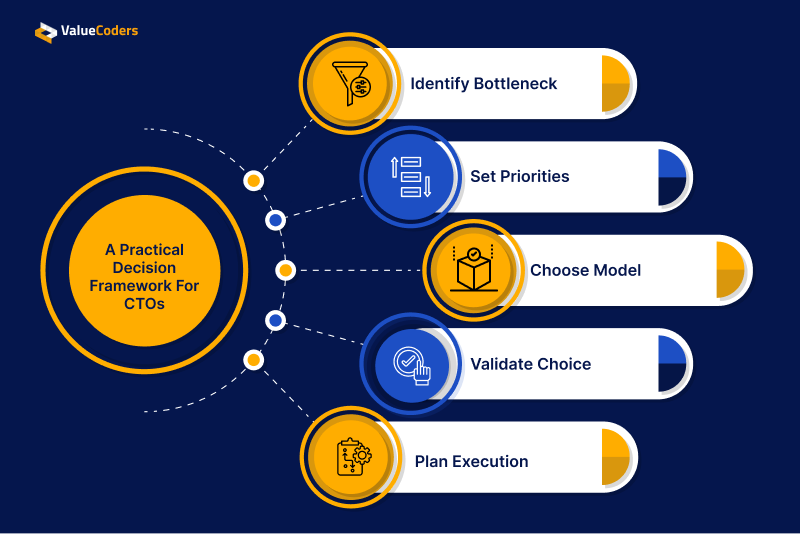
Step 1: Identify Bottleneck
Start by understanding what is slowing you down.
- Hiring delays often point to a need for long-term roles.
- Short-term workload gaps usually require additional capacity.
- Slow delivery may come from system issues, not team size.
- Missing expertise can limit progress even with a strong team.
Be clear about the real constraint before choosing a model.
Step 2: Set Priorities
You cannot optimise for everything at once.
Focus on what matters most right now:
- speed of delivery
- control and ownership
- flexibility
- long-term stability
Your top priorities should guide the decision.
Step 3: Choose Model
Map your situation to the right approach.
Long-term ownership and stability point toward building in-house.
Short-term needs or skill gaps are better handled by extending the team.
A need for full team support suggests a dedicated setup.
System delays should be addressed through modernisation first.
Also Read: Product Engineering KPIs: What to Measure to Ensure Velocity Success
Choose the option that removes your main constraint.
Step 4: Validate Choice
Before moving forward, check your decision.
- Does this match your timeline?
- Does this fit your risk level?
- Do you have the leadership to manage it?
Any uncertainty here is a sign to reassess.
Step 5: Plan Execution
Once the direction is clear, act quickly.
- Start hiring and align the budget for in-house roles.
- Fix the biggest system bottleneck in the case of modernisation.
- Define skill gaps and onboard support for team extension.
- Set roles and begin structured execution for a dedicated team.
Early action helps avoid delays later.
Reduce hiring delays, improve delivery speed, and scale engineering teams with clarity.
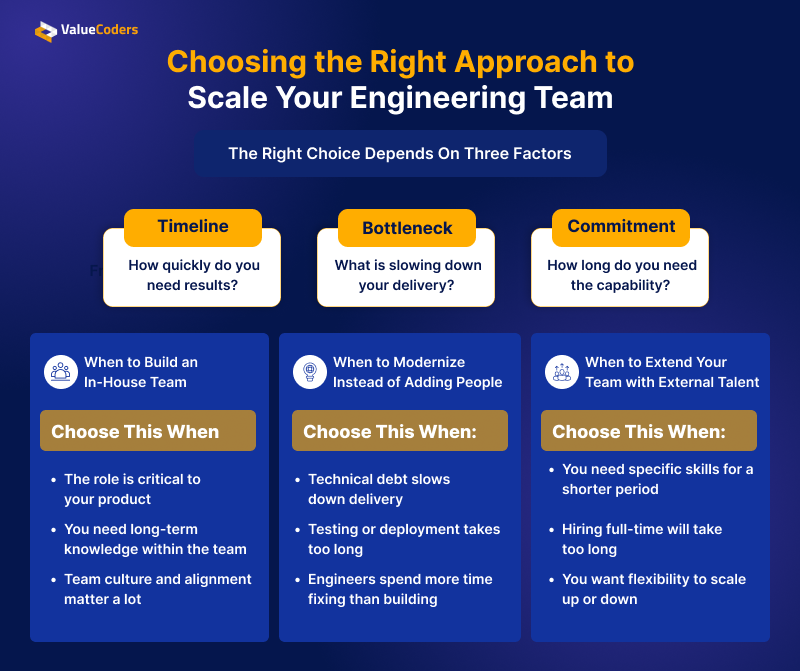
Choosing the Right Approach to Scale Your Engineering Team
Scaling engineering teams is not about picking the most popular option. It is about selecting the approach that fits your specific situation.
The right choice depends on three factors:
- Timeline: How fast do you need results?
- Bottleneck: Is it people, systems, or skills?
- Commitment: Is this permanent or temporary?
Let’s examine each approach.
When to Build an In-House Team
The approach: Hire full-time engineers who work directly for your company.
Choose this when:
- The role is critical to your product
- You need long-term knowledge within the team
- Team culture and alignment matter a lot
Avoid this when:
- You need results in the next 30 to 60 days
- The skill is temporary or highly niche
- Your budget cannot support long-term hiring
When to Modernise Instead of Adding People
The approach: Improve your systems, processes, and workflows before hiring more people.
Choose this when:
- Technical debt slows down delivery
- Testing or deployment takes too long
- Engineers spend more time fixing than building
Avoid this when:
- Your systems are already efficient
- The problem is clearly a lack of people
- You cannot pause delivery for improvements
Also Read: How a US Dev Agency Lifted Margins by 40% With Strategic Channel Partnerships
When to Extend Your Team with External Talent
The approach: Add external engineers to work with your current team using IT staff augmentation services.
Choose this when:
- You need specific skills for a short period
- Hiring full-time will take too long
- You want flexibility to scale up or down
Avoid this when:
- The role needs deep, long-term knowledge
- Your team lacks structure to manage external members
- Security rules require full internal control
Identify the right path to increase delivery capacity without creating new operational bottlenecks.
Dedicated Team vs Extended Team: Understanding the Differences
You have three paths forward. But choosing the right one requires comparison, not just awareness. This section helps you evaluate each approach against your specific situation.
Many CTOs decide to extend their team. But this is where confusion starts.
A dedicated development team and an extended team may look similar. Both involve external engineers. But they work very differently.
A dedicated team works as a separate unit. They handle delivery as a group and take ownership of outcomes.
An extended team works inside your setup. You manage tasks, priorities, and delivery.
Choosing the wrong model can slow things down instead of fixing them.
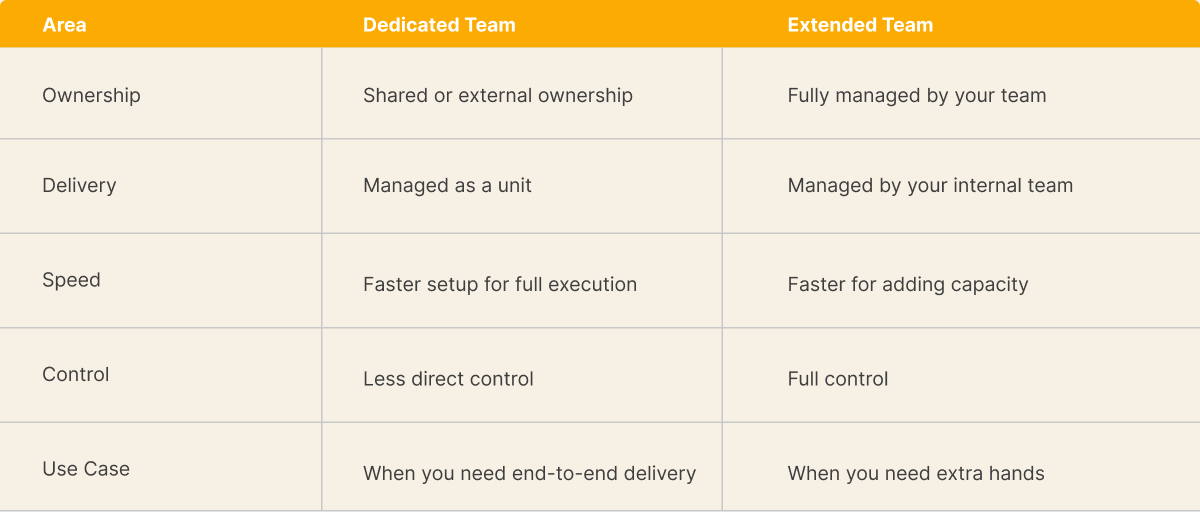
Quick Comparison: Dedicated vs Extended Team
The main difference is ownership. A dedicated team owns delivery, while an extended team supports your internal delivery.
What CTOs Should Focus On
The choice is not about which model is better. It is about how much ownership you want to keep.
Choose a dedicated team when:
- You need faster execution with ownership
- The internal structure is limited
Choose an extended team when:
- You already have a strong team
- You need more capacity
The difference is simple:
- Dedicated team handles delivery
- The extended team supports your delivery
Understanding this makes the next decision much easier.
Also Read: How to Build a Dedicated Development Team in 4 Weeks
Common Decision Mistakes
Many scaling and modernization initiatives fail because businesses address symptoms instead of the underlying operational challenges.
Hiring Before Fixing Systems
Adding engineers rarely solves workflow bottlenecks. Inefficient processes and unclear priorities continue to slow delivery.
Modernising Without Clear Priorities
Large modernization efforts can disrupt without measurable improvements in delivery speed, product quality, or business outcomes.
Extending Teams Without Ownership
External capacity works best when accountability, decision-making authority, and delivery responsibilities are clearly defined.
Final Thoughts
There is no single right way to scale a team. The build vs extend development team decision depends on what is slowing you down right now. Build when long-term ownership matters. Extend when speed and flexibility are the priority. Modernise when systems are the real bottleneck.
The goal is not to pick a model. The goal is to remove the constraint that is slowing delivery.
At ValueCoders, we’ve helped software-led businesses scale delivery through product engineering, modernization, and dedicated teams. Contact us to discuss the best approach for your engineering goals.