

Bandwidth outgrows the in-house capacity during sprints.
Yet, you must fulfill your delivery pipeline commitments.
Here, mini and specialist pods are two viable options that enable you to:
- Maintain the momentum and operational excellence.
- Upscale the pace during the early development phase.
- Carry out complex initiatives with their expertise.
Selecting either is subject to your unique requirement of rapid scalability or expertise. This blog does a mini pod vs specialist pod comparison, enabling you to determine the best-suited choice for you.
Before anything else, let’s first understand what mini and specialist pods are.
Understanding Mini and Specialist Pod
Mini Pod
A pod of low headcount designed for the rapid delivery of product features with minimal dependency overhead. This agile pod setup is a suitable choice to deal with early development phases, experimentation, and MVPs.
- Internal collaboration within the pod enables it to offer end-to-end delivery without external support.
- Such a pod is featured with speed, adaptability, and a shorter release cycle.
Add specialist-led pods that handle deep technical challenges without disrupting ongoing work.
Specialist Pod
A domain-focused pod built to solve deep technical challenges and improve system-level maturity.
- This pod model framework is an ideal choice for scalability upgrades, architecture evolution, performance tuning, or security initiatives.
- Niche experts in domains such as DevOps, data, AIL/ML, security, and cloud offer the solutions.
- Resilience, precision engineering, and long-term sustainability are the top priorities.
Next, let’s compare both pods on various metrics and understand how they differ in speed, scalability, and long-term value.
Also Read: 10-Step Checklist to Build a Successful MVP for Startups
Mini Pod vs Specialist Pod – Key Comparison Matrix
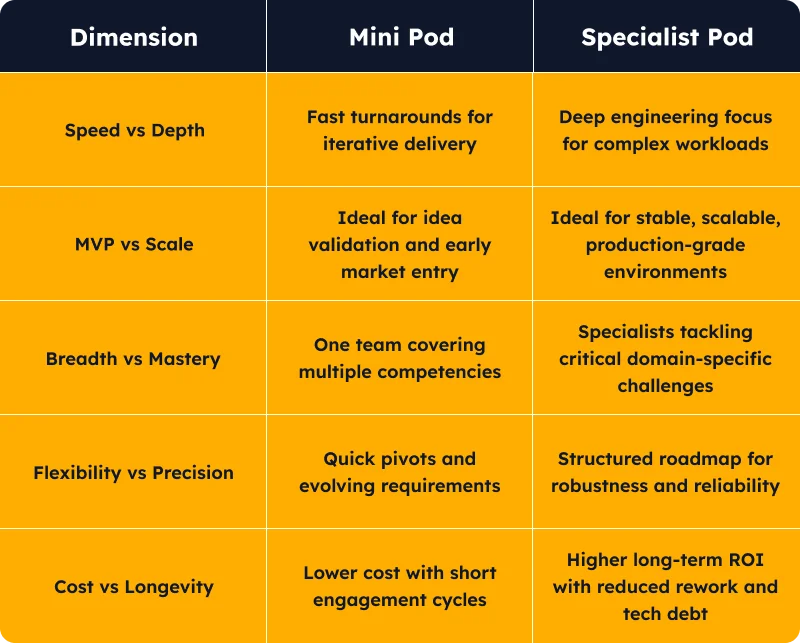
The following are the five critical dimensions that truly matter for CTOs seeking the right balance:
Speed vs Depth
- When it comes to rapid iteration and delivery velocity, mini pods have the upper hand.
- However, special pods are like an extension of dedicated development teams, and are designed to resolve complex architectural and infrastructural challenges with technical depth and domain expertise.
Use compact pods designed for quick iteration, MVPs, and early releases.
MVP vs Scale
- Enterprises prefer mini pods when they need to convert theory into a functional prototype. Such a collaboration helps them accelerate discovery.
- Once the MVP is validated, enterprises require a production-grade ecosystem before they deploy the final product to the public domain. Specialist pods dominate this phase by offering extensive capacity planning, API optimization, CI/CD automation, and infrastructure scaling.
Breadth vs Mastery
- Team scalability with mini pods brings a consolidated approach where each member fulfills distinct roles and responsibilities across the stack, ensuring smooth delivery.
- On the other hand, with mastery of dedicated product extension pods, you receive precise solutions, optimized performance, and enhanced technical foundation.
Cost vs Longevity
- Mini pods are inherently cost-efficient. In addition, they help to reduce costs by offering short engagement cycles.
- Specialist pods offer long-term value by creating a formidable system that needs minimal rework, reduces maintenance costs, and prevents performance bottlenecks in the future.
Selecting the right pod makes all the difference, which requires due consideration.
Also Read: Top MVP Development Companies: A Comparison of Services, Costs, and Expertise
Choosing the Right Pod for Your Engineering Roadmap
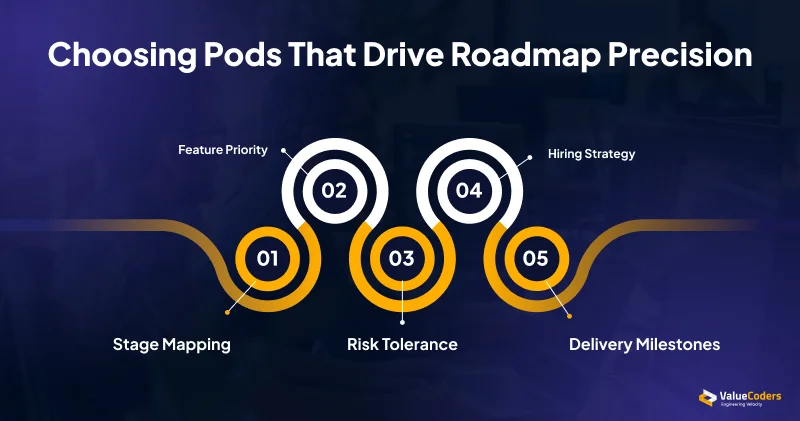
CTOs must consider this operational decision as a critical engineering choice. Here is how they can align their endeavours to the most suitable pod configuration:
1. Stage Mapping: CTOs need to determine where the product currently stands in its lifecycle. Based on that, and what’s next 90-180 days demand, a reasonable choice should be made.
2. Feature Priority: Analyze the feature backlog and make a decision based on urgency and complexity.
3. Risk Tolerance: Mini-pods are best suited if the priority is speed to market with acceptable trade-offs. However, if the requirements are extensive technical excellence, such as zero-compromise security, durability, and performance, specialist pods are a necessity.
4. Hiring Strategy: Mini Pods mitigate immediate hiring pressure by providing compact cross-functional units to keep development flowing. Specialist Pods offer niche expertise without forcing permanent recruitment for rare skill sets.
5. Delivery Milestones: Mini Pods create rapid momentum for frequent feature releases, early demos, and user feedback loops. Specialist Pods unlock milestone success during hardening phases such as scaling, refactoring, or cloud transformation.
Move to expert pods that stabilize systems and reduce long-term technical issues.
Final Thoughts
Specialist and mini pods have their virtues and vices, making them suitable for specific use cases. Enterprises should have mini or specialist pods based on the urgency or complexity of the job they require.
ValueCoders is a recognized engineering partner trusted for its software development services. We offer 100% ownership of the sprint throughput. Contact us if you want pods deployed in 1–2 weeks, not months.