


Outsourcing is often used by product teams to access engineering talent and accelerate development. However, many outsourcing partnerships fail to deliver predictable results.
Research shows that 20-25% share of outsourcing projects either miss expectations or fail to meet business objectives.
For product teams, the problem is rarely outsourcing. The real issues are weak delivery governance, poor communication, misaligned expectations, and vendors focused on headcount instead of outcomes.
This article explains the most common reasons outsourcing fails for product teams and what engineering leaders can do to avoid these mistakes.
Why Product Development Outsourcing Often Fails
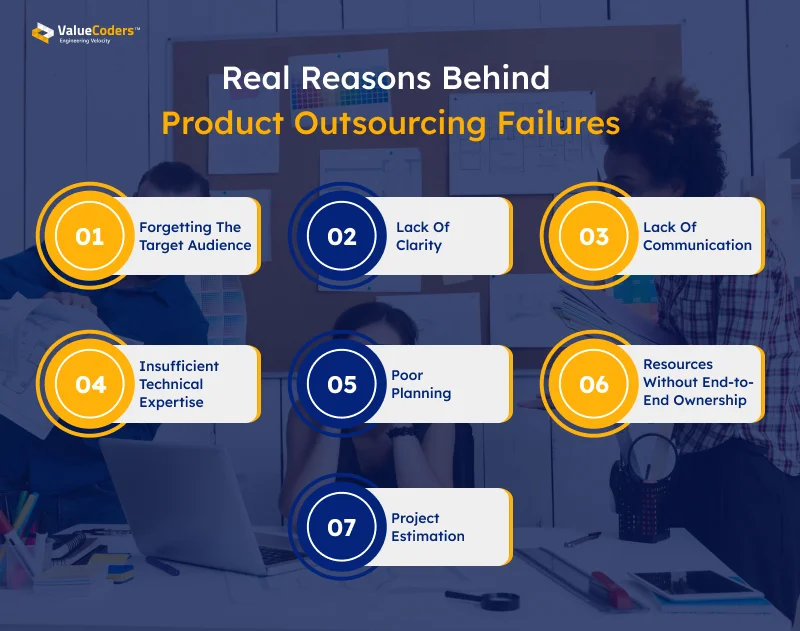
When outsourcing product extension pods, tech companies demand smooth workflows, consistent delivery, and minimal rework. Some of the reasons why outsourcing partnerships continue to break down include, but are not limited to:
Reason 1: Forgetting The Target Audience
What increases the outsourcing risks for product development companies is product-vendor misalignment. Some of the practices that can be termed as misdirected efforts are:
- Developing the product without validating suitability with the ideal customer profile.
- Not giving user experience and stakeholder feedback enough weightage and failing to make changes in real-time.
- Lacking originality in the product and offering a repurposed and rebranded copy.
Collectively, these lead to a delivery that lacks the potential and delivers limited product impact. Consequently, projects finish, but fail to serve the underlying purpose.
Reason 2: Lack Of Clarity
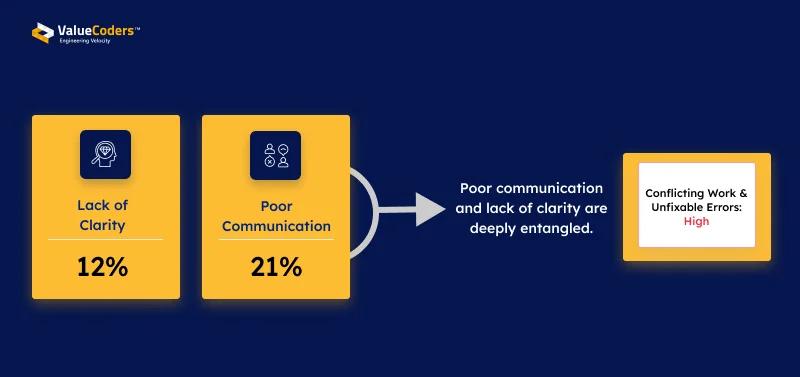
Allocation of work in willy-nilly makes things tedious and lead to disjointed efforts. Consequently, 12% of companies claim that outsourced teams do not follow the instructions.
In most instances, outsourced teams lack the fundamental clarity, which incapacitates them from acting as instructed.
Reason 3: Lack Of Communication
21% of companies have reported communication issues, which makes it difficult to share clear instructions. Due to which:
- Outsourced employees fail to understand the precise requirements and fail to attain the preordained quality threshold.
- Execution suffers due to a lack of collaboration between the in-house and outsourced teams.
Lack of communication may result in product team outsourcing challenges that cause them to direct their efforts in conflicting directions. This could create anomalies that are difficult to fix, even by multiple reworks.
Use delivery models that enable fast feedback cycles and continuous validation.
Reason 4: Insufficient Technical Expertise
When we talk about software products, technical expertise is a must for the outsourced team. When you outsource the teams that fail to comply with this basic requirement, consequences emerge as:
- Missed Deadlines: 14% of businesses have reported missed deadlines when working with outsourced teams. In most instances, the prominent reason behind this is not negligence but the lack of expertise and proficiency.
- Wrong Delivery: Skill-constrained teams turn flat when it comes to meeting the client’s expectations, and end up delivering work that lacks the desired depth and quality.
- Frequent Vendor Offboarding: Product teams have a workflow that runs on fast-moving and feedback-driven cycles. Teams that lack the expertise and experience of the domain are more habituated to a linear work structure. They fail to adapt, compelling the teams to face delivery issues due to mid-sprint partnership termination.
In total, these outcomes are more than enough to compromise the operational endeavours, affecting other business aspects.
Reason 5: Poor Planning
Even with the dedicated development teams, a structured execution is more than pivotal. Sub-optimal planning undermines the effectiveness of the execution. The following are the structural issues that demonstrate the interplay between inadequate preparation and project instability:
- Unclear Scope Definition: Projects lacking pre-determined metrics suffer from scope creep, deviation from core objectives, and frequent reworks, making the process slow.
- Unrealistic Timelines: The workflow in the product teams is not linear. Ignoring the variables that affect the delivery results to the timeline slips, further, erodes the stakeholder confidence.
- Lack of Risk Contingency: When the professionals proceed with a project without considering the conditional factors, they face real-time issues that cannot be fixed immediately.
Poor planning does not affect just immediately; it leads to issues that compound exponentially.
Reason 6: Resources Without End-to-End Ownership
In the traditional software development outsourcing model, concerned individuals are held responsible for delivery and not outcomes. Consequently, resulting in:
- Fragmented delivery across internal and external teams.
- Challenges in fixing any real-time issue.
- Unpredictable sprint velocity that leads to increased dependencies.
Resources without accountability complete the project but fail to address the underlying objective.
Shift focus from lowest bids to reliable product delivery.
Reason 7: Project Estimation
Although the budget does not seem to be the domain of CTOs. But, in one way or another, financial constraints affect the delivery, quality, and technical decision-making. When companies choose vendors based on lowest cost, they expose themselves to execution risks.
- Degraded Performance Benchmarks: Low-cost estimates do not offer viability and reliability in execution. Over time, what appears to be cost-efficient turns out to be cost and time-intensive through reworks.
- Compromised Technical Feasibility: Limited budget compels teams to minimize expenditure on architecture, QA and testing services, and scalability. Additionally, products created with a lack of adequate resources display their vulnerabilities as usage grows.
- Unpredictable Delivery Outcomes: Tight cost estimates make you susceptible to frequent renegotiations on scope, timelines, and resources. Reactive delivery due to the same creates issues in planning releases or committing reasonably to stakeholders.
Not fixing these issues affects both long and short-term strategies. These common outsourcing pitfalls require your immediate attention.
How Product Teams Avoid Outsourcing Failures
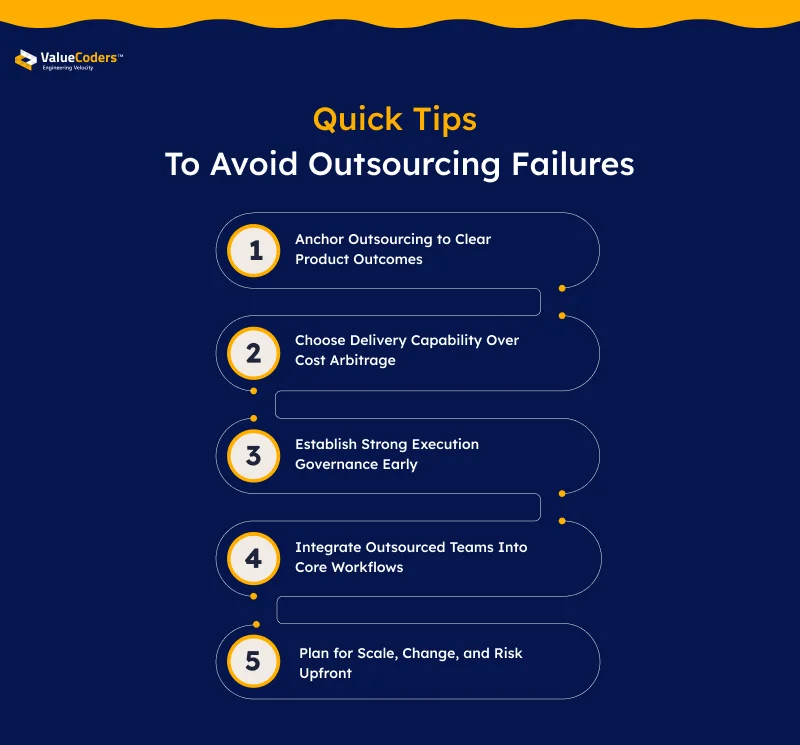
Before locking into any outsourcing engagement, product teams must address the structural gaps that cause delivery breakdowns. Here are some of the most pragmatic initiatives that help you counter the common product team outsourcing challenges:
Anchor Outsourcing to Clear Product Outcomes
Measure the success in terms of measurable outcomes, which include:
- Shipped features.
- Performance benchmarks.
- User impact.
The switch from the hour or headcount-based system is the first shift towards optimal performance.
Choose Delivery Capability Over Cost Arbitrage
When weighing cost-efficiency and delivery capability, prioritize the latter. It creates the possibility for:
- Technical depth.
- Ownership-based workflow.
- Delivery consistency.
Collectively, these keep you protected from subpar outsourcing experiences, and you can drive measurable value from the whole experience.
Establish Strong Execution Governance Early
You must establish:
- Clear ownerships.
- Decision rights.
- Escalation paths.
- QA standards.
It increases the likelihood of predictable delivery, ramped-up issue resolution, and consistent outcomes.
Align external teams with real product goals.
Integrate Outsourced Teams Into Core Workflows
Unify in-house and outsourced teams and treat them as a unit. To accomplish the same, you must align:
- Tools.
- Sprint practices.
- Documentation.
- Communication channels.
It allows collaboration that leads to more efficient project management.
Plan for Scale, Change, and Risk Upfront
Have a system equipped with a fallback plan. To actualize this objective, account for:
- Evolving requirements.
- Technical debt.
- Workload spikes.
Such extensive planning allows delivery to remain stable during contingent phases of sudden demand shift.
Ensure every initiative has clear ownership and execution control.
Final Verdict
Software development outsourcing fails to deliver the desired outcomes when the team’s efforts are not appropriately governed. Product teams that consider outsourced teams as their delivery partner have better results. If you outsource based on cost-efficiency, fail to assess the core competencies, or do not maintain the needed transparency with your service partner, you are likely to have an unfavorable experience.
ValueCoders offers clients senior-led delivery guided by end-to-end ownership. With the same, we have gained trust and recognition that has enabled us to expand our consumer base across the globe.
Still confused about what to do? Get in touch with us to start flawless product development with the engagement model that suits your particular requirements.