


Measuring software development performance is harder than it looks. Release timelines slip. Dependencies stack up. Engineering teams stay busy, yet product delivery slows.
For engineering leaders, the real challenge isn’t collecting more data. It’s identifying which software development metrics actually reflect delivery health.
Track the wrong metrics and teams optimize for activity instead of outcomes.
That’s why product engineering KPIs matter.
The right KPIs expose workflow bottlenecks, unstable planning, and hidden rework early—before they affect product delivery, customer experience, or revenue.
Where Engineering Velocity Breaks Down
Engineering velocity rarely collapses overnight. It degrades gradually.
In most product teams, leaders start noticing familiar patterns:
- One quarter feels fast, the next feels unexpectedly slow
- Hiring more engineers doesn’t improve delivery speed
- Work keeps stalling in reviews, dependencies, or rework
- Teams appear productive, but releases keep slipping
What makes this frustrating is that the output remains visible. Tickets are closed. Commits are made. Sprints are completed.
The 10 Product Engineering KPIs That Support Velocity
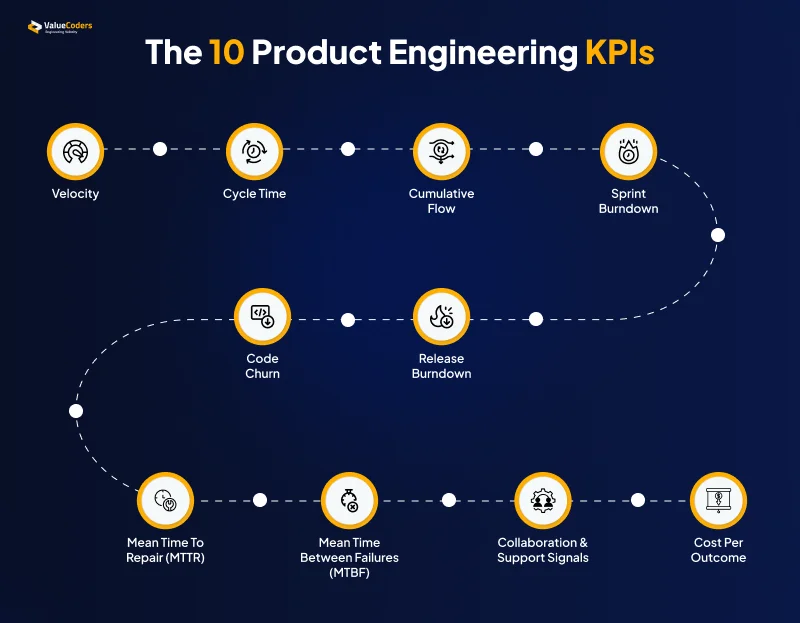
The most useful product engineering KPIs measure system flow, not individual performance.
For CTOs and engineering leaders, these metrics reveal whether engineering teams are improving delivery stability—or accumulating hidden inefficiencies.
Used together, these software development metrics provide a clearer view of engineering team performance, product team efficiency, and delivery predictability.
1. Velocity
Velocity only becomes meaningful when viewed over time.
Sprint-by-sprint velocity often hides volatility. Trend-based velocity reveals whether delivery is becoming more predictable—or slowly breaking down.
What it helps leaders understand
Are software product development services getting better at delivering consistently or relying on short-term bursts?
Use case
Sprint velocity looks flat, but quarterly trends show fewer completed epics. This often signals growing dependencies, oversized work items, or planning instability, not weaker execution.
2. Cycle Time
Cycle time measures how long work takes once it starts, not how much work is completed.
It’s one of the clearest indicators of delivery health because it exposes waiting, not just doing.
What it helps leaders understand
Where does work slow down after it’s already in progress?
Use case
Cycle time increases while output stays flat. Analysis shows work sitting idle in review and QA queues. The bottleneck isn’t development capacity; it’s handoffs.
3. Cumulative Flow
Cumulative flow visualizes how work moves across stages over time.
Unlike point metrics, it shows whether flow is balanced or backing up.
What it helps leaders understand
Which stage is quietly becoming a bottleneck?
Use case
The “In Review” band grows wider every sprint. Engineers aren’t blocked by complexity—the review process lacks capacity or clear ownership.
Also Read: How Early‑Stage CTOs Can Build High‑Velocity Teams Without the Hiring Bottlenecks
4. Sprint Burndown
Sprint burndown shows how work progresses within a sprint, but its real value lies in patterns, not ideal lines.
What it helps leaders understand:
Are teams executing planned work, or constantly reacting to change?
Use case:
Most work closes late in the sprint. This often points to shifting priorities, late dependency resolution, or unplanned work—not poor estimation.
5. Release Burndown
Release burndown tracks delivery progress across multiple sprints, making it essential for roadmap confidence.
What it helps leaders understand:
Are release commitments grounded in reality?
Use case:
Sprint burndowns look healthy, but releases consistently slip. Teams are completing tasks—but not the right ones tied to the release goal.
6. Code Churn
Code churn measures how often recently written code is changed or removed.
High churn doesn’t mean poor engineering; it usually means decision instability.
What it helps leaders understand:
Is rework silently consuming delivery capacity?
Use case:
Churn spikes after feature completion. Requirements weren’t validated early, leading to rewrites that slow effective velocity.
Also Read: How SaaS Companies Scale Engineering Without Expanding Headcount?
7. Mean Time to Repair (MTTR)
MTTR measures how quickly teams recover when things break.
It reflects operational readiness and delivery confidence.
What it helps leaders understand:
Can teams ship frequently without fearing prolonged disruption?
Use case:
Incidents are fixed quickly, but engineers are pulled off planned work to do it. MTTR looks healthy, but delivery suffers elsewhere.
8. Mean Time Between Failures (MTBF)
MTBF tracks how often failures occur over time.
Together with MTTR, it shows whether speed and stability are balanced.
What it helps leaders understand:
Is increased delivery speed weakening system reliability?
Use case:
Deployment frequency rises, but failures happen more often. Velocity improves in the short term but becomes fragile and unpredictable.
Also Read: The Role of Digital Transformation in Product Engineering
9. Collaboration & Support Signals
These include review wait times, handoffs, and shared ownership.
They reveal friction that traditional metrics miss.
What it helps leaders understand:
Is work flowing smoothly across teams or blocked by dependencies?
Use case:
Pull requests wait days because only a few senior engineers can approve changes. Velocity slows without showing up in sprint metrics.
10. Cost per Outcome
Cost per outcome ties engineering spend to delivered value—not activity.
It’s critical as teams scale.
What it helps leaders understand:
Is increased investment producing proportional delivery gains?
Use case:
Team size grows, but release frequency stays flat. Costs rise without improved outcomes, indicating a system scaling issue.
Also Read: Zero Violation Engineering and How Enterprises Stay Audit Ready from Day One
How a Structured Product Engineering Process Improves Velocity
Product engineering KPIs are most useful when supported by a clear delivery process.
A well-structured product engineering process:
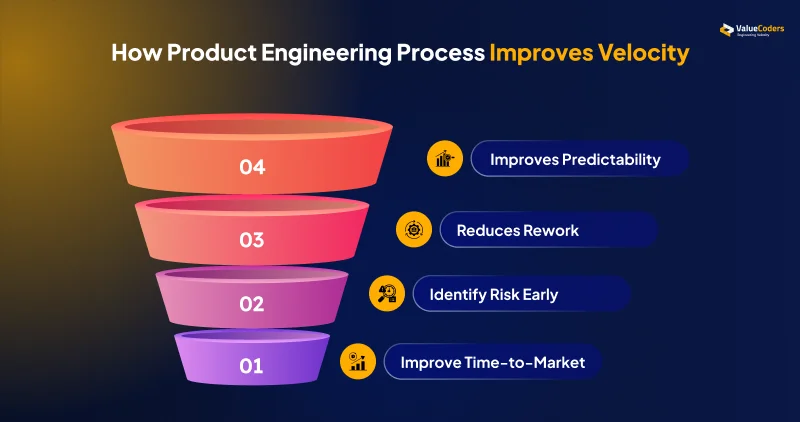
- Shortens feedback loops, improving time-to-market
- Identify risks early through architecture validation
- Reduces rework by aligning delivery to outcomes
- Improves predictability as complexity grows
When engineering processes and product delivery metrics align, teams accelerate without sacrificing stability.
Using KPIs as a Leadership Tool
KPIs are most effective when they help leaders remove friction, not control teams.
Used well, they shift conversations away from effort and toward flow, outcomes, and system health.
Instead of asking how hard teams are working, leaders can focus on:
- Delivery flow
- Engineering bottlenecks
- Product delivery outcomes
A practical KPI review rhythm helps maintain visibility:
A sustainable review rhythm works best:
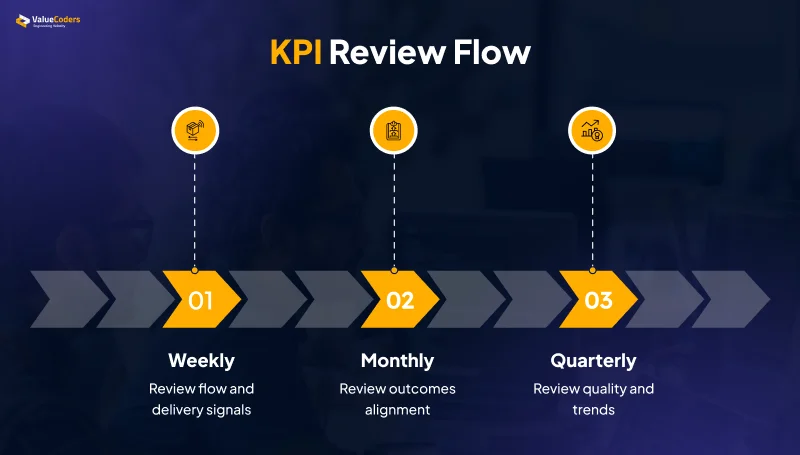
- Weekly: Review flow and delivery signals to identify bottlenecks early
- Monthly: Review quality and stability trends to ensure speed isn’t creating rework
- Quarterly: Review outcome alignment to confirm teams are building the right things
This reframes velocity as the ability to move work smoothly from idea to production, sprint after sprint.
Velocity ultimately lives at the pod level, where ownership is clear and accountability is shared. When teams own outcomes end to end, software project KPIs become tools they can act on, not reports leaders react to.
Conclusion
Engineering velocity leaks quietly through reviews, rework, handoffs, and recovery.
The right product engineering KPIs make this visible. They shift focus away from individual effort and toward system health, revealing where work slows down, where rework starts, and where stability is at risk. When used well, these metrics help leaders act earlier and make better trade-offs.
At ValueCoders, velocity is defined by outcomes, not activity. It lives at the pod level, where ownership is clear, and teams are accountable for delivery end to end. If you’re looking to improve delivery speed without adding overhead, ValueCoders’ execution-focused engineering pods help teams move faster with clarity, accountability, and predictability.