

Create maintainable, high-performance web applications using Angular frameworks.
Design, modernize, and scale enterprise-grade applications with Angular Development Services that support complex workflows, high user concurrency, and long-term maintainability.

Outstanding results, clear communication, and a dedicated team. We’re extremely satisfied with their IT services.
- Jonathan
Future-proof your frontend with thoughtfully engineered services built for long-term consistency, extensibility, and performance at scale.
Create tailored web applications aligned with business logic, performance requirements, and user experience goals.
Build responsive, secure, and scalable web interfaces for complex business applications.
Develop interactive, high-performance web applications that scale with user demand.
Modernize legacy frontends using Angular without disrupting core systems.
Enable smooth communication between Angular frontends and backend systems.
Deliver fast, secure Angular applications that meet enterprise standards.
Develop structured Angular applications that support long-term growth, performance, and maintainability.
Frontend systems remain responsive, maintainable, and adaptable as business demands change.
Maintain frontend systems that remain manageable as applications grow.
Enable faster feature delivery without destabilizing UI layers.
Improve visibility into frontend health and stability.
Support governance and access control requirements.
Support secure, high-accuracy financial interfaces.
Enable compliant, user-friendly healthcare applications.
Support fluctuating traffic and dynamic user journeys.
Improve usability of internal enterprise systems.
Enable real-time visibility across distributed workflows.
Support scalable, configurable frontend platforms.
Build structured and maintainable frontend systems.
Ensure consistent visual presentation across applications.
Manage complex UI logic efficiently.
Enable controlled and repeatable frontend releases.
Protect frontend interactions and user data.
Enable Angular applications that deliver 2–3x faster UI scalability, predictable performance, and long-term frontend stability across product lifecycles.
As an experienced AngularJS Development Company in India, we work with early-stage startups as well as large enterprises, building SaaS platforms and high-traffic digital products.
Augment existing teams with experienced Angular developers when required.
Partnering with businesses in diverse sectors to unlock new avenues for growth and innovation.
Frontend systems are developed and integrated within a broader enterprise technology ecosystem to ensure compatibility, performance, and operational alignment.
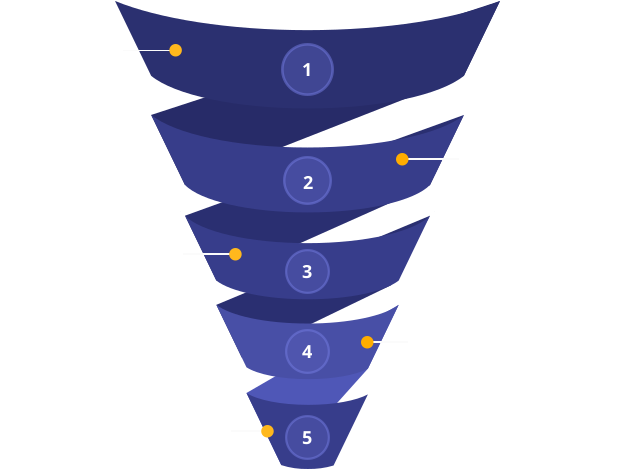
A structured Angular execution model focused on clarity, predictability, and long-term maintainability.
UI behavior and technical constraints are defined early.
Frontend structure is organized to for reuse and separation of concerns.
Features are delivered in controlled increments with ongoing validation.
Performance, usability, and security are reviewed before release.
Deployments are supported with post-release checks and tuning.
Enhancements and refinements are introduced as product needs evolve.
Choose from our flexible hiring models designed to fit your needs and budget.
For businesses with well-defined project scope and requirements.
For businesses with long-term project requirements or complex development process. They get more control of the process.
For businesses looking to pay for completed project instead of committing to fixed project cost.

Angular is a popular open-source JavaScript framework developed by Google. It is widely used for building robust and scalable web applications. Angular follows a component-based architecture, allowing developers to build reusable UI components and efficiently manage complex applications. With its extensive features and powerful tools, Angular simplifies the development process and enhances the overall productivity of developers.
TypeScript: Angular is built with TypeScript, a statically typed superset of JavaScript. TypeScript provides features like static typing, enhanced tooling, and improved code organization, making it easier to develop and maintain large-scale applications.
Two-Way Data Binding: Angular offers two-way data binding, enabling automatic synchronization between the model and the view. This simplifies data handling and ensures real-time updates, improving the overall user experience.
Component-Based Architecture: Angular’s architecture is based on reusable components. Each component encapsulates its own HTML, CSS, and business logic, promoting code reusability, maintainability, and testability.
Dependency Injection: Angular provides a built-in dependency injection mechanism that facilitates loose coupling between components. This helps manage dependencies, promotes code modularity, and enhances the overall flexibility of the application.
Routing and Navigation: Angular includes a powerful routing module that allows developers to implement routing and navigation between different views within the application. This enables the creation of single-page applications with multiple views and deep linking capabilities.

Lazy Loading: Implement lazy loading to load modules and components only when they are required, optimizing the initial loading time of the application.
Code Splitting: Utilize code-splitting techniques to split the application into smaller chunks, allowing for faster loading and better performance.
Performance Optimization: Use tools like Angular CLI, Webpack, and Lighthouse to optimize the performance of the application, minimize bundle sizes, and improve loading times.
Tree Shaking: Employ tree shaking techniques to eliminate unused code and reduce the size of the final bundled JavaScript file.
AOT Compilation: Utilize Ahead-of-Time (AOT) compilation to pre-compile templates and improve the application’s startup time.
Angular: Angular is a full-fledged framework that provides a comprehensive solution for building complex applications. It offers a complete set of features, including robust routing, dependency injection, and a powerful CLI. Angular is best suited for large-scale applications that require extensive features and enterprise-level support.
React: React is a JavaScript library for building user interfaces. It focuses on the view layer and provides a flexible and efficient component-based architecture. React is highly popular due to its simplicity, performance, and vibrant ecosystem. It is suitable for building single-page applications, mobile applications, and progressive web applications.
Vue: Vue is a progressive JavaScript framework that emphasizes simplicity and ease of integration. It offers a gentle learning curve and provides a versatile set of features for building scalable applications. Vue is known for its flexible architecture, excellent documentation, and ease of integration with existing projects.

The choice between Angular, React, and Vue depends on the specific requirements of the project, the scale of the application, and the familiarity of the development team with the respective technologies. Top ReactJS Development Companies To Build Robust Web Apps, refer to our blog post.
Angular modules are a fundamental building block in Angular applications. They are crucial in organizing and modularizing code, especially in large applications. Here’s an explanation of what Angular modules are and how they help achieve better code organization:

1. Angular Modules
In Angular, a module is a logical container that groups related components, services, directives, and other code into a cohesive unit. Each Angular application has at least one root module, typically named “AppModule,” and is the entry point for bootstrapping the application.
2. Code Organization
Angular modules help organize code by providing a structured way to group related functionality. Instead of placing all components, services, and other artifacts in a single file or folder, you can create multiple modules to segregate and manage different parts of your application. This organization improves code maintainability and makes it easier to collaborate with team members on large projects.
3. Encapsulation
Modules encapsulate components, services, and other artifacts, ensuring they do not interfere with or pollute the global scope. This encapsulation prevents naming conflicts and unintended interactions between different application parts.
4. Reusability
Modules promote code reusability. You can create feature modules encapsulating related components, services, and directives. These feature modules can then be reused across different parts of your application or even in other Angular projects.
5. Lazy Loading
Angular supports lazy loading of modules, meaning that modules are only loaded when needed. This can significantly improve the initial load time of your application, as it doesn’t load all modules at once, but fetches them on-demand as the user navigates to specific routes.
6. Dependency Management
Modules help manage dependencies between different parts of your application. By specifying which modules depend on others, you can ensure that Angular loads the required modules in the correct order.
7. Testing
Modules simplify unit testing because you can isolate and test individual modules independently. This makes writing unit tests for components, services, and other parts of your application easier.
8. Readability
Well-organized modules enhance the readability of your codebase. When another developer looks at your application’s code, they can quickly understand its structure and how different parts of the application relate to each other.
In summary, Angular modules are a powerful tool for organizing and modularizing code in large applications. They help improve code maintainability, reusability, encapsulation, and dependency management.

Learn more about our processes and how we work with the help of the following frequently asked questions.
Ans. Angular application timelines typically range from 6–14 weeks, depending on UI complexity, number of modules, integration requirements, and testing scope. Phased delivery ensures predictable progress without disrupting existing systems.
Ans. The cost of an AngularJS project depends on various factors such as project complexity, features, design, and development time. When you choose ValueCoders as your AngularJS web development services company, we provide customized solutions to clients and offer flexible engagement models to fit their budgets and needs.
Ans. Angular is typically chosen when applications require strict architectural consistency, complex workflows, role-based interfaces, and long-term maintainability. It works well for data-heavy dashboards, internal enterprise systems, and products where frontend stability is critical
Ans. We provide post-development support and maintenance services to clients. Our team of AngularJS developer experts is available 24/7 to provide any modifications or changes in the application as per the client’s needs.
Ans. Yes, Angular can be used for desktop applications. Angular can create web and desktop applications with the help of frameworks like Electron.

We are grateful for our clients’ trust in us, and we take great pride in delivering quality solutions that exceed their expectations. Here is what some of them have to say about us:
Co-founder, Miracle Choice
Executive Director
Director
Director
Trusted by Startups and Fortune 500 companies
We can handle projects of all complexities.

Startups to Fortune 500, we have worked with all.

Top 1% industry talent to ensure your digital success.
Let's discuss how we can bring your vision to life.