

Many Series A–B startups struggle to maintain delivery velocity within months of funding.
Not because they lacked talent, but because execution didn’t scale as expected.
The biggest post-funding mistake businesses often make is rushing to fix everything at once; hiring gaps, delivery delays, tech debt, and process issues – all in parallel.
Instead of stabilizing what already works, teams scale on top of fragile systems. Headcount grows before ownership is clear. Process is added before bottlenecks are fixed. Architecture is postponed “for later.”
This is how post-funding momentum gets lost—not through bad intentions, but through rushed decisions made under pressure.
7 Post-Funding Mistakes That Kill Product Delivery
As a startup, you have a long runway to cover. Making common post-funding mistakes can pull you back to where you started. Avoid these post-funding mistakes to stop killing your business velocity.
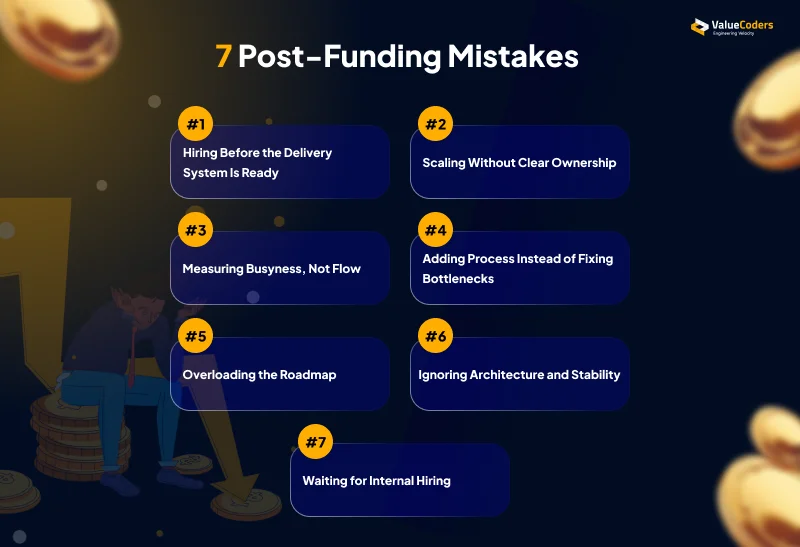
1. Hiring Before the Delivery System Is Ready
One of the biggest post-funding pitfalls is assuming that more engineers automatically mean faster delivery.
Every new hire adds coordination overhead, onboarding time, and context switching, which slows down existing engineers if systems aren’t ready.
Without stable pipelines, clear ownership, and onboarding systems, hiring increases coordination overhead. Senior engineers shift from building to firefighting, and new hires struggle to contribute effectively.
Result:
Headcount increases, but product team velocity drops.
How to fix it:
- Stabilize CI/CD, QA, release workflows, and environments first
- Define clear roles and ownership before adding people
- Create a structured onboarding with documentation and mentors
- Scale hiring only when engineers can plug into a predictable system
If you’ve already over-hired into chaos, pause new hiring, simplify work-in-progress, clarify ownership, and invest a sprint or two in systematizing delivery.
We help you avoid costly post-funding mistakes by diagnosing execution gaps, simplifying delivery flows, and aligning teams around clear ownership.
2. Scaling Engineering Teams Without Clear Ownership
Many startups begin scaling engineering teams without defining who owns what. When everyone can change everything, accountability disappears.
Decision-making slows. Releases require excessive coordination. Engineers spend more time aligning than executing.
Result:
More coordination. Less execution. Teams spend their time in sync meetings, clarifying responsibilities, and debating priorities instead of shipping value.
How to fix it:
- Assign clear ownership by domain, service, or component
- Define decision boundaries explicitly
- Align backlogs and OKRs to ownership areas
- Enable teams to ship independently
If your teams are already stepping on each other’s toes, start by mapping your system, assigning owners, and communicating “who decides what” explicitly.
3. Measuring Busyness Instead of Delivery Flow
After funding, leaders often start tracking activity metrics:
- Tickets closed
- Hours logged
- Sprint utilization
These numbers can look impressive, but often hide real startup engineering challenges like blocked work, rework, unclear requirements, and heavy dependencies between teams.
Result:
Teams look busy, but business progress slows. Work gets started, paused, and reworked; delivery dates slip even though everyone feels overloaded.
How to fix it:
- Measure flow metrics: cycle time, lead time, throughput, WIP
- Track blockers and dependency patterns
- Optimize for value delivered, not hours spent
- Limit parallel work aggressively
If you’re stuck in “everyone is busy, nothing is done,” start by visualizing your workflow (Kanban board) and ruthlessly unblocking and simplifying the flow.
Also Read – Product Engineering KPIs: What to Measure to Ensure Velocity Success
4. Adding Process to Fix Chaos
Another classic post-funding mistake is introducing heavy processes before fixing root problems. Leaders try to fix chaos with process.: More status updates. More documentation.
The process itself isn’t the issue. Adding it before fixing bottlenecks is.
This is one of the most common post-funding pitfalls in SaaS teams.
Result:
Longer cycle times and slower decisions. Engineers spend more time talking about work than doing work. Morale drops as teams feel micromanaged instead of supported.
How to fix it:
- Define ownership at service/module level with clear decision boundaries
- Start with lightweight processes and evolve gradually
- Regularly prune meetings, tools, and approvals
- Involve engineers in process design
This pattern is especially damaging in early-stage startup engineering teams that previously relied on speed and autonomy.
Our dedicated product engineering pods optimize CI/CD and test the product engineering framework.
5. Overloading the Product Roadmap
New capital encourages aggressive planning, new features, refactors, experiments, and integrations, all at once.
This creates the same pattern seen earlier; scaling scope before stabilizing focus.
Result:
More work started. Less work shipped. Deadlines slip, quality drops, and the roadmap becomes a wish list instead of a realistic plan.
How to fix it:
- Ruthlessly prioritize: identify the 1–3 most critical outcomes.
- Limit parallel initiatives at the roadmap level.
- Break big bets into staged milestones.
- Say “not now” to low-impact requests.
If your roadmap already feels bloated, reset: re-evaluate initiatives based on impact, effort, and strategic fit, then cut or defer what doesn’t make the top tier.
Also Read – How Early‑Stage CTOs Can Build High‑Velocity Teams Without the Hiring Bottlenecks
6. Ignoring Architecture and Technical Stability
Early-stage products often move fast by taking shortcuts—quick fixes, brittle integrations, minimal testing. That’s normal in the earliest phase.
After funding, teams delay fixing those foundations to “move faster” and keep shipping features. That debt compounds. Systems become fragile, deployments risky, and debugging painful.
This is a classic early-stage startup engineering issue.
Result:
Every release takes longer than the last. Simple changes trigger regressions. On-call load increases. Engineers become afraid to touch critical areas of the codebase.
How to fix it:
- Allocate 20–30% capacity to tech debt and stability
- Prioritize high-risk systems first
- Invest in testing, observability, and CI/CD
- Use product engineering services when internal bandwidth or expertise is limited
This is one of the most damaging post-funding mistakes affecting long-term velocity.
Also Read: How SaaS Companies Scale Engineering Without Expanding Headcount?
7. Waiting for Internal Hiring to Catch Up
Hiring takes months. Delivery pressure is immediate.
Many teams wait for internal hiring to close the gap, while deadlines, customer expectations, and investor pressure keep rising. In the meantime, the existing team burns out trying to cover everything.
Result:
Roadmaps slip, quality declines, and your core team gets exhausted. By the time new hires arrive, momentum and morale are already damaged.
How to fix it:
- Accept that internal hiring timelines are unpredictable
- Use dedicated development teams for immediate capacity
- Keep core ownership in-house while outsourcing execution-heavy streams
- Integrate external teams into your workflows and culture
If you’re already behind and still waiting on hires, consider bringing in experienced external partners now to protect delivery while your internal team scales.
Scale your business with execution-ready engineers, stabilizing your architecture and unblocking delivery without overloading your core team.
How to Protect Product Team Velocity
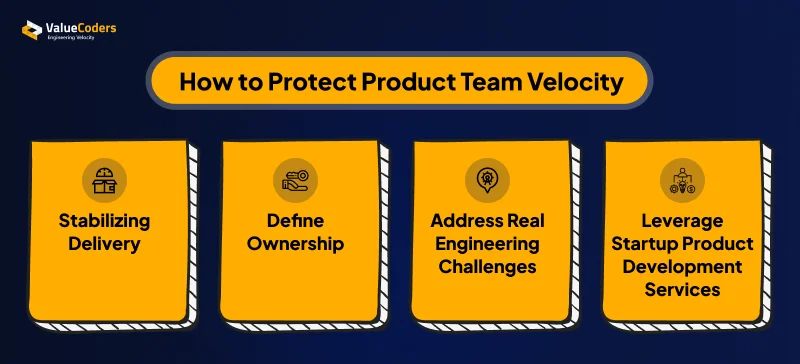
High-performing SaaS teams protect their product velocity early, especially after a new funding round. Instead of only hiring more full‑time engineers, they design a delivery model that can scale without burning out the core team.
Instead of repeating common post-funding mistakes, they:
- Stabilize delivery flow before scaling headcount
- Define ownership before expanding teams
- Address real startup engineering challenges early
- Leverage startup product development services to move fast without overloading the core team
By combining a strong internal team with the right product engineering services partner, startups can scale responsibly. They meet post-funding expectations without sacrificing quality or control.
Get senior engineers who integrate into your stack, workflows, and delivery process within days.
How ValueCoders Helps Improve Your Business Velocity
Post-funding success isn’t about hiring faster; it’s about scaling delivery without losing control.
ValueCoders helps you do exactly that. As a trusted IT staff augmentation services partner, we add the right engineering capacity without adding chaos. Our experienced remote developers plug into your product teams, processes, and tech stack so you can:
- Scale product delivery without overloading your core team
- Close skill and capacity gaps quickly—without waiting months for internal hires
- Protect product team velocity during high-pressure growth phases
- Avoid common post-funding engineering mistakes that slow product velocity
If your product delivery is slowing down after funding, connect with our team to identify bottlenecks and get your execution back on track.
FAQs
Ques. How does investor pressure influence engineering and delivery outcomes?
Ans. Investor expectations often push engineering teams to accelerate delivery without stabilizing systems. This leads to rushed decisions, overloaded roadmaps, and increasing technical and operational risk.
Ques. Why do funded startups struggle with cross-team communication gaps?
Ans. As teams scale quickly, ownership becomes unclear and dependencies increase. Without pre defined boundaries, teams spend more time aligning than executing and that slows down delivery.
Ques. What are the hidden costs of scaling engineering teams too quickly?
Ans. Rapid hiring adds coordination overhead, onboarding delays, and context switching. Instead of increasing output, it often slows existing teams and reduces overall delivery efficiency.
Ques. How can startups align product strategy with engineering execution?
Ans. Focus on high-impact priorities, align ownership with those, and limit parallel work. Clear goals and structured delivery flow ensure strategy translates into consistent execution.
Ques. What early warning signs indicate declining product team velocity?
Ans. Work keeps increasing, but releases slow down, cycle times grow, and dependencies block progress. Teams feel busy, but outcomes don’t improve, signaling delivery flow breakdowns.