


Most startup founders think the hardest part is finding someone to build the product.
It’s not.
In reality, the bigger challenge is getting from idea to market before time, budget, or execution problems slow the business down.
This is where many founders face an important decision:
Should you bring in a technical co-founder?
Or work with a startup product development partner?
The Technical Co-Founder vs. Product Partner decision is one of the most important execution choices early-stage businesses make.
The answer depends less on technology and more on what your business needs the most.
In this guide, we’ll break down both models in practical business terms and help you determine the fastest, lowest-risk path to a scalable product.
Why This Decision Matters
The wrong choice can delay product launches, increase hiring costs, and slow customer validation.
For most founders, the challenge is not finding developers.
The challenge is balancing:
- Speed to market
- Product quality
- Hiring risk
- Technical ownership
- Cost of execution
A technical co-founder and a product development partner solve these problems differently.
Choosing the right model is often a critical part of a company’s broader product development strategy, especially when delivery timelines are tied to funding, market validation, or growth objectives.
Understanding the trade-offs early can prevent months of delay and expensive course corrections later.
Build and launch faster with dedicated engineering teams aligned to your roadmap and delivery goals.
Understanding the Two Models
Before comparing the two, technical co-founder and product development partner, it’s important to understand the role each one plays inside a growing company.
Technical Co-Founder
A technical co-founder is an equity partner who helps shape the company’s long-term technical direction.
A technical co-founder typically:
- Leads technical decision-making
- Defines product architecture
- Protects technical IP
- Builds engineering culture
- Drives long-term innovation
- Takes ownership of technology strategy
A technical co-founder becomes part of the company itself and shares responsibility for its long-term success.
Product Development Partner
A product development partner is an external team that helps businesses design, build, launch, and scale products through structured execution.
A product development partner typically:
- Launches products faster
- Reduces hiring delays
- Provides immediate engineering capacity
- Offers flexible team scaling
- Introduces delivery governance
- Deploys cross-functional engineering teams
- Creates visibility across planning, development, testing, and release cycles
Instead of hiring individual specialists, businesses gain access to an entire delivery system.
An experienced outsourced development partner also functions as a startup product consulting services provider and can help you with delivery processes, governance frameworks, and specialised expertise that would otherwise take months to build internally
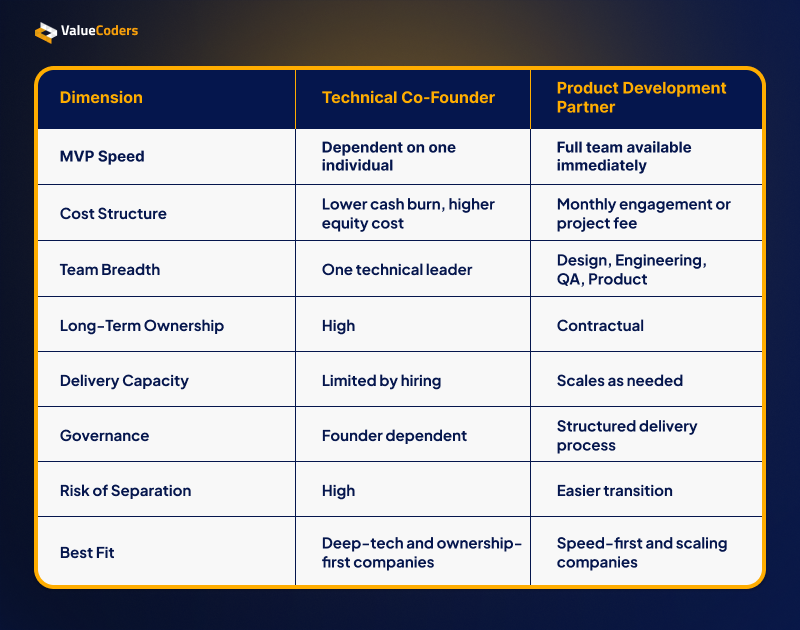
Technical Co-Founder vs Product Partner: Side-by-Side Comparison
Also Read: Post-Funding Mistakes That Quietly Kill Product Team Velocity
When Is a Technical Co-Founder the Better Fit?
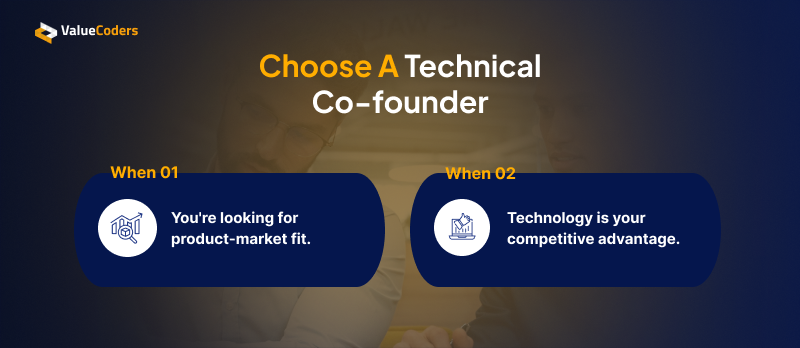
A technical co-founder makes the most sense when technology itself is the business.
Examples include:
- AI infrastructure companies
- Deep-tech startups
- Hardware businesses
- Blockchain protocols
- Proprietary technology platforms
A technical co-founder may be the right choice if:
You’re Still Searching for Product-Market Fit
You need a long-term partner who can iterate continuously as the business evolves.
Your Technology Is the Competitive Advantage
If the company’s value depends on proprietary technology, deep technical ownership becomes critical.
Also Read: How to Build a Dedicated Development Team in 4 Weeks
When Does a Product Development Partner Make Sense?
A product development partner becomes valuable when execution speed matters more than ownership structure.
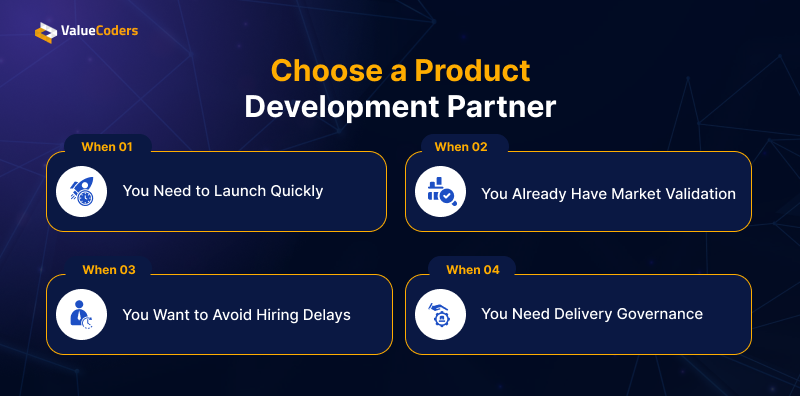
You Need to Launch Quickly
A development partner can deploy a cross-functional team immediately rather than waiting months to recruit internally.
For many startups, an outsourced development team provides the fastest path from roadmap to release.
You Already Have Market Validation
At this stage, most startups are no longer solving a technology problem. They’re solving a delivery problem. The challenge shifts from deciding what to build to consistently shipping what has already been validated.
Once demand is validated, the challenge shifts from ideas to execution.
You Want to Avoid Hiring Delays
Building a team takes time.
A development partner provides immediate access to dedicated development teams, including:
- Engineers
- Designers
- QA specialists
- Product experts
without lengthy recruitment cycles.
You Need Delivery Governance
Many startups don’t fail because they lack engineers.
They fail because they lack:
- Engineering systems
- Release discipline
- Sprint visibility
- Technical accountability
An experienced product development partner introduces:
- Delivery cadence
- Engineering governance
- Progress visibility
- Structured execution
This often becomes the difference between building software and consistently shipping software.
Expand engineering capacity while maintaining delivery quality, visibility, and accountability.
The Cost of Waiting
One factor founders often underestimate is time.
Finding the right technical co-founder can take months.
During that time:
- Product development slows
- Customer feedback is delayed
- Market opportunities disappear
- Competitors continue moving
In many cases, the biggest risk is not choosing the wrong path. It’s waiting too long to start.
For startups under delivery pressure, execution speed often creates more value than waiting for the ideal team structure.
Where Both Models Fail
Neither model is risk-free.
The key is understanding which risks your company is better equipped to manage.
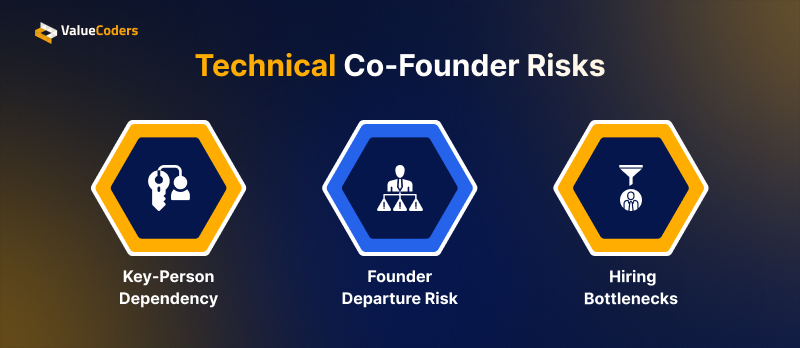
Risks of a Technical Co-Founder
Equity Dilution
A long-term partner typically requires meaningful ownership.
Key-Person Dependency
Technical knowledge can become concentrated in one individual.
Founder Departure Risk
Leadership changes can create:
- Knowledge gaps
- Hiring disruption
- Product delays
Hiring Bottlenecks
A strong technical leader still needs time to recruit and build a team.
Risk of a Product Development Partner
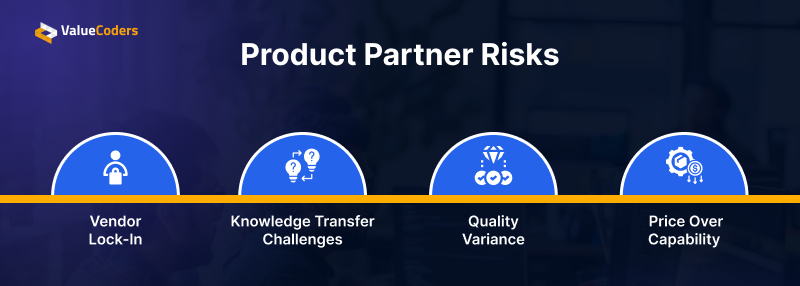
Vendor Lock-In
Ownership and transition terms must be clearly defined.
Knowledge Transfer Challenges
Documentation and handover processes should be established early.
Quality Variance
Not all development firms operate with the same delivery maturity.
Choosing Price Over Capability
The cheapest option often becomes the most expensive once rework and delays appear.
Also Read: Product Engineering KPIs: What to Measure to Ensure Velocity Success
What Are You Actually Optimizing For?
Many founders frame this decision incorrectly.
The real question isn’t:
Which model is better?
The real question is:
What constraint is slowing my business today?
The most effective product development strategy aligns execution capacity, ownership requirements, and business priorities with the company’s current stage of growth.
| If You Need | Optimize For |
| Product validation | Speed |
| MVP launch | Execution |
| Technical leadership | Ownership |
| Faster roadmap delivery | Engineering capacity |
| Scalable product execution | Delivery governance |
Once you identify the constraint, the decision becomes much clearer.
Also Read: Top MVP Development Companies: A Comparison of Services, Costs, and Expertise
The Smartest Startups Often Use Both Models
Many startups do not choose between ownership and execution.
They separate them.
Internal technical leadership owns architecture and product direction.
External delivery teams accelerate execution.
Many businesses:
- Launch with a product development partner
- Validate the product
- Build traction
- Add internal technical leadership later
Others combine both approaches:
- A technical co-founder owns long-term architecture
- A dedicated development team accelerates execution
In many cases, an outsourced development team handles delivery while internal leadership focuses on product direction and business growth.
This hybrid approach often works well for:
- SaaS companies
- Scaling startups
- Venture-backed businesses
- Teams under aggressive roadmap pressure
Also Read: Top 11 Software Product Development Companies in 2026
Decision Framework for CEOs and Founders
Use this framework to determine which model fits your current stage.
| Dimension | Technical Co-Founder Fits | Product Development Partner Fits |
| Stage | Idea or pre-seed | Validated and scaling |
| Budget | Equity-driven | Cash-funded |
| Timeline | Flexible | Urgent |
| Core Need | Ownership | Delivery |
| Team Gap | Strategic technical leadership | Immediate engineering capacity |
Interpretation
Mostly left column → Technical Co-Founder
Mostly right column → Product Development Partner
Mixed answers → Hybrid model
Access experienced product teams that help you ship, iterate, and scale efficiently.
Final Thoughts
If your challenge is execution speed, engineering capacity, and delivery governance, a product development partner may help you move faster with less operational risk.
At ValueCoders, we help software-led businesses accelerate product delivery through our software product development services, dedicated engineering teams, and structured execution.
Ultimately, the technical co-founder vs. product partner debate comes down to identifying the constraint that is slowing growth and selecting the model best suited to remove it.
The goal is not choosing the perfect model. The goal is removing the constraint that is slowing product delivery today.
Contact us to discuss your product requirements.
FAQ’s
When should I hire a product development partner instead of searching for a co-founder?
Ans. If you already have market validation and need to launch quickly, a product development partner can help you accelerate product delivery without long hiring delays.
Is a technical co-founder necessary for raising investor funding?
Ans. In many early-stage startups, investors prefer seeing strong technical leadership within the founding team, especially for tech-heavy products.
Can outsourced teams build scalable SaaS products?
Ans. Absolutely. Many startups first work with a development partner to validate the product and later build an in-house team as they scale.
What happens if a technical co-founder leaves?
Ans. Founder exits can create:
- equity disputes,
- engineering ownership gaps,
- hiring disruption,
- and fundraising challenges.
This is why vesting agreements, governance structures, and clear technical ownership matter early in the company lifecycle.
Can a startup succeed without a technical co-founder?
Ans. Yes. Many funded startups successfully launch and scale products using experienced product development partners, especially when speed, structured execution, and engineering scalability matter more than long-term founder-led technical ownership