


Cloud migration mistakes directly lead to transaction issues, compliance risks, and downtime.
You must be wondering that “cloud migration promises agility, cost savings, and scalability.” So how can it lead to challenges that threaten the company’s growth?
For FinTech businesses, mistakes in cloud migration can affect more than just operations. Ultimately, they compromise customer experience, threatening your reputation as a reliable platform.
How should we handle this issue? You can’t avoid cloud migration. Can you?
For the answer, let’s explore cloud migration mistakes Fintech companies must watch out for and how to prevent any mishap due to them.
Why Is FinTech Cloud Migration Complex?
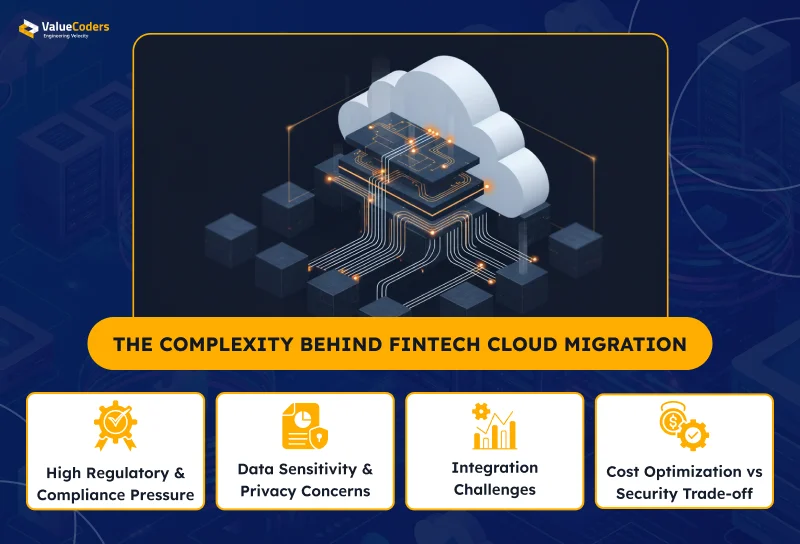
Cloud migration is much more than modernization. Particularly in Fintech, where every byte of data, every API call, and every access point is critical for a company’s existence.
The slightest of errors can trigger failed payments, reconciliation mismatches, or compliance alerts. Hence, there is no slightest latitude even for an iota of error.
Here are the aspects that contribute to major cloud migration challenges:
1. High Rеgulatory & Compliancе Prеssurе
- Compliance with a strict framework, such as PCI-DSS, GDPR, and local data protection law, is a mandate.
- Cloud misconfigurations can violate regulations for footprint, data storage, access, and encryption, leading to financial and reputational damages.
- A dedicated front, including the domain expertise and continuous monitoring, is needed to ensure compliance across multi-cloud or hybrid environments.
2. Data Sеnsitivity & Privacy Concеrns
- Any lag in real-time verification compromises valuable data, such as:
- Cardholder data
- Banking credentials
- Identity documents
- Risk and fraud scores
- Any lapse leads to massive monetary loss and regulatory backlash.
- Mismanaging encryption keys or using unreliable APIs makes you susceptible to fraud.
- Safeguarding the data and its storage is a legal obligation.
3. Intеgration Challеngеs
- The Fintech ecosystem usually includes:
- Core banking systems
- AML/KYC workflows
- Payment gateways
- Fraud engines
- Third-party APIs
- Fintech systems are deeply intertwined and require very precise execution, domain knowledge, and deep architectural planning.
- Some of the most used legacy systems in Fintech are not cloud native, necessitating re-engineering.
- Either of them, such as legacy banking systems, payment gateways, third-party APIs, or compliance tools, etc., has mismatched configurations, and migration becomes challenging.
Benefit from frameworks that strengthen uptime, enhance compliance, and scale financial operations securely.
4. Cost Optimization vs Sеcurity Tradе-off
Managing cost with top-notch security is one of the pressing challenges Fintech faces when switching to the cloud.
Overemphasis on cost-cutting or over-engineering polarises towards one and compromises the underlying objective of attaining a high-performing yet financially sustainable cloud framework.
Mitigating these risks requires a robust cloud migration strategies. Moreover, you must refrain from general errors highlighted by top cloud developers.
Top Cloud Migration Mistakes FinTechs Keep Making (and How to Avoid Them)
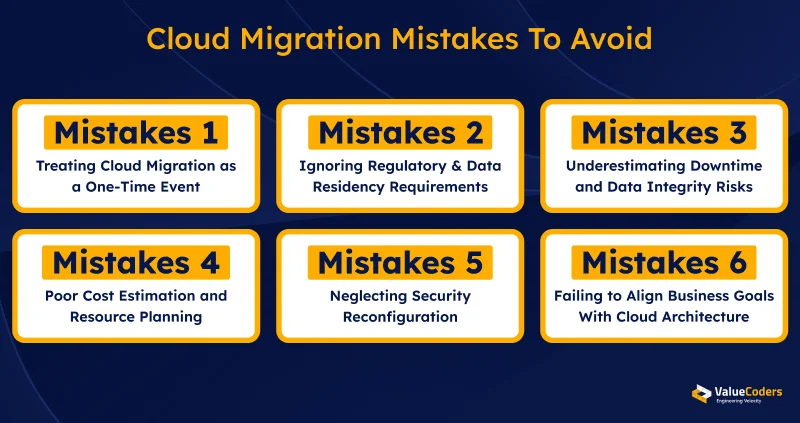
The lack of a cloud migration roadmap leads to mistakes that have residual impacts. Some of the most frequent mistakes are:
Mistake 1: Treating Cloud Migration as a One-Time Event
What Happens:
- Under the pretense, companies move legacy apps “as-is”, assuming it will save time.
- With the same on-premise inefficiencies, the shift to the cloud, and create performance issues, inflates costs, and leads to underutilized cloud services.
Why It’s a Mistake:
- Legacy workloads are not engineered to accommodate cloud-scale growth.
- Lags in architecture put a constraint on agility and increase the overall operational costs.
How to Avoid It:
- Reimagine and redesign workloads to embody cloud-native architecture.
- Get a rational assessment from cloud migration services to determine the scopes before migration.
Mistake 2: Ignoring Regulatory & Data Residency Requirements
What Happens:
- Companies maintain the same data storage system across regions, creating regulatory conflicts (GDPR, PCI DSS, RBI, SOC 2).
Why It’s a Mistake:
- Due to any non-compliance, financial and reputational losses are overwhelming.
How to Avoid It:
- The cloud strategy must be compliance-centric.
- Outsource an experienced cloud strategy and consulting service well-versed in norms of Fintech security frameworks and regional data residency laws.
Also Read: Cloud Migration: Benefits, Process, Types & Challenges
Mistake 3: Underestimating Downtime and Data Integrity Risks
What Happens:
- Teams make the mistake of undervaluing the significance of data mapping, transfer speeds, or downtime.
- Results in inconsistencies in databases and data loss.
Why It’s a Mistake:
- Real-time transactions occur at very high throughput levels.
How to Avoid It:
- Before migrating to a cloud infrastructure, a data audit is a must.
- Employ ETL pipelines and real-time validation frameworks.
- Hire cloud migration services with expertise in handling platforms such as AWS, Azure, and more.
Balance cost and performance with transparent, monitored resource allocation across all environments.
Mistake 4: Poor Cost Estimation and Resource Planning
What Happens:
- Fintech companies migrate their teams to cloud native without analysing the cost and scope for implementation.
- Unplanned provisioning of cloud resources without accounting for standard FinOps practices.
Why It’s a Mistake:
- Overspending compromises the sustainability of an operational endeavour.
- Misaligned cloud resources lead to operational inefficiencies that may slow down real-time transaction processing.
How to Avoid It:
- Encourage the adoption of standard FinOps practices to ensure consistent visibility and accountability.
- Partner with a cloud strategy & consulting service well-versed in implementing cloud-native tools such as AWS Cost Explorer, Azure Cost Management, or Google Cloud.
- Roll out usage-based scaling policies to ensure adequate provisioning.
Also Read: Top 5 Cloud Financial Management Companies You Should Know
Mistake 5: Neglecting Security Reconfiguration
What Happens:
- Even after migration to cloud-native systems, Fintech teams continue with legacy security configurations.
- Identity and Access Management (IAM), encryption policies, and API permissions remain outdated.
- Cloud-native vulnerabilities arise due to unpatched access controls and open endpoints.
Why It’s a Mistake:
- Financial applications handle sensitive data with outdated configurations, exposing them to cyber risks and compliance violations.
- A single misconfigured S3 bucket or public API can lead to breaches and regulatory penalties.
How to Avoid It:
- Adopt a zero-trust architecture with continuous access validation.
- Reassess and update IAM, encryption, and API policies for every migration phase.
- Automate vulnerability scanning using tools like AWS Security Hub or Azure Defender.
Also Read: How to Evaluate a Strategic Fintech Outsourcing Partner
Mistake 6: Failing to Align Business Goals With Cloud Architecture
What Happens:
- Migration focuses only on infrastructure lift-and-shift, not on strategic business outcomes.
- Teams deploy workloads without mapping them to revenue, customer experience, or scalability goals.
- Cloud resources are optimized for technical convenience, not business growth.
Why It’s a Mistake:
- Misaligned architectures lead to underutilized systems, higher costs, and missed KPIs.
- Cloud adoption becomes a cost center instead of a performance and innovation enabler.
How to Avoid It:
- Define clear business KPIs (e.g., faster transactions, improved uptime, reduced customer churn) before migration.
- Build a migration roadmap that connects technical architecture with measurable business outcomes.
- Involve cross-functional stakeholders, IT, compliance, and product teams in architecture planning.
Balance cost and performance with transparent, monitored resource allocation across all environments.
Final Thoughts
Fintech companies can unlock significant agility, security, and improved performance with cloud migration. However, a flawless cloud migration requires precision, planning, and expertise.
Avoiding the common mistakes helps you create a concrete foundation that supports sustainable and long-term growth.
Overwhelmed by the whole process?
Partner with ValueCoders, a recognized company for cloud application development services.
ValueCoders is trusted by the Fintech companies for its experience and expertise, and offers a cloud migration that leaves minimal disruptions to ongoing operations.