


The offshore development landscape is entering a pivotal phase. According to industry forecasts, the global offshore software development market is expected to grow at a 6.51% CAGR and attain a market volume of US$806.55 billion by 2030.
This upsurge suggests how global businesses of different sizes are reimagining the way they operate.
Amidst the hustle of new technological adoption to meet changing digital expectations, offshore software development has emerged as a reliable approach for scale-ups.
Today, CTOs across the globe are turning to offshore partnerships to:
- Access specialized talent pools.
- Reduce internal costs.
- Accelerate digital product launches.
- Ensure continuous delivery.
- Strengthen data protection.
Let’s explore the top offshore software development trends and visualize their benefits from a transformative standpoint.
Offshore Software Development Trends Likely to Emerge in 2026
Scaleups across the globe are working with top offshore developers to stay abreast of changing tech trends. Earlier, most mid-sized firms refrained due to security and reliability concerns.
But with this widespread adoption and improved delivery models, such concerns are a tale of the past.
Nevertheless, software outsourcing trends are always in a state of perpetual transformation due to consistent innovations and changing market dynamics. Some of the trends most likely to emerge in 2026 include, but are not limited to:
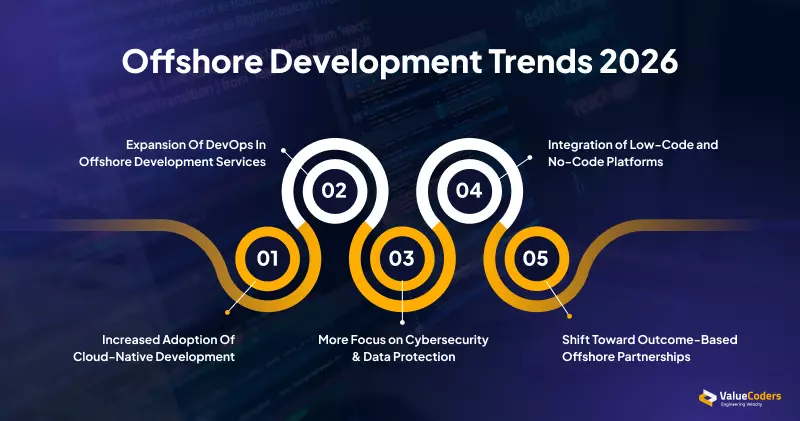
1. Increased Adoption Of Cloud-Native Development
Being a cloud native is just a prerequisite for scaleups willing to comply with the market norms.
What Drives This Change?
- More frequent application of AI, Machine Learning, and RPA.
- A shift from large applications to microservices and smaller independent components functioning together.
- Containers have gained widespread adoption among developers to package applications and dependencies into one portable unit. Kubernetes helps manage and scale those containers.
- With CI/CD pipelines in place, CTOs are expected to deliver and deploy faster and with high quality.
- Shift towards systems that can recover quickly and adjust automatically to workload changes.
What This Means for CTOs
- More companies will want offshore teams that understand tools like Kubernetes and Istio.
- Tech skills for handling many small services working together will be in higher demand.
- Older “monolith” systems will be rebuilt into modern ones.
- This will happen faster in FinTech, HealthTech, and SaaS companies.
Why does It Matter?
It offers a top-notch architecture that offers automation, smart scaling, and faster deployment by 30-50%.
Work with offshore experts already trained in 2026-ready cloud, DevOps, and automation practices.
2. Expansion Of DevOps In Offshore Development Services
Engineering teams rely on processes that are automated, integrated, and continuously optimized.
Key Shifts:
- Adoption of DevOps will speed up the delivery cycles and expand its constraints across testing, integration, and deployment.
- The trend of developing and managing simultaneously offers enhanced operational capacity that will reshape the market expectations.
- Offshore software development services will more frequently employ automation tools, making the workflows streamlined and deployment faster.
What Does it Mean for CTOs?
CTOs will determine the viability of offshore partners based on:
- Delivery velocity.
- Reliability of the automation.
- How well the introduced automation integrates with the existing workflows.
- Sprint discipline and ability of the partner to offer defined tasks in a predetermined time slot.
Why does it Matter?
Teams well-versed in the norms of DevOps deliver code 46x faster and offer end-to-end solutions.
3. More Focus on Cybersecurity & Data Protection
CTOs can no longer afford to have teams that consider cybersecurity measures and data safety protocols a peripheral element.
Key Shifts:
- Cyberthreats have evolved over time. Hence, data security tasks will notice an exponential increase in 2026.
- With emphasis on data protection, expectations will shift towards cyber audits and firewall monitoring.
- Hence, SOC 2 / ISO 27001 delivery practice is likely to become the norm.
What It Means for CTOs?
- CTOs will prioritize partners with proven compliance, encryption, and data protection practices over low-cost providers.
- Cyber resilience will become a board-level KPI, with CTOs reporting how well their offshore network prevents, detects, and responds to threats.
Also Read – Software Development Cost For Startups, Scaleups & Enterprises
4. Integration of Low-Code and No-Code Platforms
CTOs will turn to options that can reduce the turnaround time involved in screating the digital fronts from scratch.
Key Shifts:
- Software and app development will be more frequent through open-source frameworks.
- The demand for reduced coding efforts and advanced customization will ensure innovations and advancements across open sources.
5. Shift Toward Outcome-Based Offshore Partnerships
CTOs will prefer a partner that delivers measurable outcomes rather than hours that mean nothing.
Key Shifts:
- Tracks measurable business outcomes instead of tracking hours.
- Creates a mutually beneficial system by sharing accountability between the client and offshore teams.
- Offers a fully transparent system.
Why Does it Matter?
This SLA driven, and result-centered approach will provide results that make real business impact.
Businesses must follow the offshore software development trends to remain relevant.
Deploy offshore pods that accelerate delivery, strengthen security, and improve engineering ROI.
Why CTOs Must Stay Updated With These Latest Offshore Development Trends
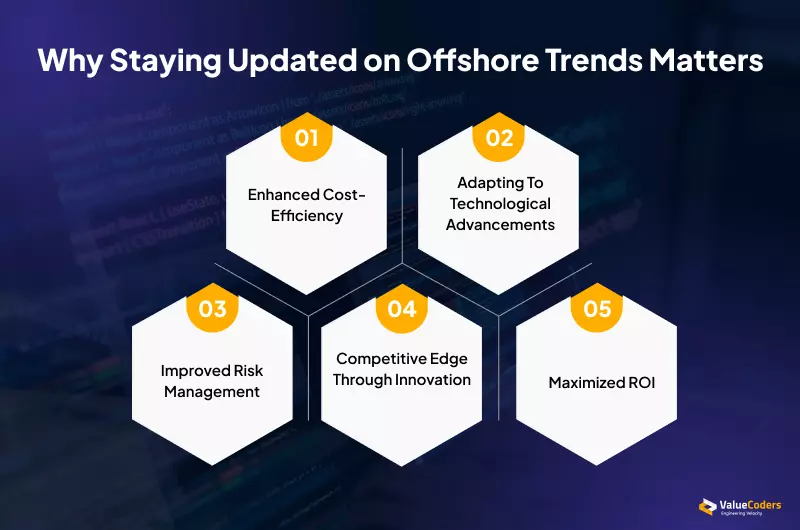
Offshore software development models supersede the other outsourcing models for their efficacy and fresh perspective. The following are the benefits of following the scale-up and startup software outsourcing trends:
1. Enhanced Cost-Efficiency:
- Aligning the efforts with offshore development trends helps you reduce the monetary burden on multiple fronts, such as low initial costs, reduced operational costs, tax benefits, etc.
- Reduces the engineering cost by 40-60%.
- You receive quality work from top offshore developers at an optimum price.
2. Adapting To Technological Advancements:
- Businesses tracking software outsourcing trends can access teams skilled in emerging technologies such as AI, blockchain, and IoT, ensuring they stay competitive and disruption-free.
- Offshore developers collaborate closely with in-house teams, enhancing coordination, agility, and overall operational efficiency.
3. Improved Risk Management:
- Geopolitical stability of the offshore region, economic progress, the availability of skilled developers, and advanced technologies affect the operations on several fronts, such as:
- Diversify engineering risks.
- Ensure uninterrupted delivery.
- Maintain regulatory compliance across industries.
- Tracking such external factors keeps your operational efficiency intact.
Also Read – Top 10 Offshore Software Development Companies
4. Competitive Edge Through Innovation:
- Follow the latest innovative models, such as cloud integration and hybrid outsourcing, to handle the offshore teams more efficiently.
- Additionally, it offers a competitive edge through 3 times faster development and deployment.
5. Maximized ROI:
- Enables companies to have customized solutions for their customers with a minimal cost incentive.
- Streamline operations, maximize resource use, and have an inflated ROI.
Partnering with a reliable service provider enables scaleups to access the benefits of dedicated development teams. The same lays a concrete base that makes the way to fulfilling the underlying agenda.
Add experts in automation, resilience, and secure distributed architectures.
Why Should CTOs Consider Offshore Software Developers?
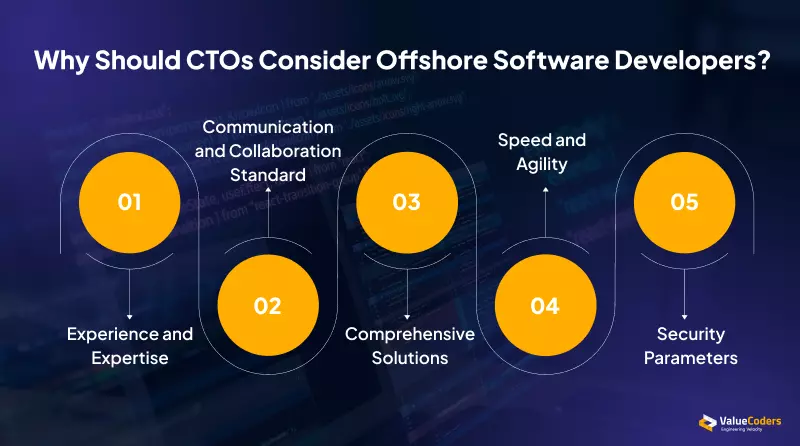
Here are some of the factors CTOs need to consider when partnering with offshore software development services providers:
1. Experience and Expertise
Relevant experience and expertise offer you solutions with minimal aftereffects at best. Hence, CTOs should prioritize partners with:
- 10+ years of delivery experience
- Domain specialists (FinTech, HealthTech, SaaS, eCommerce)
- Proven portfolio in cloud-native, DevOps, and distributed architectures
2. Communication and Collaboration Standards
Software development for scaleups is only possible when departments connect and collaborate. Such a culture is the prerequisite for a dedicated front. This includes:
- Overlapping work hours.
- Clear documentation processes.
- Engineering governance frameworks.
- Seamless tools integration (Jira, GitHub, Slack, Azure DevOps).
Also Read – Why Leading Enterprises Trust Offshore Engineering Teams To Scale Fast
3. Comprehensive Solutions
Partner with services that offer end-to-end solutions, safeguarding your interests on multiple fronts. Prefer teams that can handle:
- Architecture + development
- QA + SecOps
- CloudOps + support
- Product modernization
- Data engineering
4. Speed and Agility:
Recognized software development services hold a track record of delivering products without additional delays. Choose partners that demonstrate:
- Stable sprint velocity.
- Automated CI/CD pipelines.
- Daily progress visibility.
- Mature Agile or Pod-based execution.
5 .Security Parameters:
Other attributes are insignificant if the service provider compromises with data security and safety protocols. It keeps you protected from cyber attacks and vulnerabilities. A reliable partner must follow:
- SOC 2 / ISO 27001 practices
- Secure coding guidelines
- Regular vulnerability testing
- Strict access control policies
Leverage dedicated teams built for speed, security, and next-generation delivery models.
Final Thoughts
In 2026, offshore software development trends are likely to make the market more accessible for scaleups. Businesses must remain updated on such trends, offering them the best experience. DevOps automation, and outcome-based delivery models. CTOs who understand and adapt to these shifts will be better positioned to scale engineering, accelerate innovation, and maintain competitive advantage.
Partnering with top-notch software development services, like ValueCoders, safeguards your interests. You will benefit from:
- More than 20 years of industry experience.
- Cloud-native, DevOps-first teams with modern architecture expertise.
- Enterprise-grade security aligned with SOC 2 / ISO 27001.
Call us to upscale your business potential with our offshore IT services.