

The debate around AI Integration vs AI Development often pushes companies to focus on building better models. But a model is useful only when it works well with your systems and data. Many teams begin building without thinking about how it will be used.
These AI integration issues are not random. They happen when teams plan integration too late. A good AI implementation and deployment strategy starts with checking your systems, data, and workflows first. Teams need to know how everything connects before choosing a model.
In this blog, we’ll discuss why most AI projects fail at the integration layer and what it takes to make AI work in real environments with the right AI Development Services.
Understanding AI Development and Integration
Before we talk about failures, we should be clear about these two terms. They are often mixed up, but they are very different in cost, time, ownership, and outcome.
AI Development is building a custom AI system from scratch using your own data.
It involves creating, training, and refining models over time. This approach takes longer and needs skilled teams and strong data support. It is used when AI is a core part of the product and needs full control.
- You own the model
- You control how it improves over time
- It can become a long-term competitive advantage
AI Integration is connecting a pre-built AI tool into your existing systems and workflows.
Instead of building a model, teams connect ready-to-use tools with their systems and workflows. The focus is on solving real tasks quickly, without long setup or heavy development. It helps teams see results early and improve step by step.
- No need to build a new model
- Works within your existing systems
- You get faster results and quicker ROI
Businesses also work with an Artificial Intelligence services company to decide whether to build or integrate based on their product needs and existing systems.
Whether you are developing a model or integrating one, success depends on how well it fits your systems, data, and workflows from the start.
AI Integration vs AI Development: A Quick Comparison
For most businesses, integration solves the problem faster. Development is still important, but not always the first step.
When this is not clear, projects can move in the wrong direction. Here is a simple comparison to make this clear.
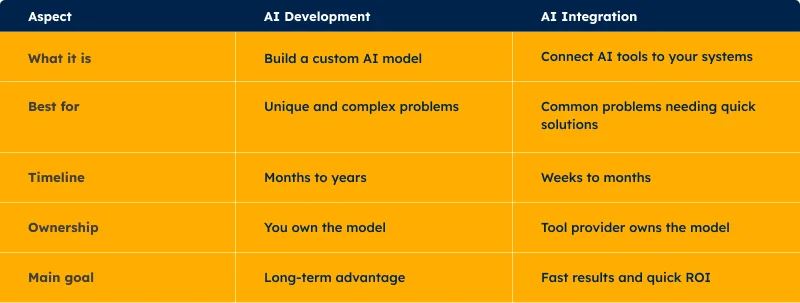
For most business use cases, AI integration provides faster time-to-value, while development is better suited for long-term, differentiated capabilities.
AI Integration vs AI Development Cost Comparison
Cost comparison between AI integration and AI development are not just about budget. They are about how quickly you spend, where you spend, and when you start seeing value.
Here is a focused comparison:
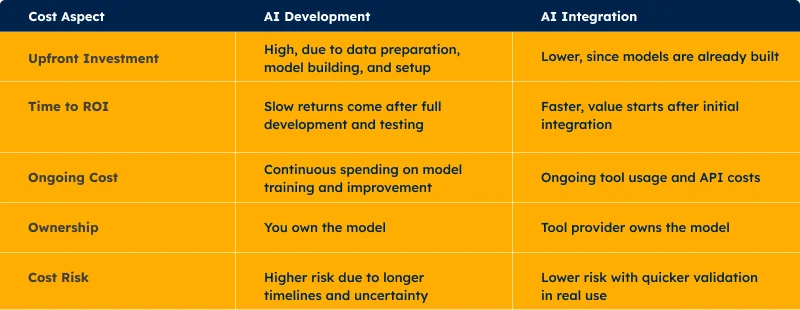
The right choice depends on how critical AI is to your product. If AI is core, development justifies the cost over time. If the goal is to solve a business problem quickly, integration keeps costs and risk under control.
Why Most AI Projects Fail at the Integration Layer
Most teams believe their AI project failed because the model was not good enough. In reality, that is rarely the case.
According to McKinsey & Company, only 39% of organizations report significant financial impact from AI, highlighting the gap between experimentation and real world deployment.
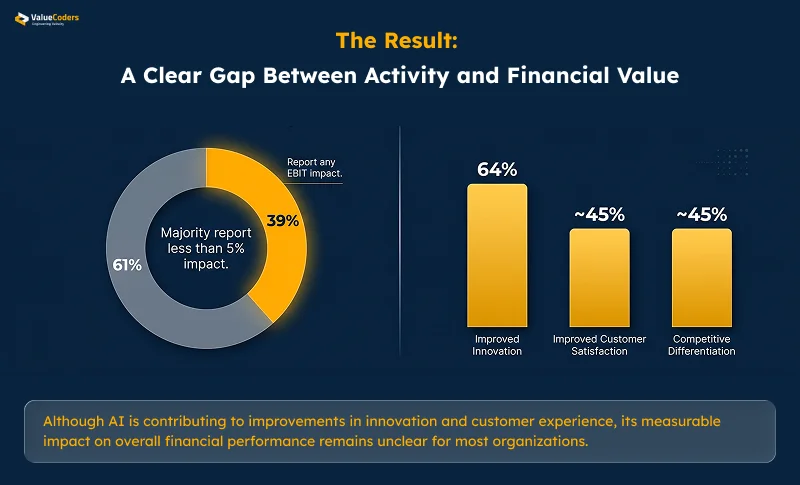
Issues begin when data is not ready, systems do not connect, and ownership is unclear. Security and compliance are often omitted early, which causes delays later.
These are not failures of development. They are failures of integration, and this is where most AI projects begin to break down.
Also Read: LLMOps Is the New DevOps – How AI Products Will Be Built & Run in 2026
AI Integration Challenges That Break Real Products
Most AI projects do not break during development. They break during integration.
The model may pass every test, and the demo may look fine. But when you connect that AI to real systems, data, and existing workflows, a different set of problems starts to appear. These problems are often not part of the initial plan.
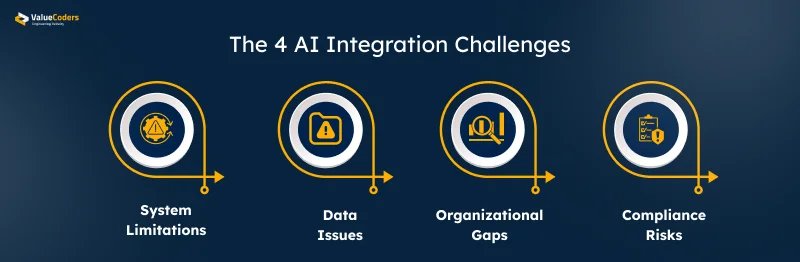
Here is where things usually go wrong:
1. System Limitations
Legacy systems are not designed to handle real-time AI workloads.
2. Data Issues
Data pipelines often break when moving from testing to production environments.
3. Organizational Gaps
Ownership across engineering, product, and data teams is unclear.
4. Compliance Risks
Security and compliance requirements are often addressed too late.
None of these comes from the model. They come from gaps in how AI is integrated into real environments.
The AI Implementation Strategy Most Teams Skip
Modern AI systems often rely on architectures like Generative AI combined with retrieval systems, making integration planning even more critical. And most teams do not struggle due to technology for AI integration. They do not have a technology problem; they lack the right approach.
Many teams select a model before they understand the integration surface, and development begins before there is clarity on real production data. This creates gaps that show up later in the project. Even with access to Top AI Engineers, projects struggle when integration planning is not clear from the start.
Strong AI integration strategies focus on getting the sequence right from the start.
- Start with a discovery phase before any code is written
- Map integration touchpoints before choosing a model
- Build for observability from day one to track how AI behaves in production
- Prove integration in one workflow first, then scale gradually
Teams do not succeed because of bigger budgets. They succeed because they treat integration planning with the same importance as development, which helps them avoid delays and problems later.
From discovery to deployment, we help you plan integration the right way so your AI works with real systems from day one.
Step-by-Step AI Implementation Roadmap
Most AI initiatives fail not because the technology is wrong but because there was no clear roadmap before the work began.
Here is a four-phase approach that keeps integration at the center of every decision.
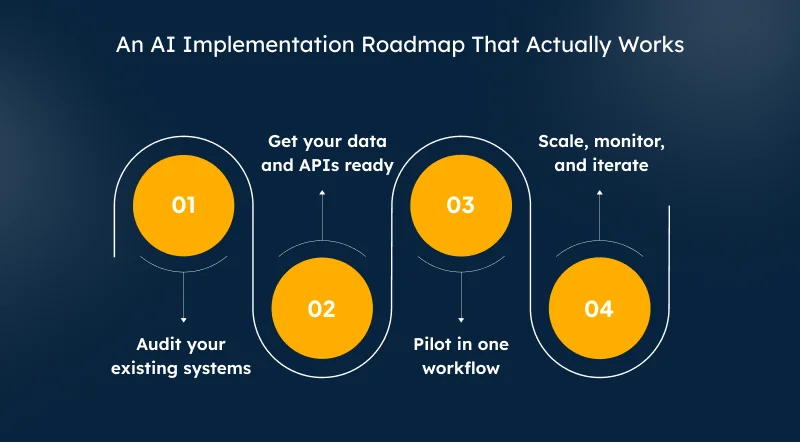
Phase 1: Audit your existing systems
Start by understanding what you already have. Review your systems, data sources, and workflows. Identify where AI needs to connect and where common mistakes are likely to occur.
AI will not work well in production if the data is inconsistent or hard to access. Clean and organize your data before development begins. Also, make sure your APIs can handle the required load and support smooth communication.
Phase 2: Get your data and APIs ready
AI will not work well in production if the data is inconsistent or hard to access. Clean and organize your data before development begins. Also, make sure your APIs can handle the required load and support smooth communication.
Phase 3: Pilot in one workflow
Choose one workflow that is clear and low risk, and test the integration there first. Focus on making it work end-to-end in a real environment. This gives your team a clear reference before moving forward.
Also Read: N8n vs Make vs Zapier vs Agentforce – Which AI Automation Platform Fits Your Business Best?
Phase 4: Scale, monitor, and iterate
Once the pilot is stable, expand step by step. Track how the model performs in real use, measure outcomes, and keep improving based on what you learn.
This approach helps teams reduce risk and move forward with clarity.
How ValueCoders Delivers AI That Works in Production
Most custom AI development projects break when it’s time to connect them to real systems and data. What works in a demo often struggles in production.
At ValueCoders, we focus on making AI work in real environments, not just in controlled setups.
Why Teams Trust ValueCoders:
- Proven production AI experience
- Integration-first execution
- Strong delivery discipline
- AI + human-led engineering
- Early risk identification
If your AI works in demos but not in production, the issue is likely in how it’s integrated. Talk to our experts and get your AI working where it matters.