

The pressure to modernize arises from a real business need: slower delivery, rising maintenance costs, compliance demands, and systems that can no longer support growth all force the issue. But many organizations move into execution before they fully understand what they’re working with. Legacy dependencies go unmapped, governance gaps go unaddressed, and migration risks stay invisible until they become expensive problems.
By the time these issues surface, budgets have expanded, timelines have slipped, and leadership confidence has eroded. Enterprise leaders often approve modernization initiatives without a clear picture of what success requires, and that gap between approval and understanding is where most programs begin to fail.
This article covers six mistakes that derail modernization efforts before a single line of code is migrated and what organizations can do to avoid them.
Identify dependencies, reduce migration risk, and modernize with minimal business disruption.
Why Discovery and Assessment Matter Before Modernization
One of the biggest reasons software modernization projects fail is that organizations attempt to estimate scope before understanding the system:
A modernization assessment helps teams:
- Identify undocumented dependencies
- Evaluate migration risk
- Assess operational impact
- Prioritize modernization phases
A structured modernization assessment creates the foundation for a realistic roadmap instead of optimistic assumptions.
This is especially critical for organizations investing in large-scale digital transformation services where multiple systems, departments, and workflows are interconnected.
6 Mistakes That Kill Modernization Before It Starts
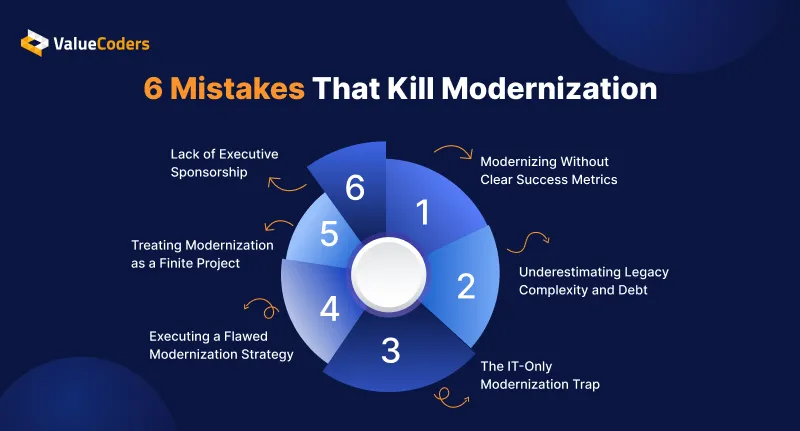
1. Modernising Without Defining Success
The pattern
Projects begin with a technical objective but no measurable business outcome.
Why it’s common
Organizations focus on fixing systems before defining what success actually looks like.
In practice
Without clear metrics, stakeholders define success differently, causing infinite scope creep
The cost
Without a defined ROI, there is no rational way to prioritize scope or know when you’re “done.”
2. When Modernisation Becomes an IT-Only Initiative
The pattern
Modernization scope is shaped by technical teams without enough business involvement.
Why it’s common
Leadership assumes modernization is purely an engineering responsibility.
In practice
Teams modernize systems that technically work while critical workflow problems remain untouched.
The cost
The business absorbs the cost of modernization without seeing meaningful operational improvement.
3. Underestimating legacy complexity: the hidden debt problem
The pattern
Organizations begin IT modernization services engagements without an accurate picture of what they’re actually modernizing.
Why it’s common
Legacy systems are often underdocumented. Key knowledge lives in the heads of employees who may have left years ago.
In practice
Undocumented integrations surface mid-project. Shadow systems appear. Timeline estimates collapse.
The cost
A McKinsey survey states that high technical debt makes modernization initiatives 40% more likely to fail.
4. Treating modernization as a one-time project, not a programme
The pattern
Leadership approves a project with a defined end date and expects to close the book on the legacy problem once it’s “done.”
Why it’s common
Project-based funding models and annual budget cycles encourage finite framing of what is actually an ongoing program.
In practice
The project ends, but immediate technical debt traps the organization in a recurring loop of the same problem.
Without long-term governance and ownership, teams often create the same operational complexity inside the newly modernized stack
The cost
You pay the modernization cost twice: once to modernize and once to re-modernize the system you didn’t maintain.
Also Read: Post-Funding Mistakes That Quietly Kill Product Team Velocity
5. No executive sponsorship
The pattern
Leaders fund the project but disengage from cross-functional decisions.
Why it’s common
Executive sponsors often approve funding but remain absent from cross-functional decision-making.
In practice
Work stops at the first departmental clash, waiting for direction that never comes.
The cost
Stalled weeks cost significantly more than active ones due to lost momentum, delivery delays, and re-ramping.
6. Choosing the wrong modernization strategy for the wrong reasons
The pattern
The application modernization strategy is selected based on vendor pitch, developer enthusiasm, or industry trend, not on the actual business context.
Why it’s common:
“Cloud-first” and “microservices” are easy to sell internally. The trade-offs are less easy to explain.
In practice
Organizations sometimes commit to a costly rebuild when a phased modernization approach could achieve most business outcomes faster, with lower operational risk and less disruption.
The cost
Strategy mismatches are among the most expensive common software modernization mistakes because they compound every other risk in the project.
ValueCoders helps enterprises assess legacy dependencies, reduce migration risk, and build phased modernization roadmaps with governance-first execution.
The Modernization Readiness Framework
Before execution begins, organizations should evaluate modernization readiness across four areas.
| Readiness Area | Key Question |
| Business Alignment | Are modernization goals tied to measurable business outcomes? |
| System Visibility | Have integrations, workflows, and dependencies been audited? |
| Governance Readiness | Are escalation paths and ownership structures documented? |
| Delivery Preparedness | Is the modernization roadmap realisticallyphased? |
Organizations that fail in one or more of these areas often experience delivery overruns, operational disruption, or migration failure.
Also Read: AI Integration vs AI Development: Why Most Projects Fail at the Integration Layer
What a Strong Modernization Starting Point Looks Like
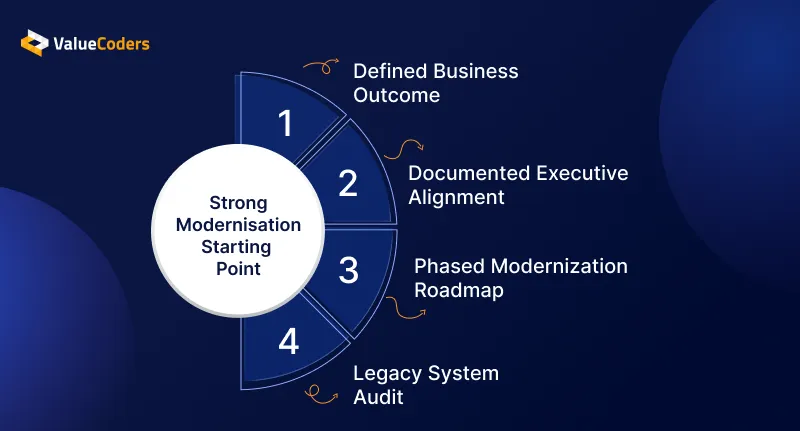
Organizations that modernize successfully share a common trait: they invest time in preparation before committing to execution.
They align modernization goals with business outcomes, validate system dependencies, and establish governance structures that reduce delivery risk.
The following elements form the foundation of a strong modernization program.
1. A Defined Business Outcome
Start with measurable business goals before discussing architecture or platforms.
Modernization without a success metric quickly loses direction. Set the metric first, then work backwards to the technical approach.
2. A Legacy System Audit
Before any application migration and modernization engagement begins, map integrations, dependencies, and undocumented workflows early.
Hidden legacy complexity becomes expensive during execution.
3. A Phased Modernization Roadmap
Break modernization into stages with independent business value. Smaller milestones reduce risk and improve adaptability.
Also Read: Why Legacy Systems are Slowing You Down and How to Modernize Them?
How Should CEOs and CTOs Evaluate Modernization Readiness?
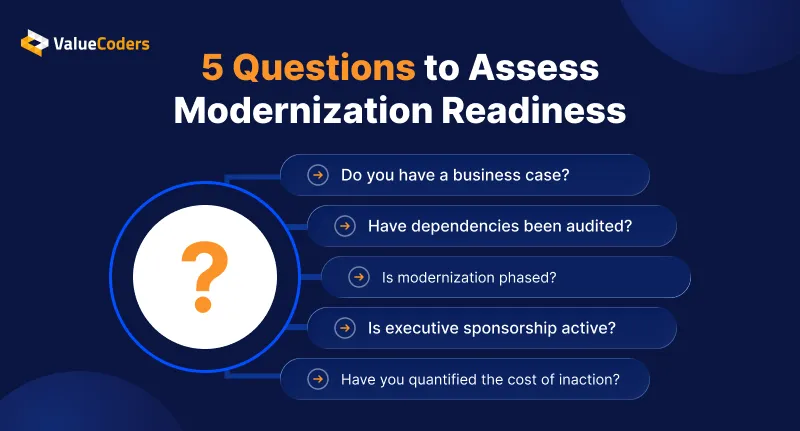
Most modernization programs fail because organizations begin execution without validating governance readiness, operational dependencies, business alignment or business outcomes
Before committing engineering budgets or engineering resources, leadership teams should evaluate whether the organization is structurally prepared for transformation.
Answer these five questions honestly. If you answer “No” to three or more, your program carries a significant failure risk regardless of the technology choices you make.
1. Do you have a written business case with defined success metrics?
Not a technology roadmap, but a business case with measurable outcomes tied to revenue, cost, or speed.
2. Has your legacy system been audited for undocumented integrations and dependencies?
If you can’t map every integration today, you will encounter it as a surprise mid-project.
3. Does your executive sponsor have the authority to resolve cross-team conflicts?
Nominal sponsorship doesn’t count. They need decision-making authority and the time to use it.
4. Is your modernization structured in phases with independent value delivery?
If the first business-usable output is more than 6 months away, the program is already at risk.
5. Have you quantified what not modernizing costs you annually?
Gaps in competitive capability, compliance exposure, maintenance costs, and lost developer productivity all compound.
3 or More “No” Answers?
Three or more “no” responses usually indicate:
- Elevated delivery risk
- Governance gaps
- Incomplete modernization planning
Your modernization program may require discovery, dependency assessment, and stakeholder alignment before technical execution begins.
A short assessment engagement now often costs far less than a prolonged one.
Identify hidden dependencies and modernization blockers before they become delivery issues.
FINAL THOUGHTS
Modernization projects don’t fail because the technology is difficult. They fail because organizations treat technology as the starting point, instead of the business problem behind it.
Successful modernization programs start with clarity. They identify the business constraints limiting growth, assess the systems contributing to those constraints, and implement modernization strategies that deliver measurable value in phases.
A custom software development services provider, ValueCoders helps enterprises reduce software modernization risk through structured assessments, governance-first planning, and outcome-driven execution.
Ready to move forward? Let’s talk about your modernization goals.
FAQ’s
1. Why do modernization projects fail?
Ans .Modernization projects typically fail because organizations focus on technology upgrades before defining business outcomes, governance structures, and modernization priorities.
2. What are the most common software modernization mistakes?
Ans. The most common software modernization mistakes include unclear business objectives, underestimating legacy system complexity, weak executive sponsorship, and attempting large-scale rewrites without a phased delivery strategy.
3. How do you create a successful application modernization strategy?
Ans. A successful application modernization strategy starts with
- Business goals
- System audits
- Phased execution planning
- Stakeholder alignment
- Measurable success metrics
4. What are the biggest legacy modernization challenges?
Ans. The biggest legacy modernization challenges include undocumented dependencies, accumulated technical debt, outdated infrastructure, integration complexity, and resistance to organizational change.
5. What is the first step in enterprise software modernization?
Ans.The first step in enterprise software modernization is assessing business goals, legacy dependencies, governance readiness, and operational risks before deciding on technologies or migration approaches
6. What is a modernization assessment?
Ans. Before modernization execution begins, a modernization assessment evaluates
- System dependencies
- Architecture risks
- Operational workflows
- Migration feasibility
- Delivery readiness
7. How long do enterprise software modernization projects usually take?
Ans. Enterprise software modernization timelines vary depending on system complexity, architecture, compliance requirements, and migration scope. Most large-scale initiatives are executed in multiple phases over several months or years.