


Healthcare software supports more than daily business operations. It handles sensitive patient data, connects clinical systems, and supports workflows that can directly affect patient care.
That makes healthcare software solutions different from standard software development. Security, access control, interoperability, and auditability must be built into the product from the start, not added just before launch.
The risk is real. According to the U.S. Department of Health and Human Services on average, a reported health data breach affects 136,300 individuals. A single security failure can quickly grow into a major incident.
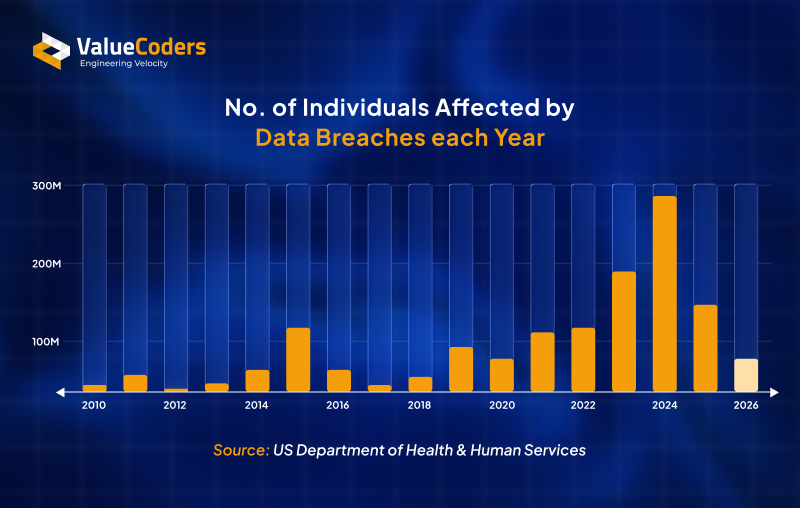
A HIPAA-aware software engineering approach means considering security and compliance requirements early.
This guide explores the key engineering practices that help healthcare software stay secure, compliant, reliable, and ready to scale.
What’s Changing in 2026: The Proposed HIPAA Security Rule Update
Healthcare engineering teams in 2026 are working in a changing regulatory environment. While the next major HIPAA security rule update is not final yet, it is important to understand where the rules may be heading.
In January 2025, HHS proposed the first major update to the HIPAA Security Rule since 2023. As of mid 2026, the proposal is still not law. The original target for finalizing it has been delayed, and the latest timeline points to mid-2027. The final rule could still change, be delayed, or be narrowed.
Even so, the proposal gives healthcare organizations a useful idea of what stronger security practices may look like when building and managing healthcare IT solutions.
- Encryption would become mandatory. Protecting ePHI at rest and in transit would no longer be treated as optional.
- MFA would be required. Systems that access ePHI would need multi-factor authentication.
- Network segmentation would be required. Systems handling ePHI would need to be separated from other parts of the network.
- Incident reporting would be faster. Certain security incidents would need to be reported within 72 hours.
- Penetration testing would be required annually. Security testing would move from occasional checks to a regular process.
- Vendor oversight would increase. Healthcare organizations would need stronger visibility into how business associates and their vendors protect ePHI.
The changes (mentioned above) may require adjustments if your architecture already uses encryption, MFA, network segmentation, and regular security testing. If not, the proposal is good enough. You do not have to wait for new HIPAA compliance requirements in software development to take effect.
The key takeaway is simple: build security into the architecture from the start, instead of treating it as a compliance task added later.
Also Read: A Complete Guide For Healthcare App Development
Healthcare Standards That Shape Software Architecture
Healthcare software has to do more than work well. Digital healthcare solutions must exchange the right data, adhere to healthcare standards, and integrate with existing clinical systems. Knowing what each one actually requires from your engineering team matters more than knowing the acronym.
| Standard | What It Covers | Engineering Takeaway |
| HIPAA | Access, authentication, data protection, and audit trail requirements for protected health information | Role-based access control, audit logging, and encryption aren’t optional add-ons; they’re the baseline architecture |
| HITECH | Extends HIPAA’s privacy and security framework and defines breach-related reporting responsibilities | Your incident response and breach notification tooling needs to meet HITECH’s timelines, not just detect the breach |
| HL7 V2 | The messaging standard still running across most hospital and clinical systems | Expect to build message mapping, validation, and acknowledgment handling; many legacy EHRs won’t give you a modern API |
| HL7 FHIR | Standardised healthcare data exchange through resources and APIs | The default choice for new EHR integrations and healthcare data platforms; check FHIR support before assuming it’s there |
| SMART on FHIR | Authorisation patterns for connecting applications to FHIR-based systems | Governs how patient- and provider-facing apps get secure, scoped access to EHR data; not a nice-to-have if you’re building an app that plugs into an EHR |
Knowing these names is the easy part. The harder part, and what actually determines whether your architecture holds up, is knowing which one fits a given integration and why. This is where healthcare software development services can help teams make the right architecture and integration choices from the start.
Get expert input on your product’s architecture, integrations, and scalability.
What HIPAA-Aware Healthcare Software Architecture Should Include
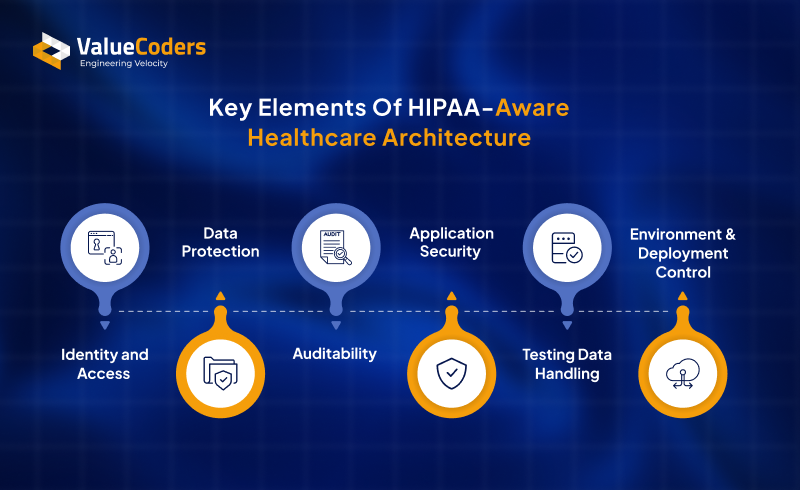
A secure healthcare architecture controls who can access data, how data moves, and how activity is recorded.
Identity and Access
- Role-based access, strong authentication, least-privilege permissions.
Data Protection
- Encryption in transit and at rest (TLS 1.2 minimum, 1.3 preferred; SSL is no longer acceptable under current guidance), secure storage, key and secrets management.
Auditability
- Tracking user access, data changes, authentication events, and administrative actions.
Application Security
- Secure APIs, input validation, vulnerability scanning, security testing.
Testing Data Handling
- Use de-identified or synthetic data in development and QA. Staging environments shouldn’t contain real PHI, so create test data that mimics patient data without using actual patient information.
Environment and Deployment Controls
- Separated development and production environments, protected credentials, controlled deployments, configuration management, and backup and recovery procedures.
So, in short, treat security as part of the architecture, not a final checklist.
Designing Healthcare Software for Scale and Reliability
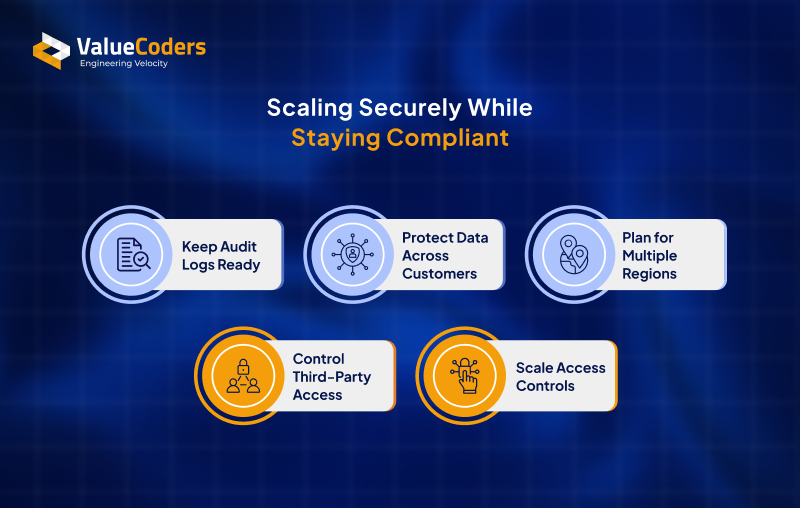
A healthcare platform must stay secure and compliant as users, data, vendors, and regions grow. Building these controls early makes it easier to scale without creating new compliance gaps.
Keep Audit Logs Ready
Audit logs should remain useful as system activity grows.
- Record important access, changes, and system activity
- Keep logs secure and easy to review
- Make sure teams can access the right records during audits or incidents
Protect Data Across Customers
As more healthcare organizations use the platform, data isolation becomes critical.
- Keep each customer’s data separated
- Apply strict access and tenant-level controls
- Use encryption and permissions to protect sensitive data
Plan for Multiple Regions
Supporting users in different countries can add data storage and processing requirements.
- Define where healthcare data can be stored and processed
- Set region-specific data controls when required
- Build these requirements into the architecture from the start
Control Third-Party Access
New AI, cloud, and analytics tools can increase the number of systems that handle sensitive data.
- Review what data each vendor can access
- Apply the required security and contractual controls
- Limit access to only what each service needs
Scale Access Controls
A growing team stronger control over who can access healthcare data.
- Use role-based access permissions
- Review employee and contractor access regularly
- Remove unnecessary access when roles or responsibilities change
The goal is simple: build security and compliance into the architecture so they can scale with the product, not become a problem later.
Make security and compliance part of your healthcare software from the start.
Healthcare Software Development Checklist
Building healthcare software requires more than getting the core functionality right. Security, data handling, integrations, performance, and operational controls need to be considered throughout the software lifecycle.
Use this checklist to identify key engineering considerations before, during, and after development.
Before Development
- Identify PHI and other sensitive data handled by the application
- Define users, roles, permissions, and access requirements
- Identify required EHR, healthcare, and third-party integrations
- Determine applicable regulatory and contractual requirements
- Define availability, scalability, backup, and recovery requirements
During Development
- Apply least-privilege access controls
- Encrypt sensitive data appropriately in transit and at rest
- Implement audit logging for relevant security and data-access events
- Validate inputs and secure API endpoints
- Keep credentials and secrets out of source code
- Use appropriate test data instead of exposing production PHI during development and testing
Before Production
- Test authentication and authorization controls
- Validate integrations, error handling, and failure scenarios
- Test application, database, and API performance under expected workloads
- Review logging, monitoring, and alerting
- Validate backup and recovery processes
- Conduct security testing and address identified vulnerabilities
After Launch
- Monitor application health, performance, and security events
- Review access and audit logs for relevant activity
- Patch application dependencies and infrastructure
- Test backup and recovery procedures regularly
- Reassess integrations, access controls, and security requirements as the application evolves
Also Read: Understanding the Cost of Building a Custom Medical Billing Software
EHR Integration: What to Get Right
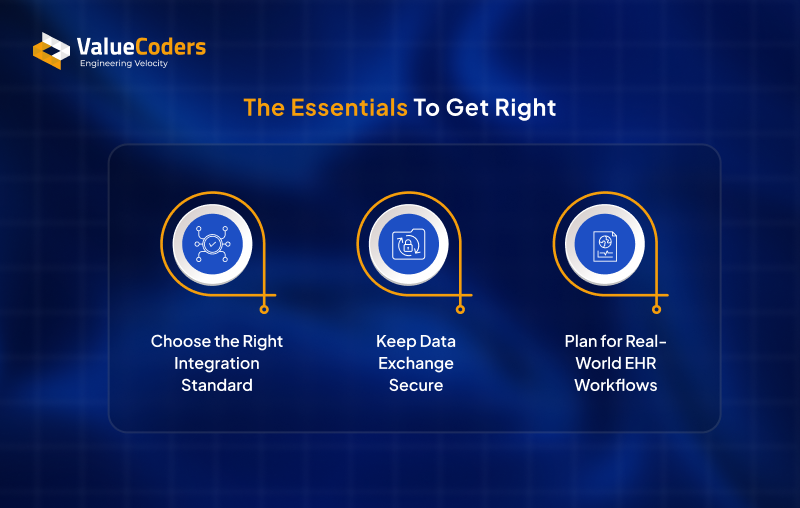
EHR integration connects healthcare software with the systems used to store and share patient information. It needs to be planned carefully so data moves safely, works correctly, and stays easy to track with the right software development services.
Choose the Right Integration Standard
The right standard depends on the system and the type of data being shared.
- Use HL7 V2 for many existing healthcare systems
- Use HL7 FHIR for modern data exchange
- Use SMART on FHIR when building apps that connect with FHIR-based systems
Keep Data Exchange Secure
Every connection between systems should protect patient data and limit access.
- Use secure APIs and connections
- Give systems access only to the data they need
- Keep records of important data access and changes
Plan for Real-World EHR Workflows
EHR integration should support the actual work healthcare teams do, not just move data between systems.
- Support clinical data and patient records
- Handle lab orders, prescriptions, and other key workflows
- Test data exchange between providers and systems
For example, ValueCoders built an Electronic Health Record system with clinical templates, ICD-10 coding, lab and diagnostic orders, CCD data exchange, and electronic prescribing.
This shows why EHR integration needs to be designed around both data exchange and real workflows.
How ValueCoders Approaches HIPAA-Aware Healthcare Engineering
The right healthcare software partner should look beyond features and delivery timelines.
It is important to understand how your data is protected today. How the system will handle more users, data, and integrations as it grows.
Compliance needs can also vary based on the project, data architecture, and applicable regulations.
ValueCoders combines compliance consulting services with development, security, and integration expertise to build reliable healthcare software.
FAQs
1: How long does it take to build a HIPAA-compliant healthcare application?
Ans. The timeline depends on the application’s features, integrations, data requirements, and security needs. A simple application may take a few months, while a larger platform with EHR integration, AI, and complex workflows can take longer. HIPAA compliance in software development should be considered from the start rather than added just before launch.
2: How does AI impact HIPAA-compliant healthcare software development?
Ans. AI can positively impact healthcare software through:
- Automation
- Data analysis
- Clinical support
- Personalized experiences
3: What are the benefits of outsourcing healthcare software development?
Ans. Outsourcing can give healthcare businesses access to experienced engineers without building a large in-house team. A good development partner can support healthcare workflows, EHR integrations, security, data protection, and ongoing product improvements while helping manage HIPAA-compliant application development time and costs.
4: How much does it cost to develop HIPAA-compliant healthcare software?
Ans. There is no fixed cost because it depends on the product’s features, complexity, integrations, security requirements, and development scope. Applications with AI, EHR integration, real-time data, or complex healthcare workflows generally require more development effort. The best way to estimate cost is to define the product requirements and technical scope first.
5: What industries benefit most from HIPAA-compliant software development?
Ans. Healthcare providers, telehealth companies, healthtech startups, hospitals, clinics, medical practices, laboratories, pharmacies, and healthcare service providers can benefit from HIPAA-aware healthcare software development. Any organisation that handles protected health information may need software designed with appropriate security and data protection controls.