
How Democratized AI is Helping Small Businesses Grow

As technology advances, AI is no longer limited to large budgets for complex computing. It’s now accessible to businesses of all sizes.

Until recently, AI tools were mainly used by big companies to handle routine tasks, analyze large amounts of data, and manage risky operations, all of which help businesses. 

Smaller businesses couldn’t afford these tools, so they missed out on benefits like improved efficiency, better cybersecurity, predicting trends, and understanding customers deeply.

Platforms like ChatGPT are democratized AI, making it easier to use for everyone, giving small businesses more options. This means you don’t have to be an expert to benefit from AI anymore, which is great news. 

It helps smaller businesses grow and encourages new ideas because more companies can join. 

Let’s take a look at some AI use cases that are helping small businesses compete with bigger ones.

Use Case 1: Lead Generation Optimization

AI-powered lead generation tools use smart algorithms to help small businesses find and reach potential customers better. 

They analyze how customers behave and what they like, which helps businesses improve how they find new leads. This usually means more people become customers, leading to more sales.
Lead Generation Optimization

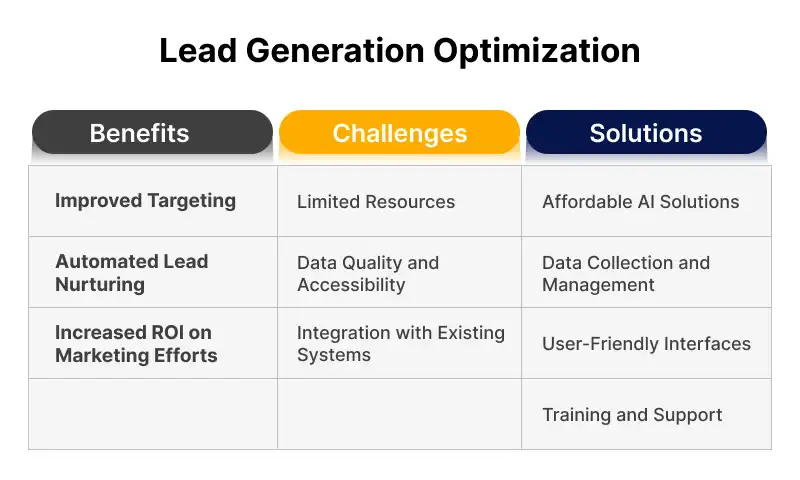
Benefits

  • Improved Targeting: Democratized AI algorithms look at a lot of customer information to find patterns and trends. This helps businesses aim their marketing more accurately. When they do this, they get better quality leads and people are more interested in what they’re offering.
  • Automated Lead Nurturing: AI-powered automation makes the process of nurturing leads smoother by sending personalized content and messages to leads when they need it. This keeps communication consistent and helps leads move through the sales process faster.
  • Increased ROI on Marketing Efforts: The benefits of AI tools help small businesses use their AI/ML for marketing money better by finding and taking care of leads more effectively. This helps them spend money more smartly, concentrating on the things that bring in the most customers.

Challenges for Small Businesses

  • Limited Resources: Small businesses usually don’t have enough money or people to buy advanced AI tools for generating leads.
  • Data Quality and Accessibility: Small businesses might find it challenging to collect customer information, making it hard for AI tools to find and connect with expected customers.
  • Integration with Existing Systems: Small businesses might not have the necessary tech knowledge and may struggle to incorporate democratizing AI tools with their current marketing setups, which could take a lot of time and effort.

Solutions

  • Affordable AI Solutions: Look for lead generation tools harnessed by Democratized AI that are made for small businesses. They should have prices that fit your budget and features that can grow along with your business.
  • Data Collection and Management: Improve data collection and organization by using tools like CRM software or getting assistance from data enhancement services.
  • User-Friendly Interfaces: Look for AI business tools that are easy to use and match with how your small business team works. This helps everyone learn fast and makes it simple for the team to begin using the tools.
  • Training and Support: Offer training and support to your employees so they can use AI tools to find leads and make sales.
Ready To Take Your Small Business To The Next Level With AI?

ValueCoders offers tailored AI solutions to help you stay ahead of the competition and drive success.

Use Case 2: Personalized Customer Experience

AI algorithms will examine how customers interact with a business to make marketing messages, product suggestions, and customer service interactions more personal. This personalized experience makes each customer feel special, making them happier and more likely to stay loyal to the business.
Personalized Customer Experience

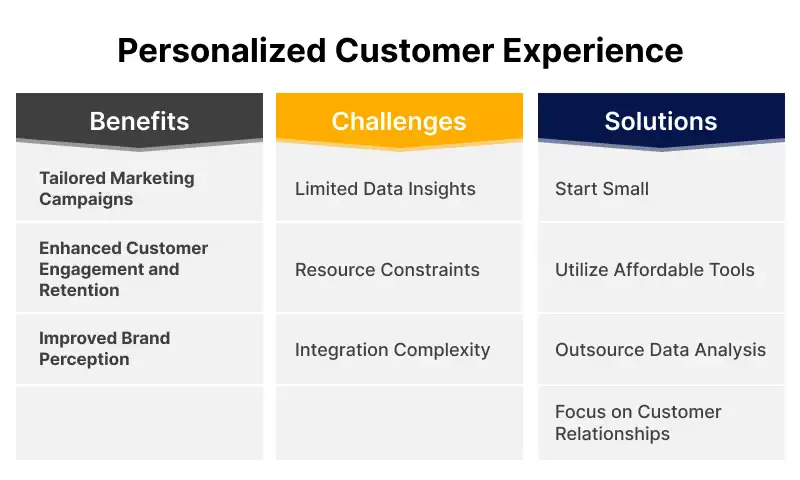
Benefits

  • Tailored Marketing Campaigns: When businesses understand what their customers like and how they behave, they can create more personalized marketing campaigns. This makes customers more interested, and such customers are more likely to buy from them.
  • Enhanced Customer Engagement and Retention: Offering personalized experiences with Democratized AI makes customers feel closer to the business. This boosts their ability to make repeat purchases and stay loyal over time. Customers appreciate when businesses pay attention to their wants and needs.
  • Improved Brand Perception: Giving customers personalized experiences shows that a business cares about making them satisfied and trying new things. This makes people think of the brand and makes it stand out from other companies.

Challenges for Small Businesses

  • Limited Data Insights: Small businesses might find it hard to get enough customer information and understand it well enough to use it for making things more personal.
  • Resource Constraints: Using AI tools to personalize things might cost a lot of money and need technical skills that small businesses might not have.
  • Integration Complexity: For small businesses that don’t have a lot of IT resources, connecting AI-powered personalization tools to their current systems and ways of working can be hard.

Solutions

  • Start Small: Start by gathering basic customer information using easy methods like email sign-ups or tracking what they buy. As your resources grow, you can collect more data in other ways.
  • Utilize Affordable Tools: Search for AI tools that personalize things and have prices that fit small business budgets. Think about using cloud-based options that don’t need a lot of money upfront.
  • Outsource Data Analysis: Think about outsourcing best AI development companies or experts who are good at analyzing data about customers. This can help small businesses gain knowledge and understand their customers better without needing to do it themselves.
  • Focus on Customer Relationships: Build genuine connections with customers by engaging with them personally and providing excellent service. Even without advanced technology, demonstrating care can significantly impact how customers perceive your business.

Use Case 3: Operational Efficiency Enhancement

AI-driven automation simplifies tasks like inventory management, supply chain organization, and maintenance scheduling. Integration of AI/ML in business operations reduces manual work, saves costs, and boosts productivity.
Operational Efficiency Enhancement

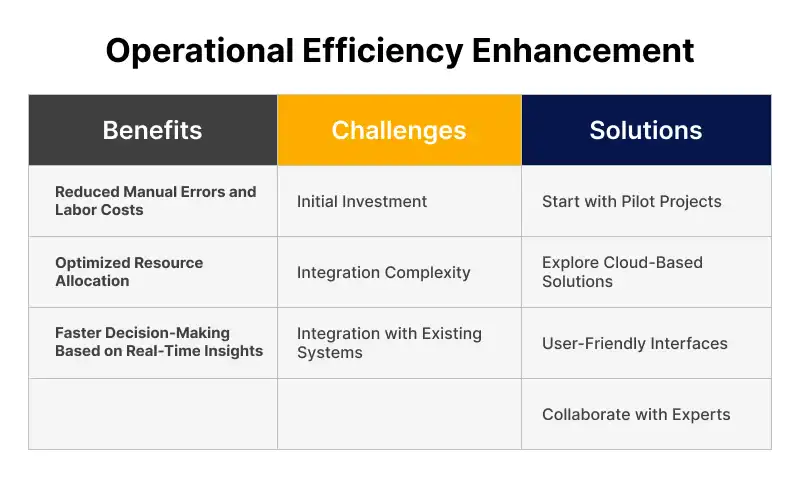
Benefits

  • Reduced Manual Errors and Labor Costs: Automation lowers the chance of mistakes when doing everyday tasks, which makes things more accurate and efficient. This means businesses can spend less on workers doing things manually.
  • Optimized Resource Allocation: Artificial Intelligence in business algorithms studies information to make sure resources are used well. This means keeping the right amount of inventory, planning production schedules well, and using resources in the best way possible.
  • Faster Decision-Making Based on Real-Time Insights: Democratized AI systems offer real-time updates to businesses about how well things are going, helping them make quick and smart choices. This agility is important for keeping up in today’s fast business world.

Challenges for Small Businesses

  • Initial Investment: Setting up AI-driven automation systems might initially need a big investment. This includes buying the technology, getting it to work, and training staff to use it.
  • Integration Complexity: Connecting AI systems to existing processes of working and technology can be hard, especially for small businesses that don’t have a lot of IT knowledge or resources.
  • Data Quality and Accessibility: Small businesses might have problems with data quality and not enough access to the right information, which can make AI algorithms less effective in making operations better.

Solutions

  • Start with Pilot Projects: Begin with small projects to show how AI automation can help in certain parts of the business. This way, you can slowly introduce it and not take big risks by doing everything at once.
  • Explore Cloud-Based Solutions: Consider using AI cloud platforms that can grow with your business. They usually don’t require a lot of upfront costs, and you can make them bigger as your business grows.
  • Invest in Training: Make sure your employees know how to use Democratized AI tools by giving them training and support. Investing in teaching them can help with any problems that come up when using new technology.
  • Collaborate with Experts: Work with companies or experts who know a lot about AI and help small businesses. They can help you choose and use the right tools that fit your business’s needs and limits.

Use Case 4: Competitive Intelligence

AI tools help small businesses monitor what their competitors are doing along with their strategies, prices, and what’s happening in the market. 

By using AI, businesses can know essential information that can help them make smart decisions and stay ahead of their competition.
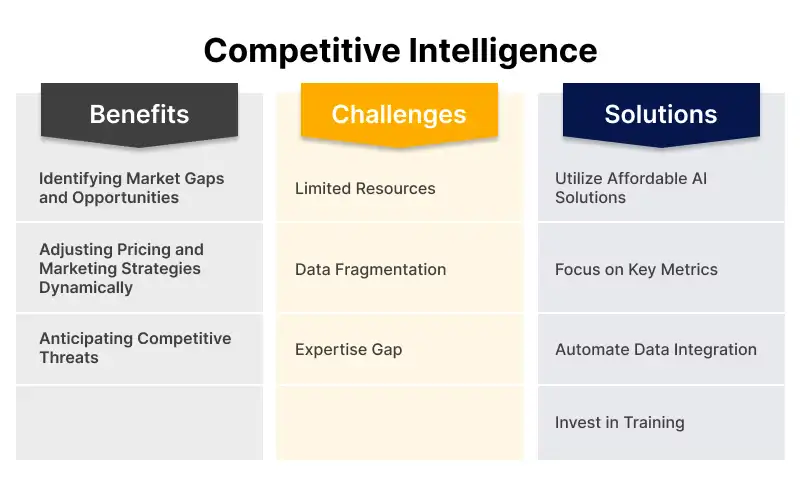
Competitive Intelligence

Benefits

  • Identifying Market Gaps and Opportunities: AI algorithms look at market information to find new trends, what customers like, and parts of the market that haven’t been used much. This helps businesses find chances to grow and try new things.
  • Adjusting Pricing and Marketing Strategies Dynamically: By always watching what competitors charge and how they advertise, businesses can change their own plans quickly to stay competitive. This helps them react fast to changes in what people want and how they act in the market.
  • Anticipating Competitive Threats: Democratized AI tools that analyze competition can tell businesses early if there might be new problems from competitors, like if they’re launching new products or doing new things. This helps businesses be ready and protect their place in the market.

Challenges for Small Businesses

  • Limited Resources: Small businesses might not have enough money or people to buy advanced AI tools for understanding their competition.
  • Data Fragmentation: Small businesses might find it hard to get information from different places like market reports, social media, and competitor websites. This makes it tough for them to do a thorough job of studying their competition.
  • Expertise Gap: Small businesses might not have the know-how or experience to understand and use the information they get from AI tools that analyze their competition.

Solutions

  • Utilize Affordable AI Solutions: Find competitive AI tools and offer prices that small businesses can afford. Consider options where you can pay a subscription fee or only pay for what you use, so you don’t have to spend a lot of money upfront.
  • Focus on Key Metrics: Focus on collecting and studying key performance measures (KPIs) that match your business goals and competition. This helps you use your resources wisely and get the most out of them.
  • Automate Data Integration: Look into tools and platforms that automatically gather, organize, and study data from different places. This saves time and effort when getting useful information and helps you make decisions faster.
  • Invest in Training: Offer training and chances for employees to get better at analyzing competition and understanding data. You could also work with outside experts or companies who know a lot about competitive intelligence to help your team.
Don't Let Limited Resources Hold Back Your Business Growth!

Leverage ValueCoders' AI expertise to scale your small business operations.

Use Case 5: Financial Management Assistance

AI-powered financial management tools assist small businesses in tasks such as budgeting, forecasting, and cash flow management. 

These tools use intelligent algorithms to provide guidance that helps in financial decision-making and risk management.
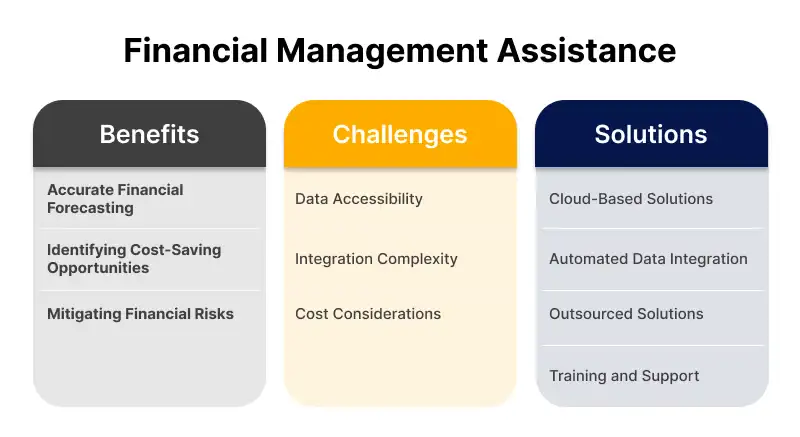
Financial Management Assistance

Benefits

  • Accurate Financial Forecasting: Democratized AI algorithms study past data and make guesses about what’s happening in the market and how much money a business will require in the future. This helps businesses be prepared for what’s coming and plan the next steps accordingly.
  • Identifying Cost-Saving Opportunities: AI financial tools examine how money is being spent and find instances where it’s being wasted. This helps businesses see where they can spend less and get more ROI.
  • Mitigating Financial Risks: AI algorithms check different things that could be risky for finances, like how prices change a lot and if someone might not pay money back. This helps businesses see what problems might happen and do things to stop them before they happen, keeping their finances safe.

Challenges for Small Businesses

  • Data Accessibility: Gathering financial data from various sources like accounting software, bank statements, and invoices can be challenging for small businesses. This makes it difficult to utilize AI tools for financial management.
  • Integration Complexity: Incorporating AI financial tools with a business’s existing systems and workflows can be difficult and time-consuming. Especially for small businesses that may lack technical knowledge.
  • Cost Considerations: Implementing Democratized AI tools for financial management may need a significant upfront investment, such as purchasing the technology and training staff to use it. This can be problematic for small businesses with limited financial resources.

Solutions

  • Cloud-Based Solutions: Think about using AI financial tools that are on the cloud. They usually have prices that fit your budget and can work well with the accounting software you already use. Cloud-based options usually don’t need a lot of money upfront, and they can get bigger as your business grows.
  • Automated Data Integration: Look into tools and tech that automatically gather and put together financial information from different places. This makes it easier to manage data and means your team doesn’t have to work as hard to get it all together.
  • Outsourced Solutions: Think about hiring top AI development companies or experts who know a lot about using AI for business financial analysis. This can help small businesses get knowledge and tools without requiring to spend a lot of money upfront.
  • Training and Support: Make sure your employees know how to use AI financial tools by giving them training. This could include workshops, online classes, or training while they’re working, all designed to fit what your business needs.

Use Case 6: Excellent Customer Care Keeps Them Coming Back

AI tools for customer service help small businesses give great experiences to customers. They do this by talking to customers in a personal way, giving help quickly, and reaching out to them first. 

These tools use smart algorithms to know what customers want and need, which helps make them happy and keep coming back.
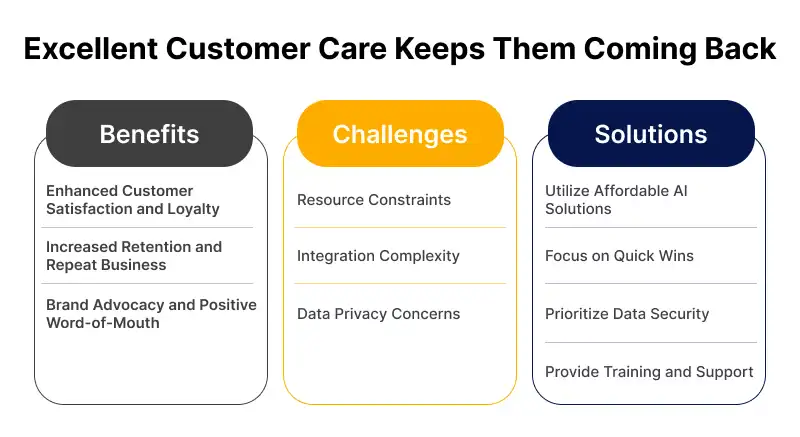
Excellent Customer Care Keeps Them Coming Back

Benefits

  • Enhanced Customer Satisfaction and Loyalty: Democratized AI customer service tools help businesses offer personalized replies quickly and respond well to customer questions, fixing problems and dealing with worries. This makes customers happier and more likely to stay with the business.
  • Increased Retention and Repeat Business: When businesses offer great customer experiences, they build strong connections with their customers. This helps in repeat customers and staying loyal to the company. A happy customers is more likely to come back and keep doing business with the company.
  • Brand Advocacy and Positive Word-of-Mouth: When customers are happy, they often tell their friends, family, and coworkers about the business. This good word-of-mouth can bring in new customers and make the company’s reputation even better in the market.

Challenges for Small Businesses

  • Resource Constraints: Small businesses might not have enough money or people to buy advanced AI tools for customer service.
  • Integration Complexity: Connecting Democratized AI customer service tools to the systems and ways of working a business already uses can be hard and take a lot of time. It needs people who are good with technology and enough resources.
  • Data Privacy Concerns: Small businesses need to make sure that AI customer service tools follow the rules about keeping customer information private and safe.

Solutions

  • Utilize Affordable AI Solutions: Search for AI development company that have prices that small businesses can afford. Many companies offer options that can get bigger as your business grows.
  • Focus on Quick Wins: Begin by using AI customer service tools in places where they can help right away, like answering common questions automatically or sending customer questions to the right part of the business.
  • Prioritize Data Security: Pick AI companies that focus on keeping data safe and following rules like GDPR or CCPA. Make sure that customer information is always encrypted and safe during the customer service process.
  • Provide Training and Support: Train your employees so they feel confident using Democratized AI tools for customer service and know how to use them well to make customers happier. Also, give them support whenever they need help or have questions while they’re learning to use the tools.

Use Case 7: Cybersecurity Must Address Evolving Threats

AI cybersecurity tools are vital for small businesses to protect their critical information and systems from evolving cyber threats. These tools use the power of AI to detect and prevent threats before they arise, ensuring uninterrupted business operations and maintaining trust with customers.
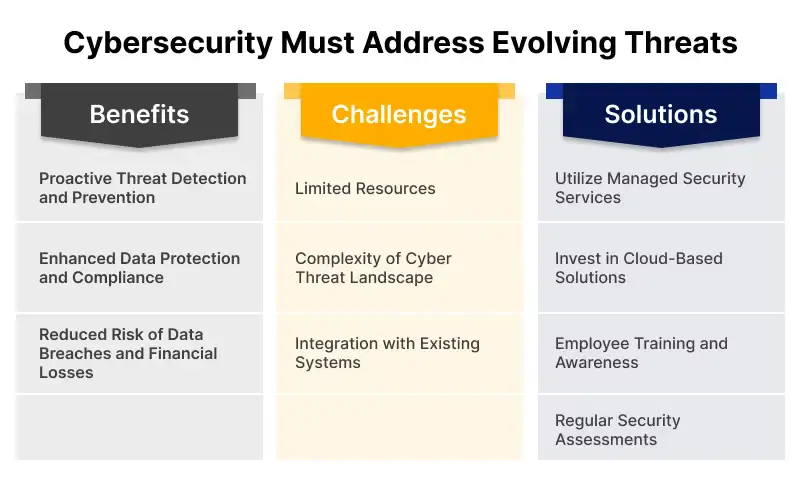
Cybersecurity Must Address Evolving Threats

Benefits

  • Proactive Threat Detection and Prevention: AI algorithms study large amounts of data to identify patterns and anomalies that could show potential cyber threats. By identifying threats in real-time, businesses can take action to prevent them before they cause any harm.
  • Enhanced Data Protection and Compliance: Democratized AI cybersecurity tools assist businesses in establishing robust security measures to protect against sensitive information from unauthorized access or breaches. This ensures customer data remains secure and the business complies with regulations like GDPR or CCPA.
  • Reduced Risk of Data Breaches and Financial Losses: AI cybersecurity tools quickly detect and prevent cyber threats, lowering the risk of hackers accessing and stealing information or causing financial harm to the business. This maintains the business’s reputation and ensures continued trust from customers.

Challenges for Small Businesses

  • Limited Resources: Small businesses might not have enough money or know-how to buy and use AI tools for cybersecurity the right way.
  • Complexity of Cyber Threat Landscape: The always-changing cyber threats are a big problem for small businesses. They might have trouble keeping track of new threats and problems.
  • Integration with Existing Systems: Connecting Democratized AI cybersecurity tools to the systems and security stuff a business already uses can be hard and take a lot of time. It needs people who are good with technology and enough resources.

Solutions

  • Utilize Managed Security Services: Consider partnering with Managed Security Service Providers (MSSPs) who specialize in keeping online businesses safe. They’re experts in cybersecurity and can tailor security solutions to meet the budgets and needs of small businesses.
  • Invest in Cloud-Based Solutions: Check out AI cybersecurity tools that work online (in the cloud) and can change to fit what the business needs. These tools usually cost less at the start and can fit with the technology the business already uses.
  • Employee Training and Awareness: Spend time and resources on teaching employees about cybersecurity so they know how important it is and can spot and deal with potential threats. This helps lower risks and makes the business more secure overall.
  • Regular Security Assessments: Regularly inspect and assess the security of the company’s computer systems to find any issues or weaknesses. This helps solve problems before they get serious and makes it tougher for cyber attacks to occur.
Empower Your Small Business With AI-Driven Customer Experiences!

ValueCoders' personalized AI solutions can enhance customer satisfaction anddriving success.

Concluding Thoughts

In closing, AI is becoming available to everyone, and the democratization of AI is changing how small businesses work and expand.

Using AI tools helps businesses improve finding potential customers, make each customer’s experience special, work more efficiently, and understand their competition better.

Even though there are challenges like not having enough money or knowing enough about technology, AI tools made for small businesses give chances to grow.

By spending on training and using easy-to-use AI programs, businesses can use AI to make smart choices, make things easier, and keep growing in today’s fast-changing market.

In the digital age, small businesses can do well, come up with new ideas, and succeed due to the democratization of AI.

Ready to discover AI’s potential for your small business? Contact ValueCoders today to explore AI solutions tailored to your needs and take your business to the next level.

How Data Analytics is Safeguarding Digital Transactions?

In the emerging digital world, safeguarding digital transactions against fraud is paramount for individuals, businesses, and financial institutions.

According to GlobalData Report, the digital payments market will be at $2,476.8 trillion in 2023 and is predicted to grow at a CAGR of 14.3% over the forecast period.

With the rise in online commerce and the proliferation of digital payment methods, the opportunities for fraudsters have also grown.

To combat this, data analytics has emerged as a powerful tool in real-time fraud detection, offering a proactive approach to identify and prevent fraudulent activities.

Let us learn more about real-time fraud detection and explore how data analytics shapes digital transactions’ security landscape.

About Real-time Fraud Detection

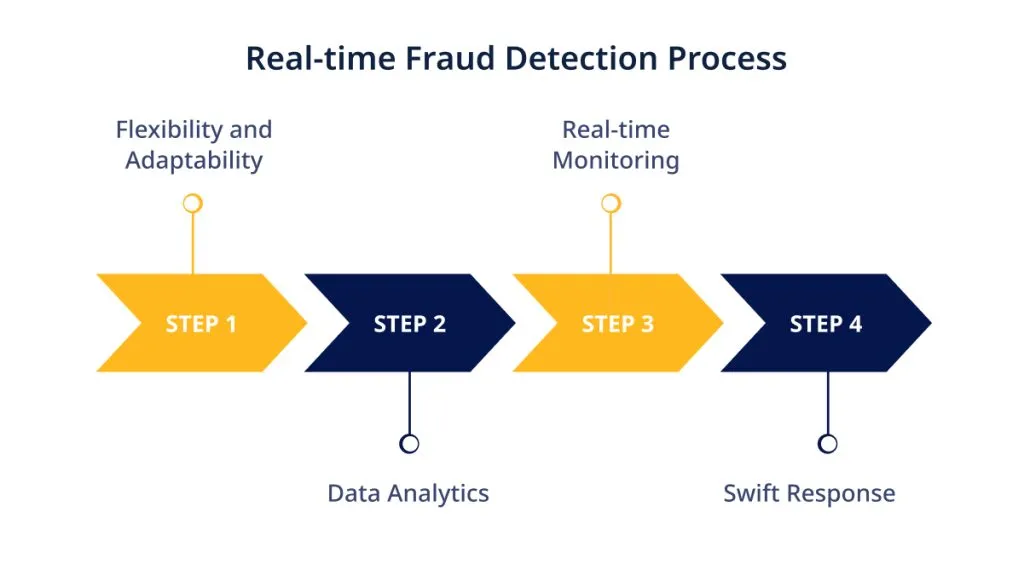
Real-time fraud detection refers to the continuous monitoring and analysis of digital transaction data to identify and prevent fraudulent activities as they occur.

It uses advanced data analytics techniques to detect anomalies, suspicious patterns, and unauthorized access in real-time.

In fraud detection, data analytics leverages:

  • Historical transaction data
  • Machine learning algorithms
  • Real-time monitoring

to identify potentially fraudulent activities.

Significance of Localization

Safeguarding digital transactions holds immense importance in today’s interconnected world. As technology advances, digital transactions have become integral to our daily lives.

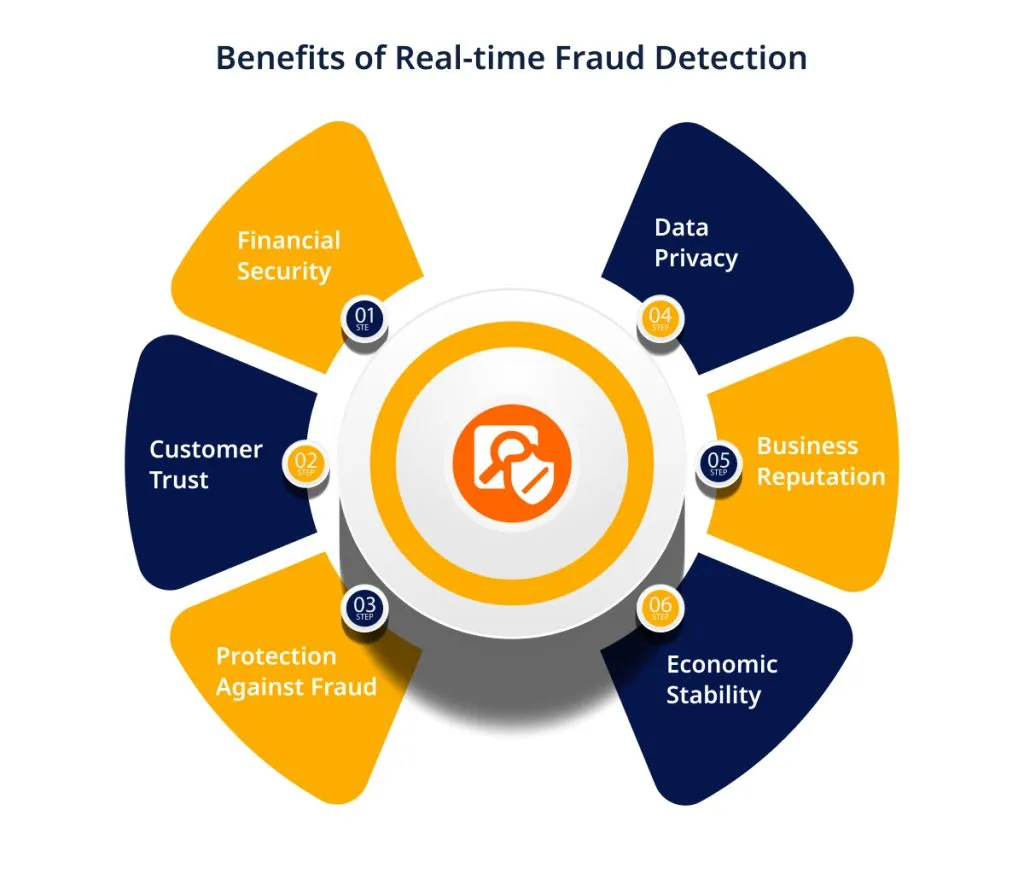
Here’s why fraud Detection in Digital Transactions is crucial, along with some key points:

1. Financial Security: Digital transactions often involve the transfer of money, making them attractive targets for cybercriminals. Ensuring the security of these transactions is paramount to prevent financial losses.

2. Customer Trust: When individuals and businesses know their digital transactions are secure, they are more likely to trust online payment systems and e-commerce platforms. This trust fosters a healthy digital economy.

3. Protection Against Fraud: Safeguarding digital transactions helps in the early detection and prevention of fraud, reducing the financial impact on consumers and businesses.

4. Data Privacy: Digital transactions often involve exchanging sensitive information, such as personal and financial data. Protecting this data is essential to maintain individual privacy and comply with data protection regulations.

5. Business Reputation: Companies that prioritize transaction security build a positive reputation. Conversely, security breaches can lead to a loss of trust, customer attrition, and damage to a brand’s image.

6. Economic Stability: The stability of financial systems relies on secure digital transactions. Preventing fraud and cyberattacks is vital to maintaining a region’s or country’s overall economic health.

7. Global Commerce: International trade and cross-border transactions heavily depend on secure digital payment systems. Safeguarding these transactions facilitates global commerce and economic growth.

Safeguarding digital transactions is not just about protecting financial assets but also about fostering trust, maintaining privacy, and ensuring the stability of our increasingly digitalized world.

Need for Real-time Fraud Detection

The need for real-time fraud detection in digital transactions is a pressing concern in today’s digital landscape.

As technology evolves, so do the tactics of fraudsters, making it essential to have proactive measures in place.

Here’s why real-time fraud detection is crucial, along with key points:

1. Rising Transaction Volumes: With the exponential growth of digital transactions, the sheer volume provides fraudsters with more opportunities to exploit vulnerabilities.

2. Evolving Fraud Techniques: Cybercriminals continually adapt and refine their methods, employing advanced tactics like phishing, identity theft, and account takeover. Real-time detection is necessary to stay ahead of these evolving threats.

3. Financial Impact: Falling victim to fraud can result in substantial financial losses for individuals and businesses alike, emphasizing the need for immediate detection and prevention.

4. Reputational Risks: Fraud incidents tarnish the reputation of businesses and financial institutions. Customer trust is easily eroded, and it can take time to rebuild it after a breach.

5. Regulatory Compliance: Many industries are subject to strict regulatory requirements regarding fraud prevention. Real-time detection helps ensure compliance with these regulations.

6. Operational Efficiency: Timely detection and automated responses to fraud attempts streamline operations, reducing the time and effort required to resolve fraud-related issues.

7. Customer Experience: Real-time fraud detection minimizes disruptions for customers. Legitimate transactions are less likely to be blocked or delayed, enhancing the overall customer experience.

Data Analytics in Fraud Detection

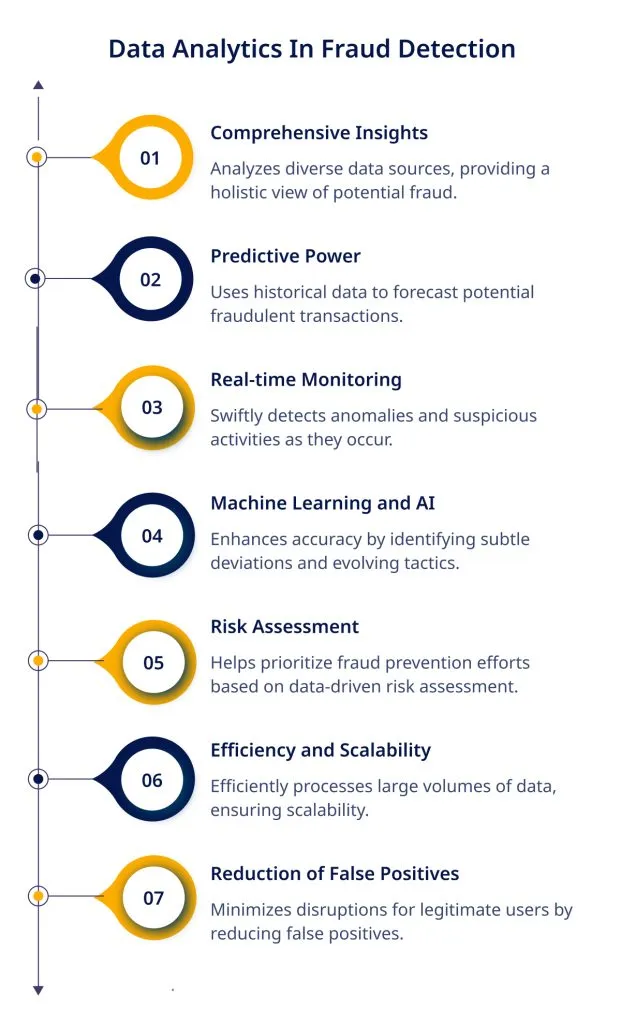
Data analytics plays a pivotal role in fraud detection, providing the means to analyze vast volumes of transaction data and identify patterns that may indicate fraudulent activity.

Predictive analytics in fraud identification has shown an accuracy improvement of 15% compared to previous years.

Challenges in Traditional Invoicing

Here’s a closer look at the significance of data analytics in fraud detection, along with some key points:

Comprehensive Insights: Data analytics enables the examination of diverse data sources, from transaction logs to user behavior patterns, providing a holistic view of potential fraud.

Predictive Power: Through predictive analytics, historical data can be leveraged to forecast potential fraudulent transactions or patterns, allowing for proactive prevention.

Real-time Monitoring: Real-time data analytics allows for immediate detection of anomalies or suspicious activities as they occur, enabling swift action to stop fraud in its tracks.

Machine Learning and AI: Advanced machine learning algorithms and artificial intelligence enhance the accuracy of fraud detection models by identifying subtle deviations and evolving tactics.

Risk Assessment: Data analytics provides a basis for assessing risk associated with transactions or users, helping organizations prioritize their fraud prevention efforts.

Efficiency and Scalability: Automation and data analytics allow for efficient processing of large volumes of data, ensuring scalability as transaction volumes grow.

Reduction of False Positives: By fine-tuning algorithms and incorporating user behavior analysis, data analytics helps reduce false positives, minimizing disruptions for legitimate users.

Real-time Data Acquisition

Real-time data acquisition is a fundamental component of effective fraud detection systems. It involves collecting and processing transaction data as it occurs, allowing for immediate analysis and response.

Significance of Localization in Mobile App Testing-2

Here’s a closer look at why real-time data acquisition is essential, along with key points:

Timeliness: Real-time data acquisition ensures that transaction data is captured and processed instantly, enabling immediate fraud detection and prevention.
Immediate Action: Fraudsters can act swiftly, making real-time response crucial for stopping fraudulent transactions in progress and preventing further damage.
Continuous Monitoring: With real-time data acquisition, transactions are continuously monitored, minimizing the window of opportunity for fraudsters.
Data Diversity: Real-time acquisition covers diverse data types, including transaction timestamps, user information, and device details, providing a comprehensive view of each transaction.
Enhanced Accuracy: Real-time data feeds enable fraud detection models to make decisions based on the most up-to-date information, improving accuracy.
Scalability: As transaction volumes grow, real-time data acquisition methods can scale to efficiently handle the increased data flow.

Building Real-time Fraud Detection Models

Building real-time fraud detection models is a critical aspect of fraud prevention. These models are designed to analyze incoming data in real-time to identify and prevent fraudulent transactions as they occur.

Significance of Localization in Mobile App

Here are some key points regarding the importance of building robust real-time fraud detection models:

Proactive Protection: Real-time models allow for proactive identification and prevention of fraud, reducing potential losses.
Continuous Monitoring: These models continuously analyze data streams, providing round-the-clock protection against evolving fraud tactics.
Feature Selection: Choosing relevant data attributes and engineering new features enhances the model’s accuracy and effectiveness.
Model Training: Machine learning models are trained on historical data to learn patterns and anomalies.
Hybrid Approaches: Hybrid models combining supervised and unsupervised learning have gained popularity, offering a 10% improvement in detection rates. Combining both supervised and unsupervised learning techniques improves detection rates.
Model Deployment: Deploying these models in real-time systems ensures immediate action against suspicious transactions.

Building real-time fraud detection models is a proactive strategy that relies on data analysis, machine learning, and real-time processing to safeguard digital transactions from fraudulent activities.

Real-time Monitoring and Alerting

Real-time monitoring and alerting are vital components of a robust fraud detection system. They ensure that any suspicious activities are promptly identified and appropriate action is taken. Here are key points highlighting their significance:

Immediate Detection: Real-time monitoring allows for instant identification of anomalies or unusual behavior.

Swift Response: Alerts triggered by the monitoring system enable quick actions to stop fraud in progress.

Minimized Losses: Early detection and rapid response help minimize financial losses associated with fraudulent transactions.

Reduced Customer Impact: Real-time systems minimize disruptions for legitimate customers by swiftly addressing fraudulent activities without blocking valid transactions.

Challenges and limitation

Challenges and limitations in real-time fraud detection are essential to acknowledge to understand the complexities and potential areas of improvement.

Here are key points highlighting some of the notable challenges and limitations:

Data Privacy Concerns: Balancing fraud prevention with data privacy regulations presents a continuous challenge.

Scalability Issues: Ensuring real-time systems can handle increasing transaction volumes can be demanding.

Adapting to Evolving Tactics: Fraudsters constantly evolve their tactics, requiring ongoing updates to detection models.

False Positives: Striking the right balance between accurate detection and minimizing false positives is a persistent challenge.

These challenges and limitations underline the dynamic nature of fraud detection and the need for continuous adaptation and innovation.

Future Trends in Real-time Fraud Detection

Future trends in real-time fraud detection point to exciting developments that will shape the fraud prevention landscape. Here are key points highlighting some of the anticipated trends:

Advancements in AI and ML: Improvement in artificial intelligence and machine learning will enhance detection accuracy.

Integration of Blockchain: Blockchain technology holds promise for enhancing transaction security and fraud prevention.

Regulatory Developments: Governments and regulatory bodies will likely play a more active role in shaping fraud detection through new legislation and compliance requirements.

The future of real-time fraud detection is characterized by advanced technologies, innovative strategies, and increased regulatory oversight to stay ahead of evolving threats.

Final Words

In conclusion, real-time fraud detection powered by data analytics is not just necessary in the digital age; it’s a proactive strategy to safeguard digital transactions and protect businesses and individuals from the ever-evolving threat of fraud.

The latest statistics highlight the effectiveness of these systems in reducing fraud rates, mitigating financial losses, and building trust in digital transactions.

Data analytics’ role in securing digital transactions will only become more critical as technology advances.

Enhancing Medical Imaging: The Role of ML in Radiology

In an era where precision and speed are paramount, the emergence of Machine Learning in radiology has ushered in a new era of possibilities.

Did you know that ML algorithms can analyze medical images with an astounding accuracy of up to 98%?

Let’s explore the remarkable impact of Machine Learning in Radiology, delve into its key applications, and navigate the challenges and considerations that come with it.

Machine Learning in Radiology

Emergence of Machine Learning in Radiology

In recent years, the world of radiology has seen a remarkable transformation with the advent of Machine Learning (ML). But what exactly is ML, and how is it changing the game in medical imaging?

Machine Learning is a technology that lets computers learn from data and predict the future without explicit programming.

Radiology Machine Learning means teaching computers to interpret and analyze medical images like X-rays, MRIs, and CT scans.

It’s like giving them a set of digital eyes that can spot subtle patterns, anomalies, and even potential diseases.

This emergence of ML and AI in radiologic diagnosis has been nothing short of a game-changer.

It’s not just about automating tasks or speeding up processes; it’s about enhancing accuracy and improving patient care.

Imagine having a second pair of eyes, consistently examining medical images for abnormalities, day or night. That’s the power of ML in radiology.

But how did we get here, and where are we headed with this technology?

Let’s delve deeper into the key applications, challenges, and exciting future ML trends in radiology to find out.

Key Applications of ML in Radiology

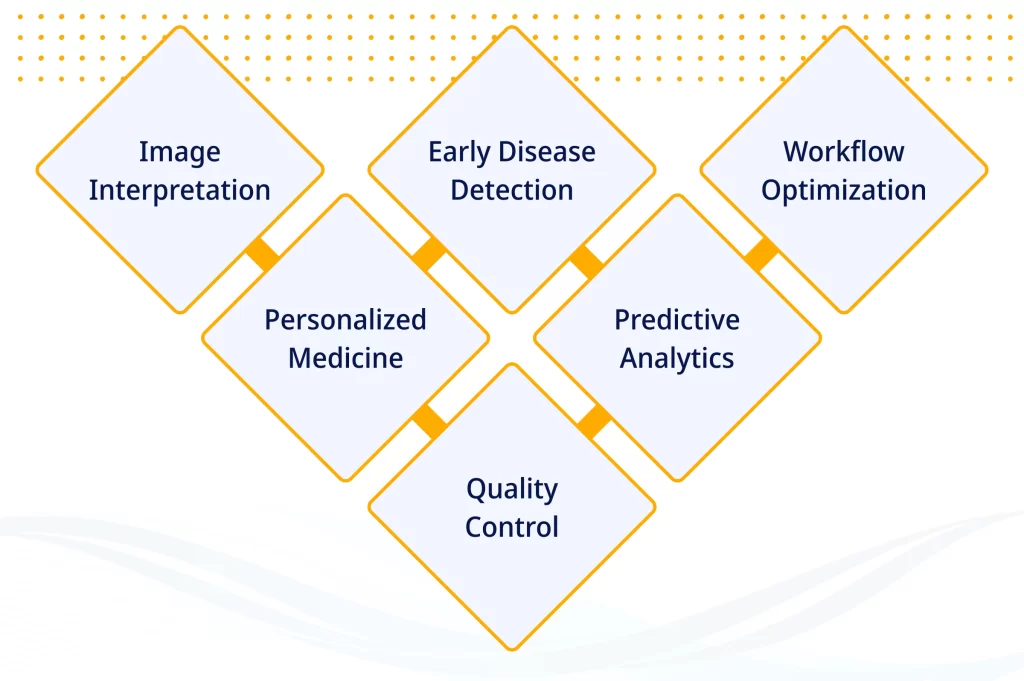
Machine Learning (ML) is making waves in radiology, bringing about transformative applications that benefit both healthcare providers and patients. Here are some key areas where Machine Learning in healthcare is making a significant impact:

Image Interpretation: ML algorithms are trained on vast datasets of medical images.

They can recognize intricate patterns and anomalies in X-rays, MRIs, and CT scans that might be imperceptible to the human eye.

This capability aids radiologists in providing faster and more accurate diagnoses.

Early Disease Detection: ML’s ability to detect subtle changes in medical images is crucial for early disease detection.

For example, in mammography, ML algorithms can identify tiny microcalcifications or early-stage tumors that might go unnoticed in traditional readings.

Detecting diseases at their inception greatly improves treatment outcomes.

Workflow Optimization: Radiology departments often face high workloads.

Machine Learning solutions help manage this by automating routine tasks like report generation and data entry.

It can also prioritize urgent cases, ensuring that radiologists focus on critical diagnoses while reducing their workload.

AI integration

Personalized Medicine: ML analyzes a patient’s medical history, genetics, and imaging results to create highly individualized treatment plans.

This approach tailors treatments to a patient’s unique needs, optimizing effectiveness and minimizing side effects.

Predictive Analytics: A Machine Learning development company can help forecast patient outcomes and the progression of diseases.

Considering historical data and patient profiles, it assists healthcare providers to informed decisions about treatment plans and adjusting interventions as needed.

Quality Control: ML continuously monitors the performance of imaging equipment.
It checks for factors like image quality, contrast, and sharpness, and alerts technicians to any deviations from the norm.

This ensures that scans are of the highest quality and reduces the need for patients to undergo additional scans due to poor image quality.

The application of machine learning in radiology collectively enhances the accuracy, efficiency, and patient-centric approach in radiology.

As ML technology evolves, it promises to usher in further advancements, ultimately leading to better healthcare outcomes and improved patient experiences.

Challenges and Considerations of ML in Radiology

While Machine Learning in radiology is revolutionizing, acknowledging the challenges and considerations that come with this transformative technology is essential. Here are some key points to ponder:

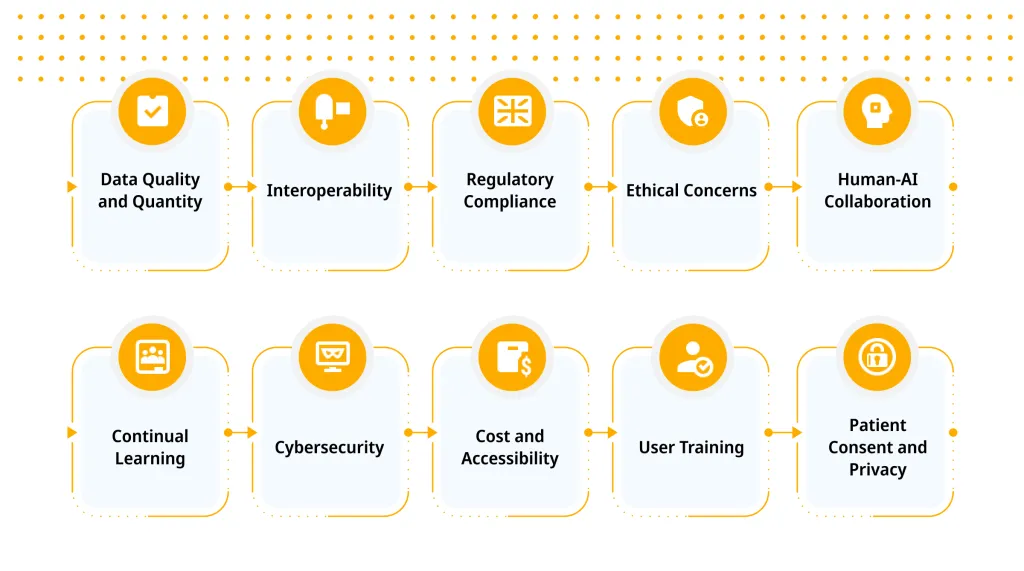
Challenges and Considerations of ML

Data Quality and Quantity: ML models rely on large and diverse datasets for training.

Ensuring that these datasets are not only extensive but also accurately represent various medical conditions and patient demographics is crucial.

Using incomplete or biased data can result in inaccurate predictions and diagnoses.

Interoperability: Healthcare institutions often use different software systems and data formats for storing medical images and patient records.

Making ML models compatible with these disparate systems can be technically complex and requires extensive data integration efforts.

Regulatory Compliance: The healthcare sector is subject to strict regulations to protect patient privacy and ensure safety.

Machine Learning applications must comply with regulations like HIPAA and GDPR.

Meeting these standards adds complexity to developing and deploying Machine Learning solutions.

Ethical Concerns: ML algorithms can inadvertently perpetuate biases in the data they are trained on.

This can lead to disparities in diagnoses or recommendations across different patient groups.

Ensuring fairness, transparency, and ethical use of Machine Learning and AI in radiology is an ongoing challenge.

Human-AI Collaboration: Radiologists need to trust and effectively collaborate with AI systems.

Building this trust, ensuring seamless integration into existing workflows, and defining the roles of humans and machines are complex considerations.

Human-AI Collaboration

Continual Learning: Medical knowledge and imaging techniques evolve over time.

ML models must adapt to these changes to maintain their accuracy.

Developing mechanisms for continual learning and updating of models is a challenge.

Cybersecurity: As more healthcare data becomes digitized and interconnected, cyberattacks and data breach risk increases.

When you hire Machine Learning engineers in India from ValueCoders, protecting patient data and ensuring the security of ML systems is paramount.

Cost and Accessibility: Implementing ML in radiology is expensive, making it difficult for smaller healthcare facilities or those in resource-constrained settings.

Ensuring that this technology is accessible and affordable for all is a challenge.

User Training: Radiologists and healthcare professionals need training to use ML systems effectively.

Bridging the knowledge gap and providing comprehensive training programs are essential for successful adoption.

Patient Consent and Privacy: Patients should be informed about how their data is used in ML applications and can consent or withhold consent for its use.

Respecting patient privacy and preferences is a critical consideration.

Addressing these challenges requires a multidisciplinary approach by a leading ML development company involving technologists, healthcare professionals, ethicists, and policymakers.

It’s a dynamic process that aims to harness the benefits of ML while safeguarding patient rights, data integrity, and the ethical use of technology in healthcare.

Future Trends and Innovations of ML in Radiology

The future of ML in radiology is incredibly exciting, with several trends and innovations on the horizon that promise to revolutionize healthcare further. Here’s a glimpse into what the future holds:

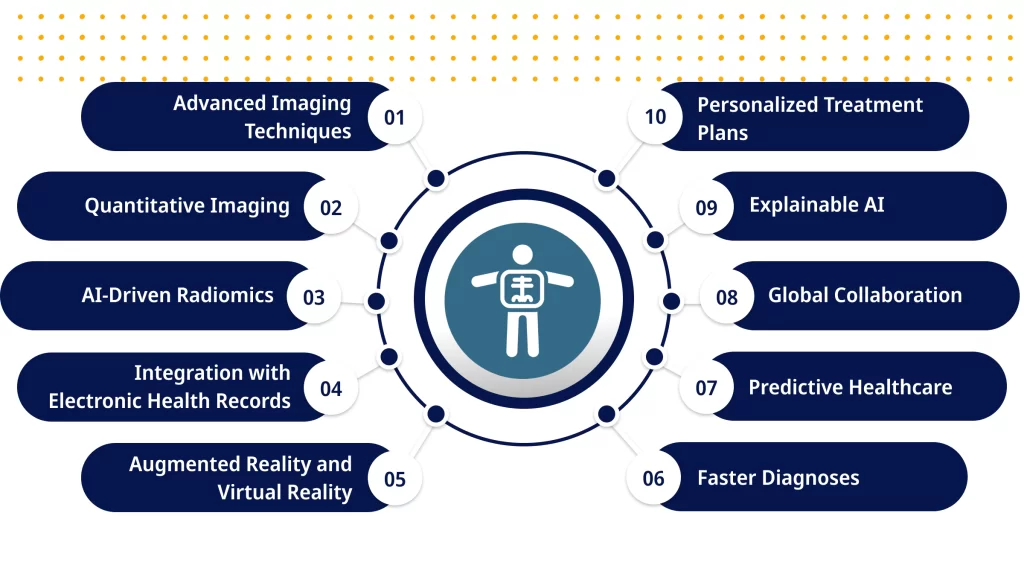
Future Trends of AI

Advanced Imaging Techniques: ML will take existing imaging methods like MRI and CT scans to the next level.

For example, it can enhance the resolution and sensitivity of these scans, enabling doctors to detect subtle abnormalities or track disease progression with greater precision.

Quantitative Imaging: Machine Learning in radiology will enable radiologists to quantify various aspects of medical images, such as measuring the exact size of a tumor, determining tissue properties like density, and calculating blood flow rates.

This quantitative data will provide a more comprehensive understanding of a patient’s condition.

AI-Driven Radiomics: Radiomics involves extracting vast information from medical images using ML algorithms. These algorithms can uncover hidden patterns and relationships within the images, helping predict how diseases behave and how patients respond to treatments.

Integration with Electronic Health Records (EHRs): ML seamlessly connects with electronic health record systems.

When radiologists examine an image, they will have instant access to a patient’s medical history, laboratory results, and other relevant data, enhancing diagnostic accuracy and treatment decisions.

Augmented Reality and Virtual Reality: Expert MLOps consulting services combined with AR and VR technologies will enable radiologists and surgeons to visualize complex anatomical structures in 3D.

This immersive experience will improve surgical planning, medical education, and training.

Faster Diagnoses: ML will continue to reduce the time it takes to analyze medical images.

Quick diagnoses can be life-saving in emergencies, such as identifying a stroke or trauma. ML will assist radiologists by rapidly highlighting critical findings.

Predictive Healthcare: Machine Learning models will become even better at predicting an individual’s disease risk from their genetic makeup, lifestyle, and medical history.

This allows for early interventions and preventive measures to reduce the likelihood of developing certain conditions.

Global Collaboration: Radiologists and data scientists worldwide will collaborate on shared datasets, improving the robustness and accuracy of ML models.

This global cooperation will drive advancements in radiology and patient care.

Explainable AI: As ML models become more complex, there will be a focus on making them transparent and interpretable.

Radiologists need to understand how AI arrives at its conclusions to trust its recommendations and make informed decisions.

Personalized Treatment Plans: ML will analyze vast amounts of patient data to recommend treatment plans tailored to each individual.

By considering genetic factors, treatment response history, and patient preferences, healthcare providers can offer highly personalized care that maximizes effectiveness and minimizes side effects.

These future trends and innovations represent a promising evolution of radiology, where ML plays a central role in improving diagnosis, treatment, and patient outcomes.

By combining the power of technology and medical expertise, radiology is poised to make significant strides in the years ahead.

Conclusion

In the ever-advancing world of healthcare, Machine Learning (ML) is the unsung hero, ushering in a new era of hope and precision.

As we explored the remarkable journey of ML in radiology, it’s crystal clear: the impact is profound, and the potential limitless.

Imagine a future where diseases are caught at their inception, treatments are tailored to individual needs, and machine learning for medical imaging becomes an art of unparalleled accuracy.

ML is the bridge to this future, enhancing image interpretation, optimizing workflows, and offering predictive insights that empower doctors and benefit patients.

But it’s not without challenges- data quality to ethical concerns. Yet, these obstacles are the stepping stones to progress.

With dedication and collaboration, we can overcome them, ensuring that ML in radiology serves everyone equitably.

The horizon looks brighter as we embrace future trends like advanced imaging techniques, augmented reality, and global collaboration.

The stethoscope of the 21st century is the algorithm, and its rhythm is one of promise and possibility.

Machine Learning in radiology isn’t just about enhancing medical imaging; it’s about enhancing lives.

It’s about earlier diagnoses, personalized treatments, and a healthier future.

So, let’s welcome this digital ally into our healthcare journey, for together, we’re painting a portrait of health that’s clearer and brighter than ever before.

AI in Financial Services: Use Cases, Benefits, and Challenges

In the ever-evolving world of finance, a transformative force is rapidly reshaping the landscape – Artificial Intelligence (AI). Unleashing its potential across the financial services sector, AI is orchestrating a revolution like never before, redefining how we manage, invest, and transact.

Embracing this wave of change, financial institutions have experienced an astonishing surge in efficiency, security, and customer satisfaction. Astonishingly, the use of AI in finance has grown by a staggering 68% in 2021 compared to 2020, as revealed by recent industry reports.

In this era of digital disruption, we embark on an enlightening journey to understand how AI for finance has carved a niche in financial services, delving into its applications, benefits, and addressing the inevitable challenges it brings. Welcome to the world where possibilities are limitless and finance meets the future!

Understanding the Impact of AI on Financial Services

Impact of AI on Financial

The integration of Artificial Intelligence (AI) has bestowed an unparalleled metamorphosis upon the realm of financial services.

Through its intricate algorithms and advanced data analytics, AI used in finance orchestrates a symphony of insights, elevating decision-making precision and propelling operational efficiency to unprecedented heights. Once confined by traditional practices, financial institutions now harness AI’s predictive prowess to forecast market trends with astonishing accuracy.

As AI service for finance industry evolves, it molds a landscape where fraud detection is fortified, customer interactions personalized, and risk management finely tuned. This dynamic shift is not just a technological advancement; it’s a transformative embrace of intelligence that resonates throughout the financial echelons, revolutionizing processes, and redefining success.

A Brief History of AI in Finance

Evolution of AI

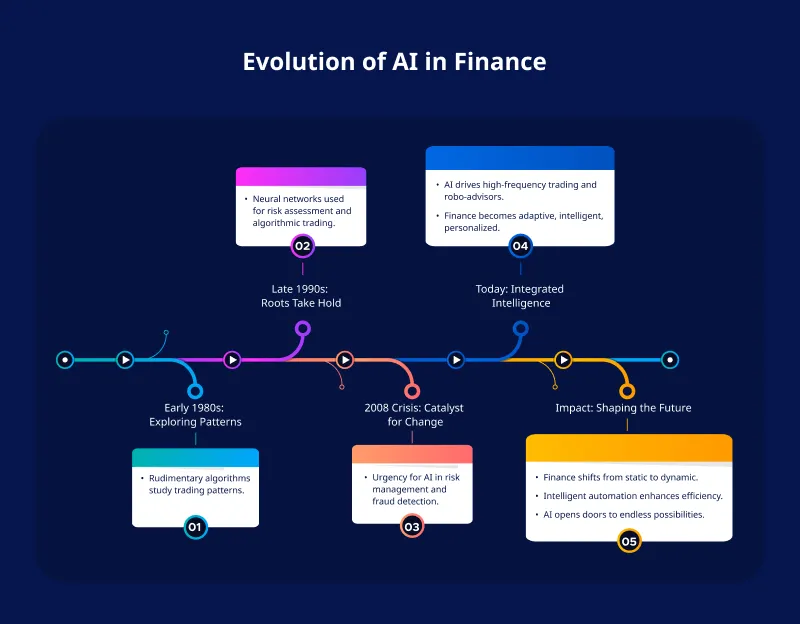
The intersection of Artificial Intelligence and finance is a captivating tale of innovation that spans decades. The inception of AI for finance can be traced back to the early 1980s when rudimentary algorithms began exploring trading patterns.

However, it wasn’t until the late 1990s that AI’s potential truly took root, with the advent of neural networks for risk assessment and algorithmic trading. In 2008, the financial crisis acted as a catalyst, compelling institutions to seek AI-powered solutions for risk management and fraud detection.

Fast forward to today, AI solutions for finance business has woven itself intricately into the fabric of finance, steering high-frequency trading, powering robo-advisors, and even sculpting personalized financial recommendations. This evolutionary journey underscores AI’s profound impact on financial landscapes, transforming them from static to adaptive and from manual to intelligent, ushering in a new era of possibilities.

AI Applications in Financial Services

The revolution has brought myriad benefits of AI in finance to institutions and clients alike. It’s reshaped service delivery and management from fraud detection to personalized planning. Let’s delve into AI’s critical roles in finance.

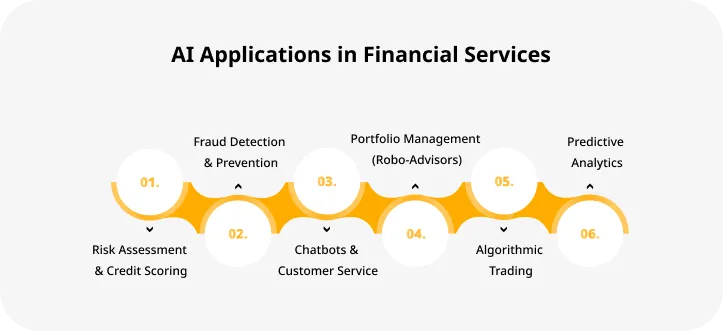
AI in Financial Services

Use Case #1 – Risk Assessment & Credit Scoring:

In the financial world, assessing risk and determining creditworthiness is paramount. Traditional methods often rely on limited data sets and can sometimes be subjective. Enter AI, which offers a more comprehensive and objective approach.

Challenges:

  • Limited data sources leading to incomplete risk profiles.
  • Historical biases affecting credit decisions.
  • Time-consuming manual review processes.

Solution:

AI algorithms can analyze vast amounts of data, from transaction histories to social media activity, to predict creditworthiness more accurately. This not only speeds up the decision-making process but also reduces biases.

Real-world example:

ZestFinance, an AI tool, improved loan approval rates by analyzing thousands of data points, leading to more accurate risk assessments without increasing defaults.

Use Case #2 – Fraud Detection & Prevention:

Financial fraud is a growing concern, with cybercriminals employing sophisticated methods to breach systems.

Challenges:

  • Rapidly evolving fraud techniques.
  • High false-positive rates leading to blocked legitimate transactions.
  • Delayed fraud detection resulting in financial losses.

Solution:

AI can monitor transactions in real-time, identifying unusual patterns or behaviors that might indicate fraudulent activity. It can adapt to new fraud techniques, ensuring robust protection.

Real-world example:

Mastercard uses AI systems to analyze transactions. This has reduced fraudulent transactions by a significant percentage, ensuring both customer trust and financial security.

Use Case #3 – Chatbots & Customer Service:

In today’s digital age, customers expect instant responses to their queries.

Challenges:

  • Handling high volumes of customer queries.
  • Providing consistent and accurate information.
  • Offering personalized customer interactions.

Solution:

AI-driven chatbots can handle multiple queries simultaneously, provide accurate information based on vast data sets, and offer personalized solutions by learning from past interactions.

Real-world example:

Bank of America’s chatbot, Erica, serves millions of customers, answering queries and providing financial advice, leading to enhanced customer satisfaction.

Use Case #4 – Portfolio Management (Robo-Advisors):

Investment strategies are crucial for financial growth, but not everyone has access to expert advice.

Challenges:

  • Providing personalized investment advice.
  • Adapting to rapidly changing market conditions.
  • Handling vast amounts of financial data.

Solution:

AI-driven robo-advisors analyze market conditions, individual preferences, and vast data sets to provide tailored investment strategies.

Real-world example:

Betterment, a popular robo-advisor platform, manages billions in assets, offering personalized investment strategies based on AI-driven insights.

Use Case #5 – Algorithmic Trading:

Introduction:

Trading in the financial markets requires speed, accuracy, and strategy.

Challenges:

  • Executing large orders without affecting market prices.
  • Adapting to real-time market changes.
  • Analyzing vast amounts of market data for decision-making.

Solution:

AI can execute trades based on predefined criteria, analyze real-time data, and adapt strategies instantaneously.

Real-world example:

Two Sigma, a hedge fund, employs AI-driven trading strategies, leading to significant returns and a competitive edge in the market.

Use Case #6 – Predictive Analytics:

Forecasting market trends is essential for making informed investment decisions.

Challenges:

  • Analyzing vast and varied data sources.
  • Adapting to rapidly changing market conditions.
  • Providing timely and actionable insights.

Solution:

AI models can analyze historical and real-time data, offering forecasts that help investors make informed decisions.

Real-world example:

JPMorgan Chase uses AI models to improve its market predictions, leading to better investment strategies and higher returns for its clients.

Benefits of AI Integration in Financial Services

Incorporating Artificial Intelligence (AI) into financial services has ignited a transformative journey, bestowing various advantages that redefine the industry landscape.

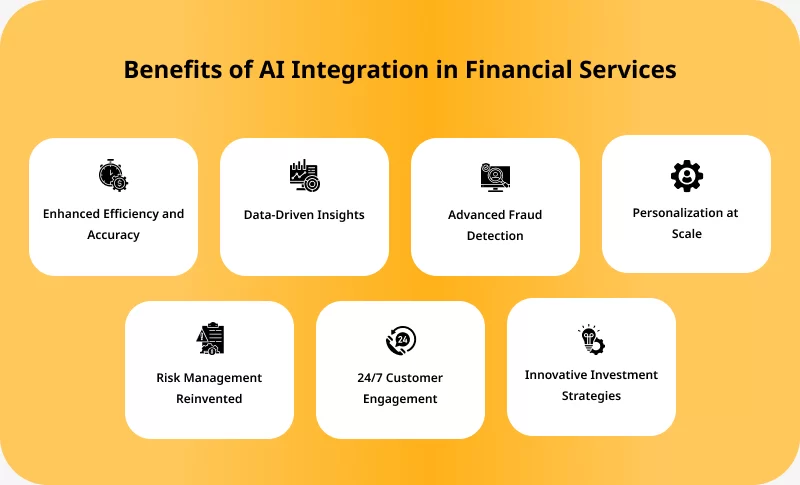
Benefits of AI

Enhanced Efficiency and Accuracy: AI’s algorithms process vast datasets at lightning speed, facilitating rapid decision-making with minimal errors. This efficiency not only expedites operational processes but also reduces the risk of human-induced mistakes, leading to cost savings of up to 30%.

Data-Driven Insights: AI’s data analytics capabilities unearth actionable insights from complex data sets, guiding institutions toward more informed strategies. This empowers professionals to anticipate market trends, adjust risk management, and craft personalized financial plans, resulting in heightened profitability and client satisfaction.

Advanced Fraud Detection: AI solution for finance businesses strengthens fraud detection mechanisms by detecting subtle transaction patterns and anomalies. This proactive approach mitigates potential losses, saving institutions an estimated $4.5 billion annually, while bolstering customer trust and loyalty.

Personalization at Scale: AI enables institutions to tailor services to individual preferences and needs. Whether recommending investment options or optimizing financial plans, AI-driven personalization fosters deeper client relationships, reflected in a 35% increase in client retention rates.

Risk Management Reinvented: The benefits of AI in finance include predictive models that offer unparalleled risk assessment, empowering institutions to assess and mitigate risks in real-time. This ensures the preservation of assets, even in volatile markets, and bolsters compliance efforts.

24/7 Customer Engagement: AI-powered chatbots deliver round-the-clock customer support, answering queries and processing transactions promptly. This seamless interaction enhances customer experience and accessibility, contributing to a 40% reduction in customer service costs.

Innovative Investment Strategies: AI-driven algorithms identify investment opportunities and execute trades with precision, adapting to market fluctuations swiftly. This agility fosters robust portfolios and increased returns for both institutions and clients.

The use of AI in finance catalyzes an era of innovation, propelling institutions beyond conventional boundaries and ushering in a future where efficiency, accuracy, and customer-centricity reign supreme.

Challenges and Concerns Surrounding AI in Finance

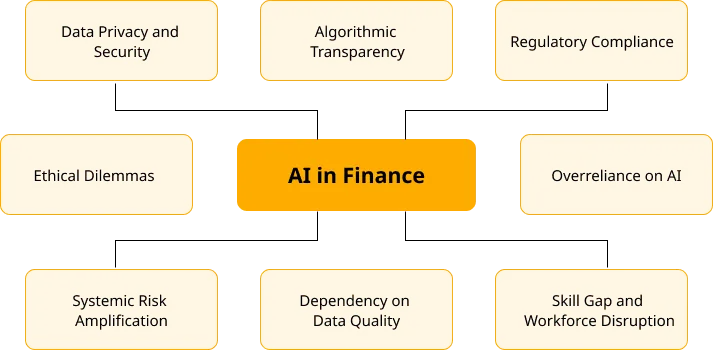
While the integration of Artificial Intelligence (AI) has undeniably revolutionized the financial sector, it is not without its share of intricate challenges and concerns that demand careful consideration.

AI in Finance

Data Privacy and Security: The huge amounts of sensitive financial data AI processes raise valid concerns about privacy and security. Safeguarding this information against breaches and unauthorized access remains a paramount challenge, necessitating robust encryption and stringent protocols.

Algorithmic Transparency: As AI’s decision-making becomes more intricate, the opacity of algorithms poses a challenge in comprehending how certain financial judgments are made. Ensuring transparency and interpretability is essential to avoid bias and maintain accountability.

Regulatory Compliance: The dynamic nature of AI for finance often outpaces existing regulations, creating a regulatory lag. Striking a balance between innovation and compliance is crucial to prevent potential legal and ethical pitfalls.

Ethical Dilemmas: AI’s automation can inadvertently lead to ethical dilemmas, such as bias in lending practices or displacing human workers. Striving for fairness, accountability, and the ethical use of AI technology becomes imperative.

Systemic Risk Amplification: AI’s interconnectedness across financial markets could amplify systemic risks, potentially leading to cascading failures. Effective risk management strategies must be devised to mitigate such scenarios.

Dependency on Data Quality: AI’s efficacy relies heavily on the quality and accuracy of data it processes. Poor data quality can lead to skewed insights and erroneous decisions, underscoring the need for comprehensive data governance.

Skills Gap and Workforce Disruption: The advent of AI solutions for finance business could shift required skill sets, potentially displacing some traditional finance roles. Nurturing a workforce with the right blend of AI-related skills and financial expertise becomes a pressing concern.

Overreliance on AI: An overreliance on AI without human oversight can lead to overconfidence in algorithmic decisions. Striking the right balance between automation and human judgment is crucial to prevent catastrophic errors.

Addressing these multifaceted challenges requires a collaborative effort between financial institutions, regulators, and AI experts. While the potential and benefits of AI in finance are boundless, a vigilant approach is necessary to navigate the complexities and ensure a sustainable, secure, and ethically sound future.

Conclusion

In the realm of AI for finance, Artificial Intelligence (AI) has kindled a revolution that reverberates through every facet of the industry. From fraud detection to personalized planning, AI’s impact is profound, reshaping practices and elevating services.

With enhanced efficiency, data-driven insights, and advanced risk management, the future promises hyper-personalization, interconnected ecosystems, and an AI-augmented workforce.

At this crossroads, ValueCoders is committed to driving this transformation forward, ensuring ethical, responsible, and innovative integration of AI solutions for finance business services. Join us in shaping a future where finance meets intelligence.

Experience the Future Today!

Juara288
Juara288
asupantoto
asupantoto
nolimithoki
nolimithoki
slot gacor malam ini
slot gacor
slot gacor malam ini
nolimithoki
nolimithoki

Use of AI in Building Autonomous Vehicles

In the realm of modern transportation, a technological revolution is unfolding, and at its heart lies the groundbreaking integration of Artificial Intelligence (AI) in building autonomous vehicles. With a myriad of use cases propelling the AI services for automotive industry forward, AI is reshaping how we envision the future of transportation.

Interestingly, the AI boom is entering the automotive industry, much like in other sectors. Companies like Tesla, Volvo, BMW, and Volkswagen have harnessed AI for autonomous vehicles to enhance their operational mechanics, making driving more convenient and efficient. Together, we drive into a future where AI empowers safer, smarter, and more connected autonomous vehicles.

According to a study, widespread adoption of self-driving vehicles in the U.S. could reduce auto accidents by 90%, saving up to $190 billion in damages and health costs annually while preventing thousands of fatalities. However, it’s crucial to acknowledge that self-driving cars aren’t flawless, and accidents may still occur.

As Artificial Intelligence in autonomous vehicles continues to evolve, these vehicles are not only navigating roads but also redefining mobility as we know it. Join us as we delve into the compelling world of AI-driven autonomous vehicles and uncover the transformative potential they hold.

AI in the Automotive Industry: An Overview

AI in Automotive

The automotive industry is experiencing a seismic shift in integrating Artificial Intelligence (AI) into its core operations.

AI, the simulation of human intelligence in machines, is revolutionizing how vehicles are designed, manufactured, driven, and serviced. Its impact extends across various domains, from autonomous driving systems that promise safer roads and reduced accidents to predictive maintenance that optimizes vehicle performance and minimizes downtime.

AI-driven technologies like machine learning and computer vision enable cars to perceive their environment, make real-time decisions, and navigate complex road conditions. These advancements are steering the industry towards a future of self-driving cars, transforming urban mobility, and redefining transportation paradigms.

Moreover, the use of Artificial Intelligence in automotive industry enhances the in-car experience with natural language processing (NLP) interfaces, voice commands, and personalized recommendations. Additionally, AI-powered smart manufacturing optimizes production processes, ensuring greater efficiency and quality.

As AI technology evolves, the automotive industry is poised for unparalleled advancements, unlocking new possibilities and creating a safer, more connected, and sustainable future for mobility.

AI Use Cases in the Automotive Industry

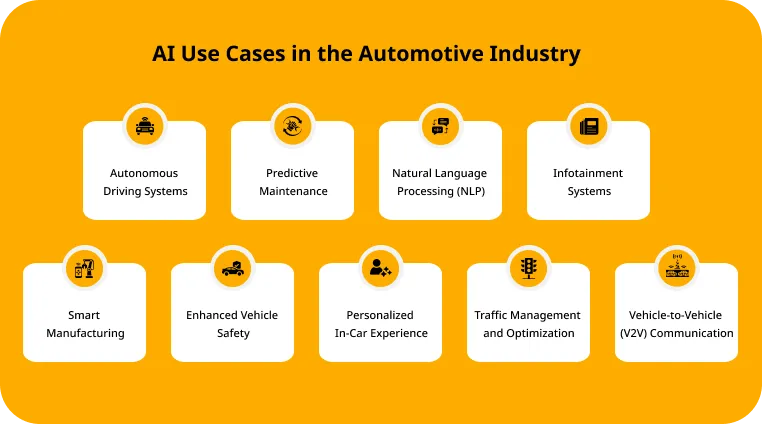
The automotive industry is rapidly embracing Artificial Intelligence for autonomous vehicles across various use cases, revolutionizing how vehicles are designed, manufactured, and driven. Here are some compelling AI use cases in the automotive sector:

Autonomous Driving Systems: Cutting-edge algorithms like deep learning and computer vision empower cars to perceive their surroundings, make real-time decisions, and navigate challenging road conditions. The ultimate goal is to revolutionize road safety, minimize accidents, and build a more efficient and seamless transportation system. With AI as the driving force, the future of autonomous vehicles looks promising and transformative.

Predictive Maintenance: AI-driven predictive maintenance helps AI solutions for autonomous vehicles optimize vehicle performance and reduce downtime. By analyzing vast amounts of sensor data and historical records, AI algorithms can predict potential breakdowns, enabling timely maintenance and preventing costly repairs.

Natural Language Processing (NLP) in Infotainment Systems: AI-powered NLP enables a more intuitive and interactive user experience within vehicles. Drivers and passengers can use voice commands to control various functions, access information, and even engage with virtual assistants for navigation and entertainment.

Smart Manufacturing: AI streamlines manufacturing by enhancing automation, quality control, and supply chain management. AI-driven robots and smart machines work collaboratively with human workers to boost productivity, reduce errors, and optimize resource utilization.

Join the Green Drive

Dive into AI's solutions for eco-friendly vehicles.

Enhanced Vehicle Safety: AI in autonomous vehicles contributes to developing advanced driver assistance systems (ADAS), including features like lane-keeping assistance, automatic emergency braking, and adaptive cruise control. These AI-powered safety systems provide additional protection for drivers and pedestrians alike.

Personalized In-Car Experience: AI tailors the in-car experience to individual preferences, creating a more personalized and comfortable environment for drivers and passengers. From adjusting seat positions and climate control to suggesting preferred routes, AI enhances the overall driving experience.

Traffic Management and Optimization: AI for autonomous vehicles helps optimize traffic flow in congested urban areas by analyzing real-time traffic data and suggesting alternate routes. This reduces travel time, minimizes fuel consumption, and lowers emissions, contributing to a more sustainable transportation ecosystem.

Vehicle-to-Vehicle (V2V) Communication: AI facilitates seamless communication between vehicles, enabling them to exchange critical information about road conditions, potential hazards, and traffic patterns. This cooperative intelligence enhances overall road safety and efficiency.

These AI use cases demonstrate the immense potential of artificial intelligence in autonomous vehicles for shaping the future of the automotive industry, making transportation safer, more efficient, and increasingly connected. As AI technologies advance, the automotive sector is poised to undergo a transformative journey, empowering vehicles to become smarter and more capable than ever before.

Benefits of AI in the Automotive Industry

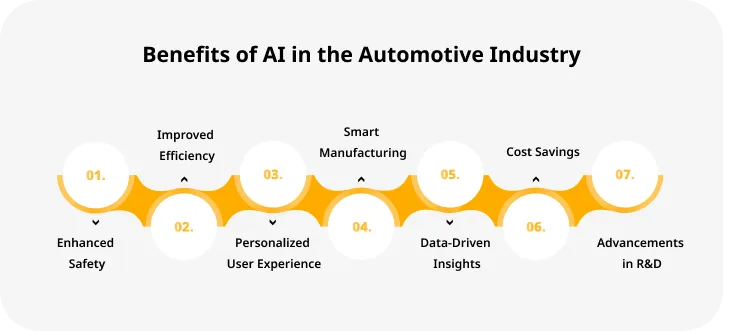
Integrating AI services for automotive industry brings forth many benefits, revolutionizing how we interact with vehicles and transforming the entire transportation landscape. Some of the key advantages include:

Benefits of AI

Enhanced Safety: AI-powered autonomous driving systems have the potential to reduce accidents and fatalities on the roads significantly. These systems can analyze vast amounts of data in real-time, enabling vehicles to make split-second decisions, identify potential hazards, and respond to changing road conditions faster and more accurately than human drivers.

Improved Efficiency: AI optimizes vehicle performance and fuel efficiency through predictive maintenance and smart driving algorithms. AI can predict maintenance needs by analyzing data from sensors and historical records, preventing unexpected breakdowns and reducing downtime.

AI in autonomous vehicles also aids in optimizing traffic flow, reducing congestion, and minimizing fuel consumption, contributing to a more sustainable and eco-friendly transportation system.

Personalized User Experience: AI tailors the in-car experience to individual preferences, providing personalized recommendations for navigation, entertainment, and comfort. Voice-controlled infotainment systems, virtual assistants, and intuitive interfaces create a seamless and user-friendly environment for drivers and passengers.

Smart Manufacturing: AI-driven automation in the manufacturing process streamlines production, improves quality control, and optimizes resource utilization. AI-powered robots and machines work alongside human workers, enhancing productivity and ensuring precision in assembly lines.

Data-Driven Insights: AI enables automotive companies to gather and analyze vast amounts of data from connected vehicles, allowing them to gain valuable insights into customer behavior, usage patterns, and driving habits. This data-driven approach empowers companies to make informed decisions, develop targeted marketing strategies, and enhance product offerings based on customer needs.

Cost Savings: With AI-driven predictive maintenance and optimized operations, automotive companies can reduce maintenance costs, improve vehicle reliability, and prolong the lifespan of critical components. Additionally, AI-powered logistics and supply chain management lead to more efficient inventory management and reduced operational expenses.

Advancements in R&D: AI accelerates research and development in the automotive sector by simulating driving scenarios, testing prototypes in virtual environments, and facilitating rapid iteration and improvement. This expedites the development of innovative technologies and new vehicle models.

Overall, the benefits of Artificial Intelligence in the automotive vehicles industry are far-reaching, promising safer roads, improved efficiency, enhanced user experiences, and a more sustainable future of transportation. As AI technology evolves, the automotive sector stands poised for continued growth and transformative advancements.

Future of AI in the Automotive Industry

The future of AI services for the automotive industry holds a world of possibilities, paving the way for remarkable advancements and reshaping how we perceive transportation. As technology continues to evolve, AI is set to play an even more significant role in various aspects of the automotive sector:

Future of AI

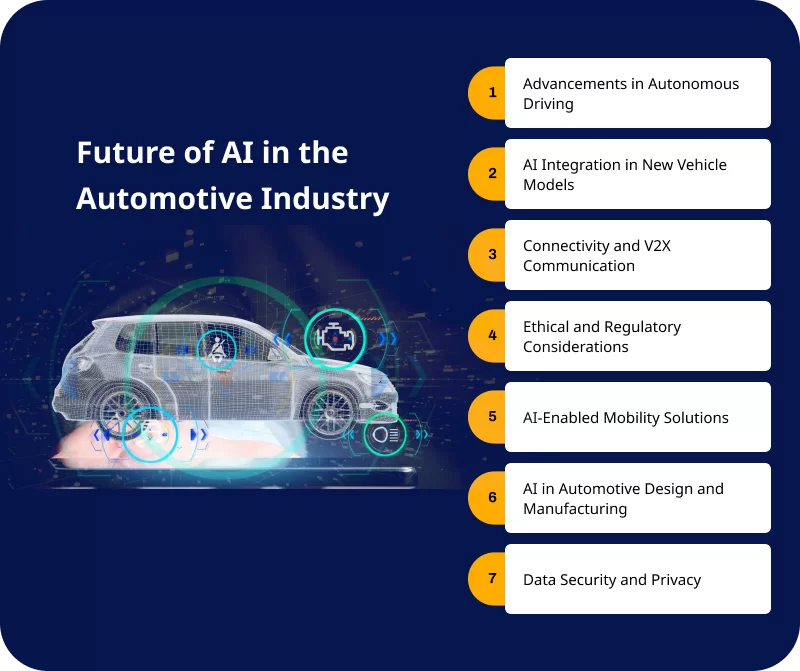
Advancements in Autonomous Driving: AI-driven autonomous vehicles are on the brink of becoming a mainstream reality. With ongoing research and development, self-driving cars are expected to achieve higher levels of autonomy, navigating complex urban environments and adverse weather conditions with improved precision and safety.

AI Integration in New Vehicle Models: As AI technologies mature, they are expected to become standard features in upcoming vehicle releases. From entry-level cars to luxury models, AI-driven functionalities, such as advanced driver assistance systems (ADAS) and in-car infotainment, will be incorporated to enhance user experiences and road safety.

Connectivity and V2X Communication: Vehicle-to-everything (V2X) communication will flourish, enabling vehicles to interact not only with each other (V2V) but also with infrastructure (V2I) and pedestrians (V2P). This interconnectedness will lead to a more efficient and safer transportation ecosystem, with AI facilitating seamless communication and cooperative decision-making.

Ethical and Regulatory Considerations: As AI in autonomous vehicles becomes more pervasive, ethical and regulatory concerns will garner increased attention. Industry stakeholders, policymakers, and researchers will collaborate to establish guidelines for responsible AI development and deployment, ensuring safety, privacy, and transparency.

AI-Enabled Mobility Solutions: Beyond personal vehicles, AI will drive the development of innovative mobility solutions. AI-powered ride-sharing and on-demand transportation services will offer more efficient and sustainable ways of getting around cities, reducing traffic congestion and carbon emissions.

AI in Automotive Design and Manufacturing: AI will transform the automotive design process, automating tasks like generative design, reducing time-to-market, and creating vehicles optimized for performance, safety, and aesthetics. In manufacturing, AI-driven robotics and adaptive production lines will enhance flexibility and precision, enabling quicker adaptation to market demands.

Data Security and Privacy: As connected vehicles generate vast amounts of data, ensuring data security and user privacy will become paramount. AI-driven solutions for data encryption, anomaly detection, and user consent management will be essential in safeguarding sensitive information.

The future of AI in the automotive vehicles industry holds boundless potential, ushering in an era of safer, more efficient, and connected transportation. As research and innovation continue, AI will play a pivotal role in transforming travel, shaping smart cities, and creating a sustainable mobility landscape for future generations.

Join the Green Drive

Dive into AI's solutions for eco-friendly vehicles.

Conclusion

In the relentless pursuit of safer roads, efficient transportation, and a connected future, AI services for autonomous vehicles have emerged as the driving force in building autonomous vehicles. From cutting-edge autonomous driving systems to personalized in-car experiences, the automotive industry embraces AI’s transformative potential with open arms.

As we stand on the precipice of a mobility revolution, the future holds promises of self-driving cars navigating bustling city streets, seamlessly communicating with one another, and elevating our daily journeys.

Embrace the incredible possibilities of AI in the automotive world, and join us in shaping a future where transportation knows no bounds. Together, let’s drive into tomorrow with AI-powered autonomous vehicles at the forefront of innovation!

Trusted by Startups and Fortune 500 companies

pixel

20+ years of experience

We can handle projects of all complexities.

pixel

4500+ satisfied customers

Startups to Fortune 500, we have worked with all.

pixel

675+ in-house experts

Top 1% industry talent to ensure your digital success.

  • Valuecoders
  • Valuecoders
  • Valuecoders

Book Free Consultation

Guaranteed response within 8 business hours.

Error Message
Error Message
Error Message
Error Message
Error Message
Error Message