


Before every successful AI feature, there is a period of quiet preparation. Data is mapped. Infrastructure is reviewed. Teams align on what success actually means.
On the other hand, failed AI initiatives often show a pattern of rushed activity.
- Tools are selected without checking system fit
- Demos use sample data, not real data
- Data quality is not validated
- No team owns the delivery end-to-end
- The integration effort is not clearly planned
This guide focuses on the preparation that’s often skipped. The practical AI readiness checklist will help engineering and product teams build once and build correctly.
Get expert support across AI integration, backend systems, workflows, and deployment planning.
What Is AI Readiness?
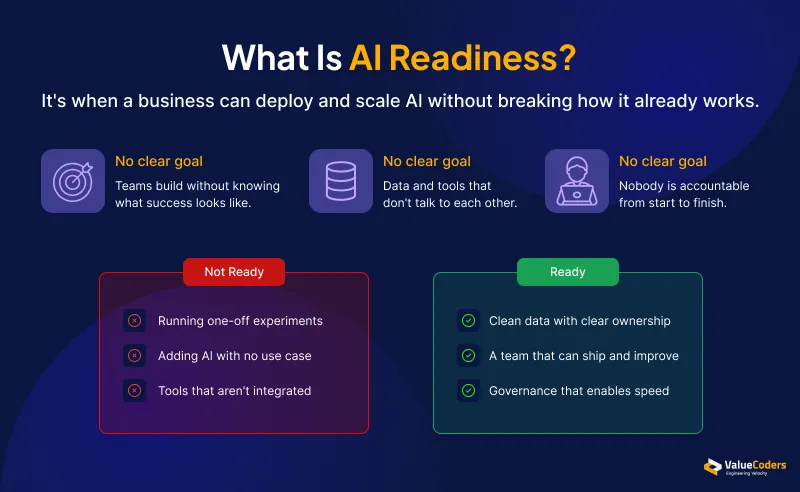
AI readiness means a business can deploy and scale AI systems without disrupting security, governance, or operational workflows.
Many teams can prototype AI quickly, but production deployment introduces integration, governance, and operational complexity.
Three common issues prevent AI readiness for businesses:
- Undefined use cases: Teams start building without a clear outcome or measurable goal.
- Disconnected systems: Data and tools do not work together, which slows delivery.
- No clear ownership: No single team is responsible for end-to-end execution.
What AI readiness is NOT
- Running a one-off experiment
- Adding AI without a clear use case
- Using tools without an integration plan
What AI readiness actually IS
- Clean, accessible data with clear ownership
- A team that can deliver, monitor, and improve
- Governance that balances speed with control
Without these, AI efforts do not scale. With these in place, teams move from experimentation to real business impact.
What Should an AI Readiness Checklist Include in 2026?
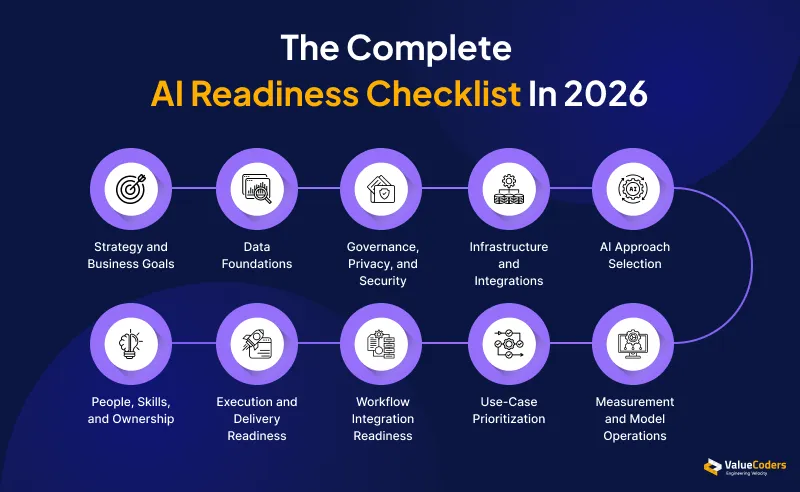
An AI readiness test helps businesses evaluate whether their systems, data, teams, and workflows are prepared for successful AI deployment. This AI readiness checklist focuses on the full system around AI, not just tools or models. Each section highlights what to review before moving into development.
1. Strategy and Business Goals
Every AI initiative should start with a clear business objective. Without this, teams build features that do not deliver measurable value.
- Define the problem clearly
- Set a 90-day success outcome
- Focus on measurable business impact
- Avoid AI without a clear purpose
2. Data Foundations
Data quality directly impacts AI performance. If data is not reliable, outputs will not be reliable.
- Identify where data is stored
- Check data quality and consistency
- Define ownership and access
- Review structured and unstructured data
If the data is not ready, output quality degrades.
3. Governance, Privacy, and Security
AI systems often work with sensitive data. Governance helps reduce risk and avoid delays during deployment.
- Define what data can be used
- Set access control and permissions
- Review compliance requirements
- Secure prompts, outputs, and logs
Also Read – RAG, Chatbots, or Workflow Automation? Choosing the Right AI Approach
4. Infrastructure and Integrations
Many AI projects fail during implementation due to weak integration. Systems should support reliable data exchange and integration workflows.
- Review current architecture
- Check API availability
- Assess integration complexity
- Plan workflow orchestration
Many AI projects fail at integration, not ideas.
5. AI Approach Selection
Choosing the right approach helps control cost and complexity. Not every use case needs a custom model.
- Evaluate RAG, chatbots, or automation
- Decide between build vs integrate
- Align approach with use case needs
Use of Generative AI Services can reduce development effort and speed up delivery.
Discuss your current setup and next steps with our AI specialists
6. People, Skills, and Ownership
AI delivery requires alignment across teams. Without ownership, progress becomes inconsistent.
- Assign clear ownership
- Align business and technical teams
- Ensure basic AI understanding
- Plan rollout and adoption
7. Execution and Delivery Readiness
Teams need a clear delivery structure to move forward.
- Define the delivery process
- Plan coordination across teams
- Assign integration ownership
- Set release and iteration cycles
8. Workflow Integration Readiness
AI should support real workflows, not operate in isolation. Integration defines actual value.
- Map AI into existing workflows
- Avoid standalone AI features
- Ensure end-to-end flow works
A clear AI integration roadmap helps connect systems and processes.
Also Read – The Real Cost of AI Development: Is It Worth the Investment?
9. Use-Case Prioritization
Not every idea should be built first. Teams should focus on use cases that deliver value quickly.
- Evaluate business impact
- Check data availability
- Assess complexity and risk
- Prioritize speed to outcome
10. Measurement and Model Operations
AI systems need continuous monitoring after deployment. Without this, performance may decline.
- Define success metrics
- Validate outputs regularly
- Monitor performance and issues
- Plan for updates and changes
Why AI Projects Slow Down During Implementation
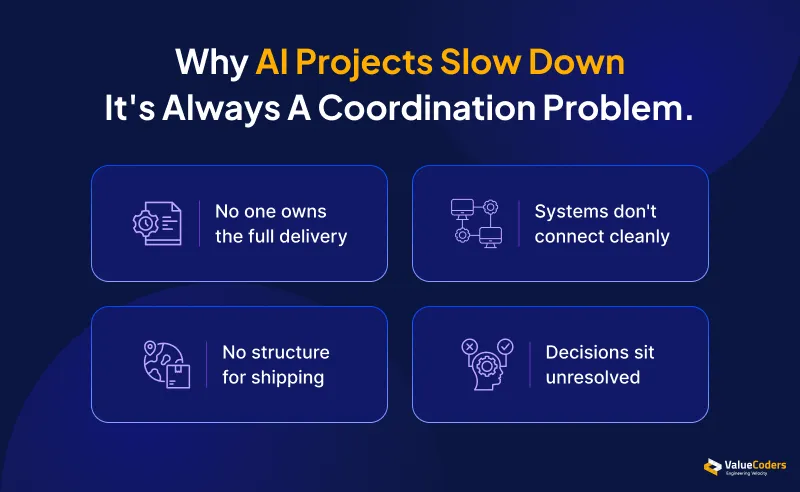
Many teams complete an AI readiness assessment and define a roadmap. But execution still slows down. The challenge is coordination across systems, teams, and workflows.
AI delivery requires more than development. It involves data handling, model integration, backend systems, and user-facing layers.
Based on enterprise AI delivery experience, most delays happen during integration across APIs, workflows, and internal systems.
Common challenges teams face:
- Fragmented ownership across teams
- Delays in system integration
- Lack of a clear delivery structure
- Slow decision-making during execution
These issues increase timelines and lead to rework, even when the use case is clear.
Working with the right partner helps bring structure to execution. It ensures that planning moves into delivery without unnecessary delays.
When a partner adds value:
- Clear ownership across the project
- Faster coordination between systems
- Structured delivery and release cycles
- Reduced rework and delays
The goal is not to replace internal teams. It is to support execution where coordination becomes complex.
Also Read – AI Integration vs AI Development: Why Most Projects Fail at the Integration Layer
How ValueCoders Helps You Become AI Ready
Being AI-ready requires structured execution across data, systems, and workflows. This is where many teams slow down.
At ValueCoders, we help teams move from readiness to delivery.
We also support implementation through Generative AI Integration Services, ensuring that AI solutions connect with real systems and workflows without disruption.
When you partner with us, you gain:
- One integrated team across AI, backend, and frontend
- Clear ownership and structured delivery process
- Faster integration across existing systems
- Consistent progress with defined milestones
As an AI Development Company, our focus is on execution that works in real environments. This helps teams move beyond pilots and deliver AI solutions that scale.
Get clarity on your use case, systems, and next steps with our team
FAQs:
What is an AI readiness checklist?
Ans. An AI readiness checklist helps businesses check if they are ready to use AI. It covers goals, data, systems, security, team ownership, and workflow planning before starting.
How do you perform an AI readiness assessment?
Ans. An AI readiness assessment checks your current data, systems, workflows, and business goals. It helps find gaps before starting AI development.
What is an AI readiness test?
Ans. An AI readiness test shows how ready your business is for AI. It checks data quality, system connections, team support, and delivery planning.
Why do AI projects fail after demos?
Ans. AI projects often fail after demos because real systems are more complex. Poor data, weak system connections, and unclear team ownership are common reasons.
What should an AI integration roadmap include?
Ans. An AI integration roadmap should include use cases, system planning, data flow, team ownership, security, and launch steps. It helps AI work with your existing systems.
How do businesses prepare for generative AI adoption?
Ans. Businesses prepare by choosing clear use cases, improving data quality, securing systems, and assigning the right team. A good plan helps AI work smoothly in daily operations.