


Most software partners look credible during the sales process.
The real test comes later, during a cloud migration, a critical release cycle, or when delivery demands begin exceeding internal capacity.
That’s when gaps in accountability, visibility, and execution begin to emerge.
For CTOs, founders, and product leaders, choosing a trusted software development partner is about more than technical expertise.
As delivery complexity grows, the focus shifts from engineering capability to operational maturity.
This becomes especially important when:
- Roadmap velocity slows despite hiring
- Platform complexity outpaces internal capacity
- Previous outsourcing engagements underperform
- Cloud modernization impacts customer-facing systems
- Distributed development teams become harder to manage
At that stage, the question is no longer whether a partner can build software. It’s whether they can deliver with structure, ownership, visibility, and consistency under pressure.
This article explores the operational signals experienced buyers use to evaluate trusted software development partners beyond ratings, reviews, and portfolio presentations.
Why Do Reviews Fail as a Reliability Signal?
Reviews Measure Satisfaction, Not Delivery Discipline
Most review platforms are designed to validate overall client experience.
They typically reflect:
- responsiveness,
- communication quality,
- project satisfaction,
- and relationship management.
Useful signals, but incomplete ones.
What they rarely capture is how the engineering organization actually functions once delivery becomes difficult. Buyers do not see governance maturity. They do not see escalation quality during production issues. They do not see whether architecture decisions were reviewed properly six months into the engagement.
A software development company can maintain excellent review scores while still struggling operationally with:
- Scaling engineering delivery
- Maintaining continuity
- Managing technical debt
- Handling evolving scope across multiple stakeholders
Get free consultation and let us know your project idea to turn it into an amazing digital product.
Reliability Starts with Governance, Not Talent
The strongest development partners build operational discipline into the engagement from day one.
Even an experienced agile development team can struggle when:
- Ownership boundaries are unclear.
- Delivery priorities shift without governance.
- Architectural decisions are disconnected across workstreams.
- Escalation happens too late to prevent downstream impact.
These operational gaps rarely appear in reviews or rating platforms, yet they often determine whether a project remains predictable six months into delivery.
That is where the difference between a staffing vendor and a governed engineering partner becomes clear.
One provides additional capacity. The other provides the structure, accountability, and engineering oversight required to sustain delivery quality over time.
Also Read – How a US Dev Agency Lifted Margins by 40% With Strategic Channel Partnerships
How Experienced CTOs Evaluate Development Partners Beyond Reviews
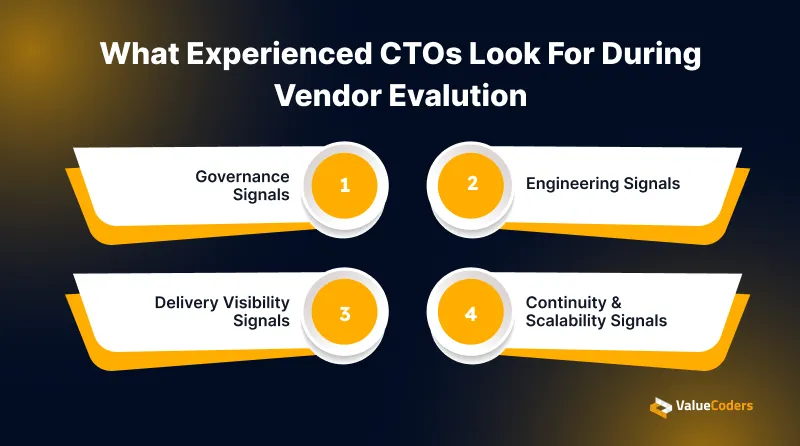
As delivery pressure increases, buyers start looking at how the engineering organization actually functions:
- How delivery visibility is maintained
- How architectural decisions are governed
- How risks are escalated
- Whether execution remains stable
At this stage, vendor evaluation shifts from assessing capabilities to operational maturity.
Most software delivery failures don’t appear during onboarding. They surface later, during release pressure, infrastructure scaling, shifting priorities, complex integrations, or unclear ownership.
Experienced buyers, therefore, focus less on promises and more on the systems that support consistent delivery.
Governance Signals
Reliable partners should be able to clearly explain:
- Who owns delivery accountability day to day?
- What governance cadence exists weekly?
- How are blockers escalated internally?
- What happens operationally if timelines begin slipping?
- How engineering and business stakeholders remain aligned.
Engineering Signals
Technical leadership involvement is often one of the strongest indicators of delivery maturity.
Buyers should evaluate:
- whether technical leadership remains involved after onboarding,
- who governs architecture decisions,
- how code reviews and deployment quality are managed,
- and how engineers are onboarded into existing delivery teams.
Also Read – How to Build a Dedicated Development Team in 4 Weeks
Delivery Visibility Signals
Strong software development collaboration depends on visibility.
Buyers should understand:
- Where delivery work is managed
- How dependencies are tracked
- What reporting visibility exists
- How delivery risks are surfaced before they become escalation issues
The objective is fewer surprises.
Continuity & Scalability Signals
As engineering initiatives grow, continuity becomes increasingly important.
Buyers should evaluate:
- How stable are the assigned dedicated development teams
- What happens during engineer transitions
- How delivery scales without disrupting continuity
- The possibility of a structured ownership model as the engagement expands
Those operational signals typically reveal far more about long-term reliability than marketplace ratings, testimonials, or sales presentations.
Work with engineering teams that prioritize governance, continuity, and predictable delivery outcomes.
The Delivery Pressure Test
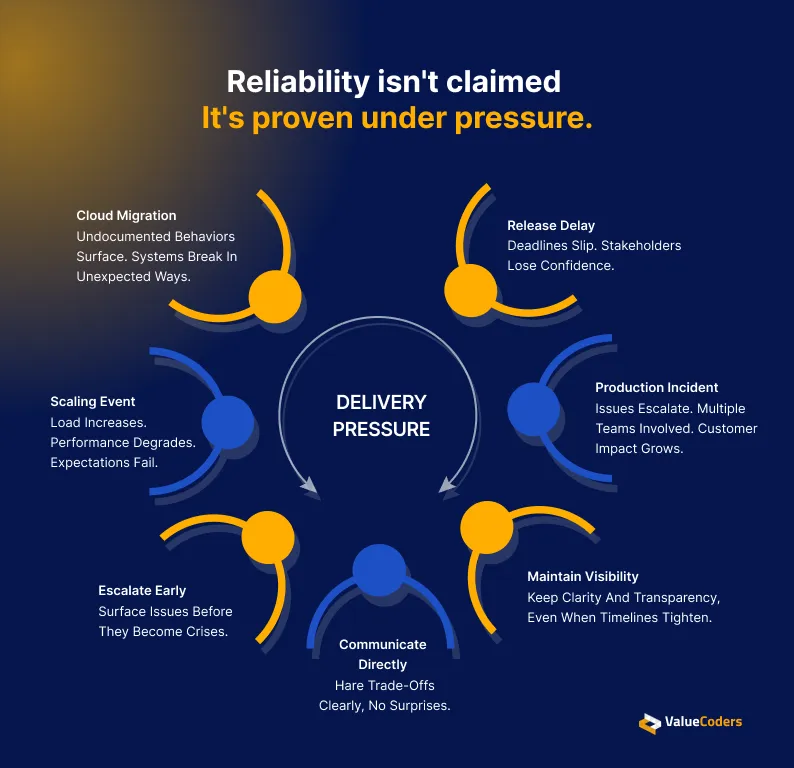
Reliability becomes most visible during delivery pressure.
The easiest phase of any engineering engagement is the sales cycle.
The harder test comes when:
- A release slips
- Dependency breaks unexpectedly
- Cloud migration exposes undocumented system behavior
- Production issue escalates across multiple teams
That is usually where delivery quality becomes fully visible.
Reliable engineering partners tend to behave consistently. They:
- Escalate issues early
- communicate trade-offs directly
- Preserve visibility even when timelines become uncomfortable
Weak vendors often do the opposite.
Risks stay hidden too long, and status reporting becomes vague.
Technical concerns surface only after delivery impact becomes unavoidable.
Strong delivery organizations remain calm, structured, and transparent as complexity increases. That is usually the clearest reliability signal available.
Also Read – Startup CTOs: How Technical Debt Kills Velocity (and How Dedicated Teams Can Fix It)
AI Velocity Demands Governance Guardrails
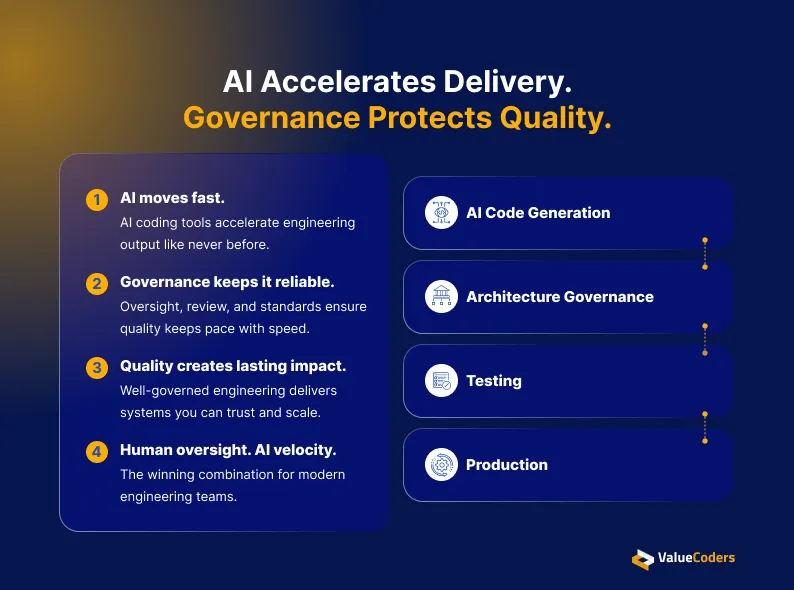
AI coding tools have accelerated engineering output considerably over the last two years.
Many engineering teams are now dealing with:
- inconsistent implementation patterns,
- undocumented business logic,
- unstable architecture decisions,
- and rapidly accumulated technical debt inside AI-generated codebases.
Code can now be produced faster than governance systems can validate it.
The differentiator is no longer just development velocity. It is the ability to govern engineering quality while delivery speed increases.
Reliable partners differentiate themselves by applying the same governance discipline to AI-assisted development that they apply to traditional engineering.
Also Read – Product Engineering KPIs: What to Measure to Ensure Velocity Success
Comparison: Reliable Engineering Partner vs Commodity Vendor
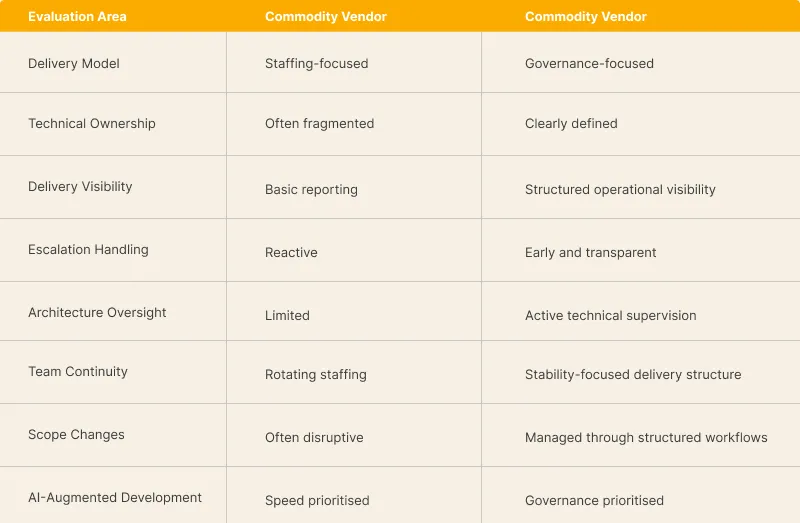
The differences between vendors often become visible only after delivery complexity increases.
A commodity vendor primarily focuses on supplying resources.
A reliable engineering partner focuses on delivery outcomes, operational accountability, and long-term execution quality.
The comparison below highlights some of the practical differences buyers should evaluate when assessing a trusted development partner.
Partner with engineering teams focused on delivery outcomes, technical ownership, and long-term execution quality.
Conclusion
Ratings and review platforms remain useful and important discovery tools. However, they are not reliable indicators of long-term engineering execution quality.
At ValueCoders, we support software-led businesses across product engineering, modernization, cloud transformation, and dedicated team engagements. One pattern remains consistent: delivery reliability is rarely determined by talent alone. It is built through governance, ownership, visibility, and operational discipline.
If execution speed, delivery visibility, and engi
neering accountability are priorities for your business, contact us to discuss your requirements.
Frequently Asked Questions
1. How do you verify a development partner’s reliability beyond client reviews?
Ask how they handle governance, technical ownership, and escalation when things go wrong. A reliable partner can explain how risk is managed after onboarding.
2. How do you find a reliable software development partner?
Prioritize operational maturity over portfolio. Look for delivery governance, engineering continuity, architecture oversight, and clear accountability. The best partners function as an extension of your team — not just external headcount.
3. What are the red flags when evaluating a software vendor?
Unclear ownership. Vague delivery processes. No escalation framework. If a vendor leads with developer profiles but can’t explain how governance holds under pressure, walk away.
4. What security practices should a trusted development partner follow?
Security should run through the entire delivery lifecycle: role-based access, secure code reviews, CI/CD controls, audit logging, and vulnerability management. Tooling matters less than operational accountability.
5. How do you evaluate long-term commitment in a development partner?
Look for continuity planning, stable delivery structures, and consistent leadership involvement. This is especially critical when scaling SaaS, modernizing infrastructure, or running complex programs where delivery gaps have real business consequences.