

Analytics has always been about turning data into better decisions. AI in data analytics is changing how quickly teams can get from raw data to useful insights.
According to McKinsey’s 2025 state of AI research, 88% of organizations report regular AI use in at least one business function, but most organizations are still experimenting or piloting AI rather than scaling it across the enterprise.
For data and product leaders, the challenge is no longer just getting AI into analytics workflows. It is making sure those AI-driven insights can be trusted and used at scale.
AI can make data analytics faster, but speed alone does not create business value.
The quality of the underlying data, the strength of the pipelines feeding it, how the AI is integrated, and how the whole system is governed determine which outcome you get.
What AI Changes in Data Analytics
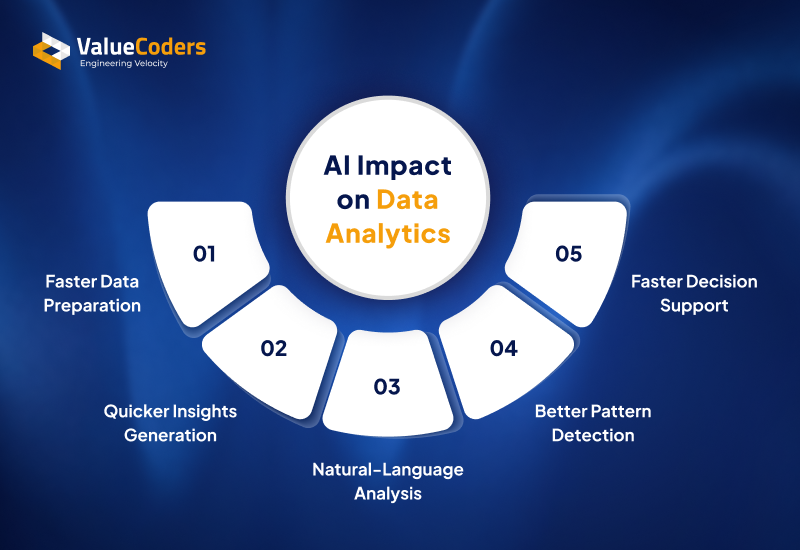
AI is moving analytics beyond static reports and dashboards. It can help teams explore data, identify patterns, summarize information, and answer questions faster.
1. Faster Data Preparation
AI can reduce some of the manual work involved in preparing data.
- Summarize large datasets
- Identify missing or inconsistent values
- Support data classification
- Reduce repetitive analysis tasks
2. Quicker Insight Generation
AI can process large datasets and surface useful signals faster.
- Identify trends
- Detect unusual activity
- Highlight important data points
- Compare patterns across datasets
3. Natural-Language Analysis
Users can interact with data using everyday language instead of relying only on predefined reports.
- Ask questions in plain English
- Explore business data without writing complex queries
- Generate summaries of results
- Follow up with additional questions
4. Better Pattern Detection
AI can help identify relationships that may be difficult to find through manual analysis.
- Connect signals across datasets
- Detect recurring patterns
- Identify unusual behavior
- Support deeper analysis
5. Faster Decision Support
AI can bring relevant information together so teams spend less time searching through dashboards and reports.
- Surface relevant insights
- Summarise business trends
- Support faster investigation
- Help teams focus on actions
The opportunity is straightforward: spend less time finding insights and more time acting on them.
But there is an important limitation.
If the underlying data is incomplete, outdated, or incorrect, AI can make the wrong insight faster and easier to trust.
Strengthen your data foundation, integrate AI, and build analytics systems ready for real-world use
Where AI in Analytics Breaks
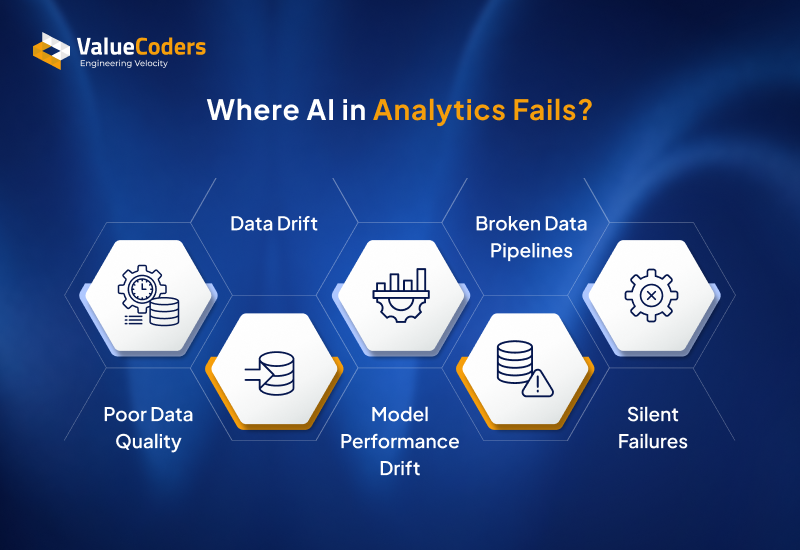
AI analytics systems depend on more than the model. They rely on data sources, pipelines, integrations, infrastructure, and ongoing controls.
When one of these layers changes or fails, the output can become unreliable.
1. Poor Data Quality
AI-generated insights are only as reliable as the data provided to the system.
- Missing or incomplete records
- Duplicate data
- Incorrect values
- Outdated information
Poor data quality can affect both analytics and AI-generated insights.
2. Data Drift
Business data changes over time.
Customer behaviour, product usage, market conditions, and operational patterns may no longer match the data used when the system was developed.
- Customer behaviour changes
- New patterns appear
- Data distributions shift
- Previous assumptions become less useful
Without monitoring, these changes can gradually affect the quality of analytics and AI outputs.
3. Model Performance Drift
A model can perform well during testing and become less accurate later.
- Predictions become less reliable
- Model performance declines
- New data behaves differently
- Existing models need review or retraining
4. Broken Data Pipelines
AI analytics depends on data reaching the right systems at the right time.
- Data sources stop sending information
- APIs change
- Pipeline jobs fail
- Processing errors affect outputs
A model cannot produce reliable analytics if the data pipeline behind it is unreliable.
5. Silent Failures
Some failures are easy to miss because the system continues to operate.
- Dashboards still load
- Reports still generate
- Models still return results
- Incorrect outputs may go unnoticed
This is one of the biggest risks in production analytics.
The system does not always fail visibly. Sometimes it keeps working while the quality of its results gradually declines.
That is why production AI analytics needs data quality checks, monitoring, clear ownership, and regular performance reviews.
Also Read: Creating a Solid AI Strategy for 2026 and Beyond
The Data Engineering Foundation AI Analytics Requires
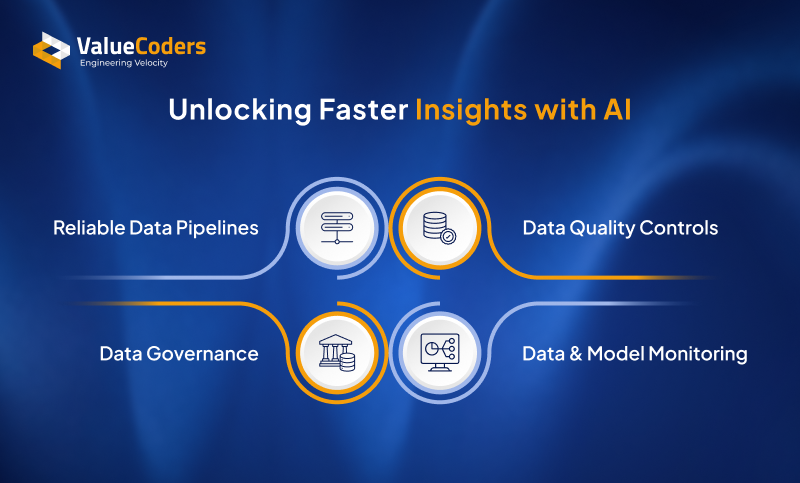
Once AI becomes part of the analytics workflow, the underlying data architecture becomes part of the AI system’s reliability.
Data engineering services provide the foundation that moves data from source systems into analytics and AI workflows, keeps it usable, and makes changes easier to detect and manage.
Reliable Data Pipelines
Data pipelines need to move information from source systems to analytics and AI systems consistently.
- Connect data from multiple sources
- Automate data movement and transformation
- Handle processing failures
- Keep data available for downstream systems
Data Quality Controls
Quality checks help catch problems before they affect AI outputs.
- Check missing values
- Detect duplicates
- Validate data formats
- Flag unexpected changes
Data Governance
As more systems use business data, teams need to understand what data exists and how it is used.
- Define data ownership
- Control data access
- Maintain data lineage
- Apply retention rules
Data and Model Monitoring
Monitoring helps teams identify problems after deployment.
- Track data quality
- Monitor model performance
- Detect data and model drift
- Investigate unusual results
The role of data engineering is not to make AI smarter. It is to give AI analytics the reliable data, pipelines, models, and controls it needs to work in production.
Get the engineering, data, and AI expertise needed to move from experimentation to reliable production systems.
How to Ship AI Analytics Safely
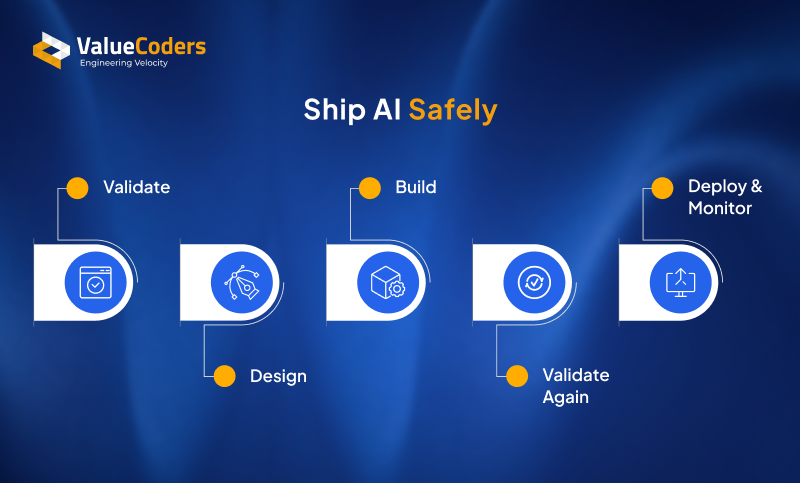
A successful pilot proves that an idea can work. It does not prove that the system is ready for real users, live data, enterprise integrations, and ongoing business use.
A safer approach is to move through clear stages.
1. Validate
Start with the business problem before building the full solution.
- Define the analytics use case
- Identify the data required
- Test data quality
- Define success metrics
2. Design
Build the technical foundation around the use case.
- Define the architecture
- Map data flows
- Plan integrations
- Set security and access controls
- Define governance requirements
3. Build
Develop the analytics and AI workflow.
- Connect required data sources
- Build data pipelines
- Develop analytics workflows
- Integrate AI capabilities
- Test the end-to-end process
4. Validate Again
Test the system with realistic conditions before wider deployment.
- Check data quality
- Test model performance
- Review security controls
- Validate business outputs
- Test failure scenarios
5. Deploy and Monitor
Production is not the finish line.
- Monitor data quality
- Track model performance
- Detect drift
- Review system changes
- Improve pipelines and models
This approach reflects the broader production-readiness principle in the ValueCoders material: AI needs scalable architecture, live data, integrations, governance, and ongoing monitoring beyond the prototype stage.
Also Read: AI Readiness Checklist for Tech Companies in 2026
What a Production-Ready AI Analytics Foundation Needs
Pulling the five stages above into a single reference: a reliable AI analytics system holds together across five connected layers.
A Practical Framework for Production-Ready AI Analytics
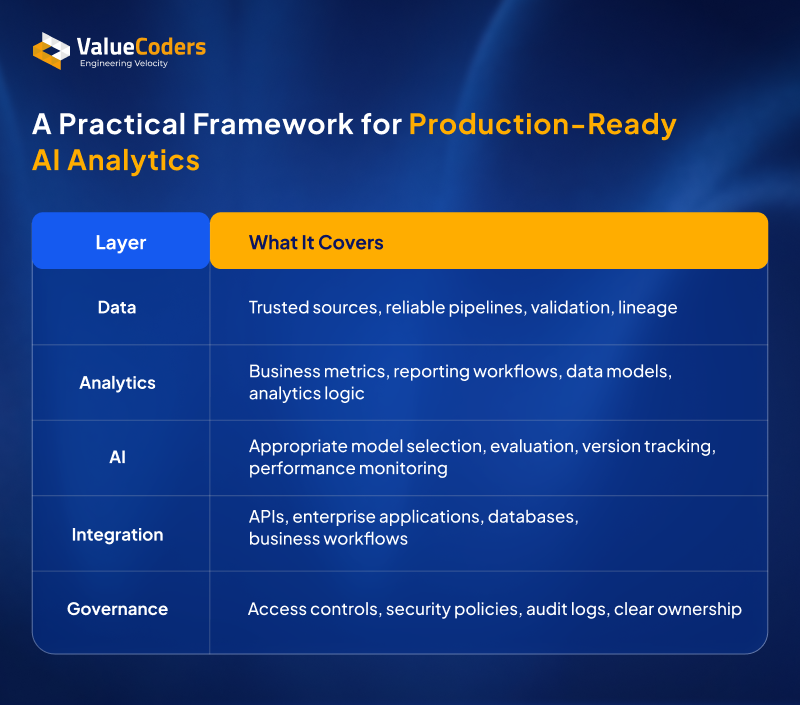
Use This Before Scaling
Before moving an AI analytics system beyond experimentation, check that:
- The business use case and success metrics are defined
- Data quality is measurable and monitored
- Data pipelines have failure handling and validation
- AI outputs are evaluated against business requirements
- Production integrations are tested
- Access and security controls are defined
- Data and model changes can be detected
- Someone owns ongoing monitoring and improvement
The goal is not simply to add Artificial Intelligence services to an existing analytics stack.
The goal is to build an analytics system where data, AI, engineering, and governance work together reliably in production.
Build analytics that helps your teams find insights and act on them with confidence.
How ValueCoders Helps Build Reliable AI Analytics
Data analytics services deliver value when the data, engineering, and AI work together. ValueCoders helps businesses build reliable analytics systems with data engineering, AI integration, secure system connections, scalable architecture, and production support.
Our teams work with your existing technology and business requirements to build solutions that can move from development to real-world use.
The goal is not just to add AI, but to build analytics your business can trust as it grows. Need help turning your data into reliable AI-powered insights? Contact us to discuss your requirements.
FAQs
1. What are the biggest limitations of AI in data analytics?
Ans. AI depends on data quality, models, and systems behind it. Poor data quality, data drift, model drift, broken pipelines, and unclear governance can lead to unreliable insights.
2. Why does AI fail in data analytics projects?
Ans. AI analytics projects might fail if:
- The business problem is unclear
- data is unreliable
- Integrations are weak
- The system is not properly tested and monitored
3. How does poor data quality affect AI analytics?
Ans. Missing, duplicate, outdated, or incorrect data cause inaccurate analysis and unreliable AI outputs. Thus, it’s necessary that you ensure strong data validation and quality checks should be in place before deployment.
4. What role does data engineering play in AI analytics?
Ans. Data engineering provides the foundation for AI analytics. It connects data sources. Builds reliable pipelines. Validates data. Maintain data models. And makes trusted data available to AI and analytics systems.
5. How can businesses improve AI accuracy in data analytics?
Ans. Businesses can improve accuracy by:
- Using reliable data
- Validating inputs
- Testing models with realistic data
- Monitoring performance
- Detecting drift
- Regularly reviewing
- Improving the system
6. Is AI suitable for real-time business analytics?
Ans. AI can support real-time analytics when the underlying data pipelines, infrastructure, integrations, and monitoring systems can process data reliably and quickly.
7. What should businesses do before implementing AI in analytics?
Ans. Businesses should define the use case, assess data quality, identify required data sources, evaluate security and governance needs, define success metrics, and plan how the system will be monitored after deployment.