


The Cambridge Centre for Alternative Finance’s 2026 Global AI in Financial Services Report found that fintechs are adopting AI faster than traditional financial institutions. The report surveyed 628 financial institutions, AI vendors, and regulators across 151 jurisdictions. It also found that 51% of more mature AI adopters are already testing or using new AI-powered financial products.
But moving fast creates another challenge: can companies show their AI systems are secure, controlled, and audit-ready?
In this article, you’ll learn how AI creates value in FinTech, where it can create risks, what a compliance-ready architecture needs, and how FinTech software development services can support both speed and audit readiness.
Also Read: Streamlining Finance: The Benefits of AI and ML in Fintech
Common gaps that show up in fast-moving FinTech AI builds
Moving quickly with AI can help FinTech teams launch sooner, but it can also leave important controls behind.
These gaps often appear when security, data, and governance are added after the product is already being built.
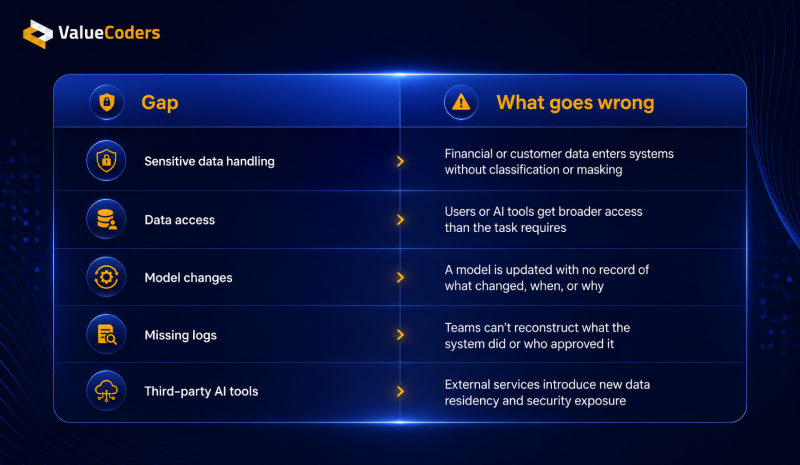
Sensitive Data Handling
AI features may need access to customer, transaction, or financial data. If this data is not properly protected, it can create security and compliance risks during software product development.
Example: A customer-support AI tool receives account details that it does not actually need to answer a basic query.
Data Access
AI systems should only access the data required for their specific task. Broad permissions can expose sensitive information to the wrong users, systems, or services.
Example: An AI service connected to a financial database can access full customer records when it only needs transaction status.
Model Changes
AI models can change over time, and an updated model may produce different results. Without proper testing and version tracking, teams may not know why a decision or output changed.
Example: A risk model changes loan-risk scores, but the team cannot trace which model version produced the earlier results.
Missing Logs
FinTech systems need clear records of important actions, changes, and access. Without proper logs, teams may struggle to investigate incidents or provide evidence during a review.
Example: An AI-driven approval workflow changes a customer’s risk score, but there is no record of who triggered the change or which model was used.
Third-Party AI Tools
External AI services can speed up development, but they also introduce questions about data handling, storage, access, and security.
Example: A team sends customer information to a third-party AI API without first confirming how that provider stores or processes the data.
The common issue: speed is valuable, but in FinTech, moving fast without clear controls can create problems that are much harder to fix after launch.
Get an engineering approach built around audit-readiness from day one
Where FinTech AI Creates Value and Where It Creates Risk
AI can improve many parts of a FinTech product, but every use case comes with its own risks. The key is to understand both before putting AI in production.
Fraud Detection: Faster Risk Identification
AI can analyze transaction patterns and flag activity that looks unusual. This helps fraud teams review high-risk transactions without checking every transaction manually.
The risk: Poor data or weak model controls can lead to false alerts or missed fraud.
Credit Decisions: More Data for Risk Assessment
AI can analyze borrower and financial data to support credit risk assessment and underwriting. This can help teams review large amounts of information more efficiently.
The risk: Incomplete data, model bias, or changing customer behavior can affect the accuracy of decisions.
Customer Support: Faster Service
AI assistants can answer common questions and help support teams find information quickly. Sensitive requests can be passed to human agents when needed.
The risk: Poor access controls can expose customer or account information.
Document Processing: Less Manual Work
AI can extract and classify information from applications, statements, and other financial documents. This can reduce repetitive data entry and speed up workflows.
The risk: Incorrect extraction can affect later decisions if the output is not checked.
The best FinTech AI use cases are not simply the ones that save the most time. They are the ones where the business value is clear, and the risks can be properly controlled.
Develop AI-powered financial solutions with strong security, data controls, and production-ready engineering.
What a Compliance-Ready FinTech AI Architecture Actually Requires
A strong architecture does not treat AI compliance in FinTech as a final checklist. The best practices for FinTech software development help build the right controls into the system from the beginning. With AI Development Services, these controls can be designed into the product from the start.
Depending on the product, market, payment flows, and data handled, the architecture may need to account for requirements and standards such as PCI DSS, SOC 2, PSD2/Open Banking requirements, ISO 20022, and applicable regulatory expectations from bodies such as the RBI, SEBI, or FCA.
Third-party payment, banking, identity, and data APIs can also introduce additional security, data-handling, and dependency considerations.
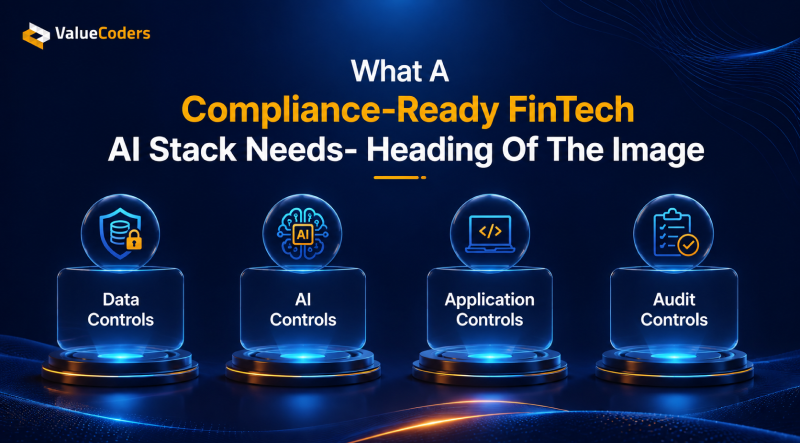
Key areas include:
Data Controls
- Data classification
- Access controls
- Encryption
- Data lineage
- Retention rules
AI Controls
- Model version tracking
- Model performance checks
- Human review where needed
- Model change records
Application Controls
- Authentication
- Authorization
- Secure APIs
- Controlled integrations
- Environment separation
Audit Controls
- Activity logs
- Approval records
- Change history
- Access records
- Evidence collection
The goal is simple: know what the system does, control who can change it, and keep enough evidence to review its operation.
Talk through your architecture, data flows, and audit requirements with our team.
How to Move AI From Pilot to Production Safely
A successful AI pilot does not mean the system is ready for real users. Production brings live data, more users, more integrations, and greater business risk.
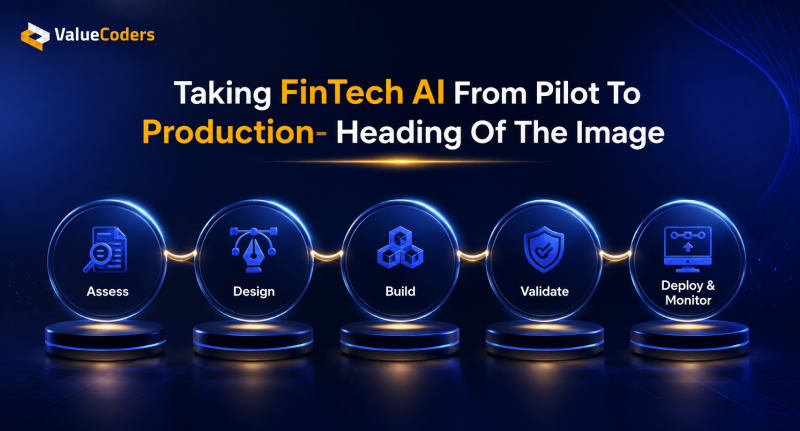
A safer path is to move through clear stages.
1. Assess
Start with the business problem.
- Define the use case
- Identify the data involved
- Map key risks
- Identify relevant requirements
2. Design
Build the technical foundation.
- Define the architecture
- Set data controls
- Plan security
- Define AI governance
3. Build
Develop and integrate the AI solution.
- Connect required systems
- Test the AI workflow
- Add security controls
- Document key decisions
4. Validate
Test the solution before a wider release.
- Check model performance
- Test data handling
- Review security
- Validate audit evidence
5. Deploy and Monitor
Production is not the finish line.
- Monitor performance
- Track changes
- Review access
- Update controls as the product evolves
This phased approach helps teams move from AI idea → pilot → production without taking on avoidable risk.
Build, test, and deploy AI-enabled financial solutions designed for real-world use.
Conclusion
FinTech companies do not have to choose between moving fast and staying audit-ready. Security, data protection, governance, and audit controls should be built into the engineering process from the start.
ValueCoders applies compliance-aware engineering practices across FinTech projects. For example, Tijoree, a mobile and web-based financial platform we built, included Min-KYC onboarding, a prepaid card integration with an RBI-licensed PPI, payment integration, and secure transaction flows.
ValueCoders combines AI-augmented product engineering with compliance-aware engineering practices to help FinTech businesses move AI applications from idea and pilot to production.
Have a FinTech project in mind? Contact ValueCoders to discuss how we can help.
FAQs
1: What features should a FinTech application include?
Ans: A FinTech application should include the following features:
- Secure login
- Payment processing
- Account management
- Transaction tracking
- Fraud detection
- Reporting
- Data analytics
The right features depend on the product and its users.
2: How much does FinTech software development cost?
Ans: The cost depends on the features, software complexity, technology stack, integrations, security needs, and compliance requirements. A simple application will usually cost less than a complex banking or payment platform.
3: How long does it take to develop FinTech software?
Ans: A basic FinTech software may take a few months, while a larger, complex platform can take longer. The time completely depends on the product scope, features, integrations, testing, and compliance needs.
4: What technologies are used to build FinTech software?
Ans: FinTech software can use technologies such as Java, .NET, Python, Node.js, React, cloud platforms, APIs, databases, AI, and blockchain. The technology stack should match the product’s needs, security requirements, and existing systems.
5: How do you choose the right FinTech development company?
Ans: Look for experience in FinTech, strong security practices, knowledge of compliance requirements, relevant technical skills, and a clear delivery process. Ask the company to share similar projects and explain how it handles security, testing, and support.
6: What compliance standards should FinTech software follow?
Ans: The requirements depend on the product, location, data handled, and type of financial service. Depending on the use case, this may include standards and regulations such as PCI DSS, SOC 2, RBI, SEBI, or FCA requirements.
7: Why should businesses invest in FinTech software development?
Ans: The global financial landscape is experiencing a massive surge in fintech app development. There are multiple reasons a business should invest in FinTech software development. Here are some of the major ones:
- Improved customer experiences
- Automated financial processes
- Robust security
- New products or services support
8: What are the latest FinTech software development trends?
Ans: Key trends include:
- AI-powered financial services
- Automated fraud detection
- Open banking
- Real-time payments
- Cloud-based platforms
- Embedded finance
- Stronger data and security controls