AI spending is growing fast. Gartner forecasts worldwide AI spending will reach $2.7 trillion in 2026, up 49.5% from 2025. But higher spending does not automatically mean higher business value.
McKinsey’s research found that 88% of organizations use AI in at least one business function, while only about one-third have started scaling AI across the enterprise.
For CTOs, CIOs, and engineering leaders, the question is no longer just whether to invest in AI. It is what it will really take to build, launch, and run AI in production.
Costs can include engineering, data, infrastructure, integrations, security, testing, monitoring, and ongoing support.
That makes the delivery model important. Build, Buy, Hire, or FDE? This guide compares each option across cost, speed, control, and long-term ownership.
What Goes Into the Total Cost of Enterprise AI?
The cost of enterprise AI goes beyond model and API fees.
A production AI solution can require data preparation, engineering, cloud infrastructure, integration, security, testing, monitoring, governance, and ongoing maintenance.
Deloitte’s 2026 research also highlights new AI cost drivers such as token usage, infrastructure, model routing, and usage management.
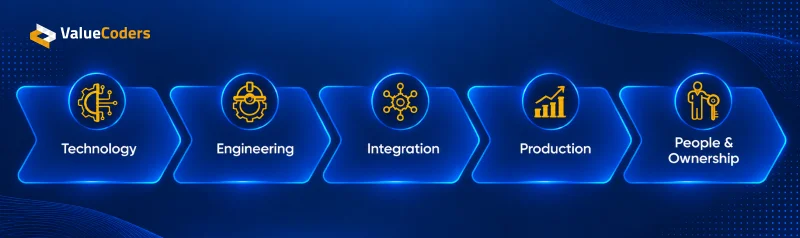
For technology leaders, it helps to look at the total cost across five areas:
- Technology: Models, APIs, cloud infrastructure, and platform services
- Engineering: AI engineers, software developers, data engineers, and DevOps
- Integration: Connecting AI with existing systems, data, and workflows
- Production & Operations: Testing, security, monitoring, evaluation, and improvements
- People & Ownership: Hiring, management, support, and long-term ownership
The better question is not “How much does the AI model cost?” It is “What will it cost to build, deploy, run, and own this AI capability?”
Pressure-test development, integration, production, and ongoing operating costs before you approve the investment.
Build, Buy, Hire, or FDE: Comparing Enterprise AI Delivery Models
There is no single delivery model that works for every enterprise AI initiative. The right choice depends on the type of AI capability you need, your internal skills, how quickly you need results, and how much control you want to keep.
Build Internally
Build means developing the AI capability internally using your existing engineering organisation.
Your team owns the architecture, integrations, data, and ongoing development. You are also responsible for moving the solution from design to production and supporting it over time.
Best fit when:
- The AI capability is highly specific to your business
- Existing products cannot meet the requirement
- You need strong control over data and architecture
- AI will remain a long-term part of your product
The cost: You take on engineering, infrastructure, security, integration, and ongoing operating costs internally.
The trade-off: You get more control and ownership, but you also take on the full delivery and maintenance work.
Buy
Buy makes sense when an existing AI product already solves most of the problem.
Don’t build the capability yourself. Buy an existing product or platform. Ask your team to focus on integration, adoption, and governance.
Best fit when:
- The use case is common across businesses
- A proven product meets most requirements
- Speed matters more than deep customisation
- You do not need to own the underlying AI capability
The cost: Licensing or usage fees are only part of the cost. Integration, customisation, security reviews, data access, implementation, and ongoing vendor fees can also add up.
The trade-off: You can get to value faster, but you have less control and depend more on the vendor.
Also Read: How AI is Changing the Way Startups Define GTM Strategies
Hire AI Talent
Hire means building dedicated internal AI capacity by recruiting specialised AI talent.
An internal AI team builds knowledge inside the company and gives you direct control over development, architecture, and operations.
Best fit when:
- AI is part of your long-term technology strategy
- You expect multiple AI initiatives
- You want permanent internal ownership
- You have the time and resources to build the team
The cost: The cost includes salaries, recruitment, benefits, onboarding, management, training, tools, and employee retention.
The trade-off: You build long-term internal capability, but hiring and building the team can slow down delivery at the start.
FDE
A Forward Deployed Engineer (FDE) works closely with business and engineering teams to solve a specific technical problem in the company’s real working environment.
For enterprise AI, this model can help when the use case is complex, requirements are still changing, or specialised engineering skills are needed to move from an idea to a production solution.
Best fit when:
- The AI use case is complex or still evolving
- The solution must work with existing enterprise systems
- Your team needs specialised AI engineering skills
- You need to move faster than internal hiring allows
- The goal is a working production solution, not just a prototype
The cost: Cost depends on the scope, project length, skills needed, and amount of engineering work. Integration, governance, and knowledge transfer should also be considered.
The trade-off: You get specialised skills without immediately building a full internal team, but ownership, handover, and long-term support need to be clearly defined.
The key difference from traditional staff augmentation is how the engineer is involved. An FDE works within the business and technical context to help solve a problem and move it toward production, rather than simply completing assigned development tasks.
The right model isn’t necessarily the cheapest. It is the one that gives the initiative the required balance of cost, speed, capability, control, and long-term ownership.
Get the engineering support needed to integrate, secure, test, and prepare your AI capability for production.
Build, Buy, Hire, or FDE at a Glance
| Build | Buy | Hire | FDE | |
| Best when | Capability is highly custom | Proven product exists | Long-term internal capability matters | Specialized expertise is needed quickly |
| Initial speed | Lower | Higher | Lower | Higher |
| Internal ownership | High | Low | High | Depends on engagement |
| Customization | High | Low-moderate | High | High |
| Primary cost | Engineering + infrastructure | License + integration | People + management | Engineering + scope |
| Main trade-off | Higher delivery burden | Vendor dependency | Hiring and ramp-up | Requires clear ownership |
The decision should therefore go beyond “Which option costs less?” For an enterprise technology leader, the better question is:
Which model gives us the right balance of cost, speed, control, technical capability, and long-term ownership for this specific AI initiative?
That is the comparison that matters before committing the AI budget.
The Cost of Moving Enterprise AI From Pilot to Production
A pilot shows that an AI solution can work. Production requires it to work reliably, securely, and at scale.
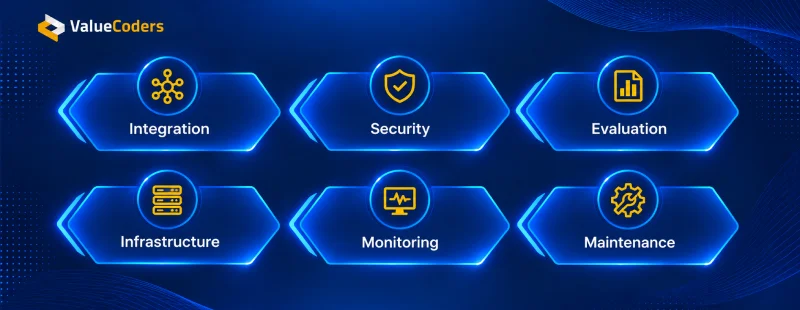
That transition adds costs that are often missed in the initial budget:
Integration
- Connecting AI with existing systems and workflows
Security
- Protecting data and managing access
Evaluation
- Testing accuracy and reliability with real use cases
Infrastructure
- Supporting production workloads and scaling
Monitoring
- Tracking performance, usage, and cost
Maintenance
- Improving the system and managing changes over time
The key difference is simple: A pilot proves the idea. Production proves the business case.
That is why enterprise leaders should estimate the full cost of production, not just the cost of building the first working version.
Bring ValueCoders into complex AI initiatives where your team needs additional skills, capacity, or production engineering support.
Before You Commit the AI Budget
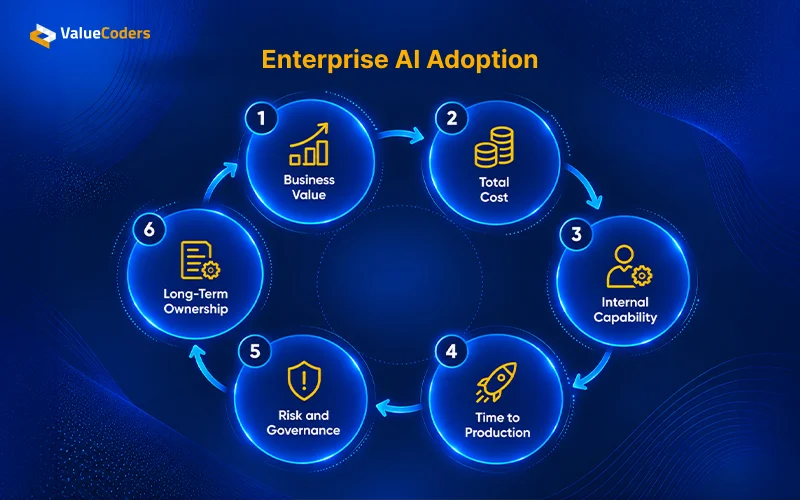
Before choosing a delivery model, make sure you can answer six simple questions:
- Business value: What business outcome should the AI capability improve?
- Total cost: What will you spend to build, integrate, run, and maintain it?
- Internal capability: What skills and engineering capacity do you already have?
- Time to production: How quickly does the business need the capability?
- Risk and governance: What security, data, compliance, and oversight requirements apply?
- Long-term ownership: Who will operate, improve, and own the capability after launch?
These answers can help you understand which delivery model fits your situation.
The right model is the one that can deliver the required business outcome with a realistic balance of cost, speed, control, capability, and long-term ownership.
Also Read: A Complete Guide For Healthcare App Development
How ValueCoders Supports Enterprise AI Delivery
Your AI needs and delivery timeline determine whether to Build, Buy, Hire, or use an FDE.
ValueCoders can help when your internal team has the product knowledge and ownership, but needs additional engineering capacity or AI skills to move forward.
Depending on the project, ValueCoders can extend your existing team, provide a dedicated delivery team for a specific outcome, or bring specialized AI engineering skills into a complex initiative.
The focus is not to replace your internal team or take away long-term ownership. It is to help you build and launch the right AI capability with the skills and capacity you need.
Evaluating Build, Buy, Hire, or FDE? Talk to ValueCoders about your AI initiative.
FAQs
1. How do you compare FDE vs. outsourcing for AI development?
Ans. An FDE works closely with your business and engineering teams to solve a specific problem and move it toward production. Traditional outsourcing is usually broader and may focus on delivering defined development tasks. FDE is often a better fit when the AI use case is complex, changing, and requires close collaboration with the business.
2. What are the hidden costs of enterprise AI implementation?
Ans. Common hidden costs include data preparation, system integration, cloud infrastructure, security, testing, model evaluation, monitoring, maintenance, and skilled engineering resources. These costs can make the total implementation cost much higher than the initial development estimate.
3. What infrastructure costs should enterprises consider when implementing AI?
Ans. Enterprises should consider cloud compute, model/API usage, storage, databases, networking, monitoring, security tools, and scaling costs. The actual cost depends on factors such as model size, usage volume, workload, and deployment approach.
4. How does data quality affect enterprise AI costs?
Ans. Poor-quality or incomplete data often requires additional cleaning, labeling, transformation, and validation before it can be used effectively. Better data quality can reduce rework and improve AI performance, making data preparation an important part of the overall AI budget.
5. How can enterprises reduce AI implementation costs?
Ans. Start with a clearly defined business use case, use existing AI services where they make sense, avoid unnecessary custom development, and build only what the business needs. Enterprises should also plan for integration, monitoring, and maintenance early to avoid expensive rework later.
6. What is the difference between AI development cost and AI implementation cost?
Ans. AI development cost covers building the AI solution itself, including engineering, models, and application development. AI implementation cost is broader and includes integration, infrastructure, security, testing, deployment, training, monitoring, and ongoing support.
7. What is the cost of hiring AI engineers vs. using an FDE?
Ans. Hiring AI engineers creates ongoing internal costs, including salaries, recruitment, benefits, management, and retention. An FDE provides specialized engineering support based on the scope and duration of the initiative, which can be useful when you need expertise quickly without building a full AI team upfront.