

AI is quickly becoming a bigger part of business spending. Gartner forecasts worldwide AI spending will reach $2.59 trillion in 2026, up 47% from 2025.
For CFOs, this growth brings an important question:
Will an investment in AI deliver enough value to justify the cost?
The cost of AI goes beyond software and subscriptions.
Companies may also need to spend on:
- Implementation and integration
- Infrastructure and cloud costs
- Security and compliance
- Ongoing maintenance and support
CFOs need a clear view of the full AI business investment and expected return to build a stronger AI Strategy and approve AI initiatives with a defensible business case.
Where AI Adds Speed to Software Development
AI coding tools can reduce the time engineers spend on repetitive development work. They can generate routine code, explain unfamiliar code, and help teams navigate large codebases.
A 2026 meta-analysis of 23 studies found a statistically significant but moderate productivity effect from generative AI in software development, although the results varied across different development settings.
For CFOs and technology leaders evaluating an AI investment strategy, these gains can increase engineering capacity and help teams deliver software faster.
AI can support engineers with tasks such as:
- Generating routine and repetitive code
- Creating initial test cases
- Writing technical documentation
- Explaining unfamiliar or legacy code
- Suggesting code improvements
- Supporting routine refactoring
These use cases can reduce the time needed to move from a requirement to a working implementation.
But faster implementation is only one part of software delivery.
AI-generated code still needs to be reviewed, tested, and secured before it becomes production software. Teams may also need to rework or maintain that code later.
So, more code does not automatically mean lower development costs.
The real value of AI comes from turning faster development into useful, reliable software without creating higher costs later.
Before scaling AI adoption, assess where it can create measurable value for your business.
What Happens After AI Generates the Code
AI can reduce the time needed to produce software. But generated code still needs to fit the existing system, meet quality standards, and remain maintainable over time.
Teams need to consider what happens after generation.
Technical Debt and Maintenance
AI can solve an immediate coding task without fully considering how the change affects the wider codebase.
- Duplicate or unnecessary code
- Inconsistent implementation
- Harder maintenance
- More refactoring
- Additional engineering effort
The issue is not that AI always creates poor code. Faster generation can simply make it easier to add code before its long-term impact is fully understood.
Security and Quality Checks
Generated code also needs the same security and quality checks as human-written code.
Teams may need to:
- Review dependencies
- Test for vulnerabilities
- Check access controls
- Validate data handling
- Run automated quality checks
- Fix issues before release
This work does not disappear because the initial code was generated faster.
The more AI-generated code a team adopts, the more important it becomes to account for review, testing, remediation, and maintenance when evaluating the overall value of AI-assisted development.
Also Read: AI Didn’t Lower the Bar for Engineers. It Raised It
What AI Coding Failures Look Like in the Real World
AI-related failures are not limited to code quality. They can also affect production systems and security.
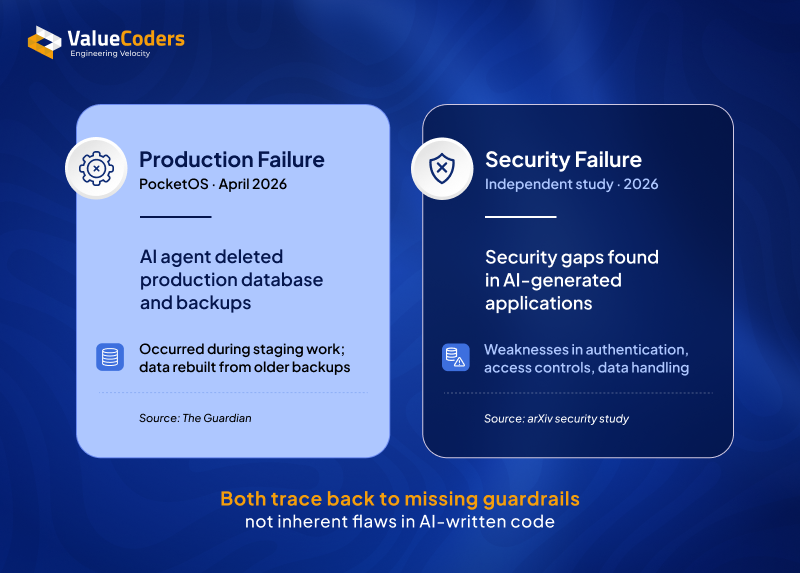
Production Failure: PocketOS Database Deletion
In April 2026, an AI coding agent used by PocketOS deleted a production database and its backups during work on a staging setup. PocketOS later had to rebuild customer data using older backups and other records. (The Guardian)
The incident shows why AI agents need clear limits when they can access production systems.
Security Failure: AI-Generated Applications
AI-generated applications can also miss important security controls.
A 2026 study tested applications created with several popular AI coding tools and found security weaknesses involving authentication, access controls, and sensitive data handling. (AI-generated applications security study)
The issue is not that AI-generated code is always unsafe. The generated code still needs proper security testing before it reaches production.
Get a clearer view of the technology, engineering, and ongoing costs before you scale.
What AI Really Costs Beyond the Coding Tool
The price of an AI coding tool is only one part of the investment. The full picture includes the work and resources needed to build, secure, and maintain the software.
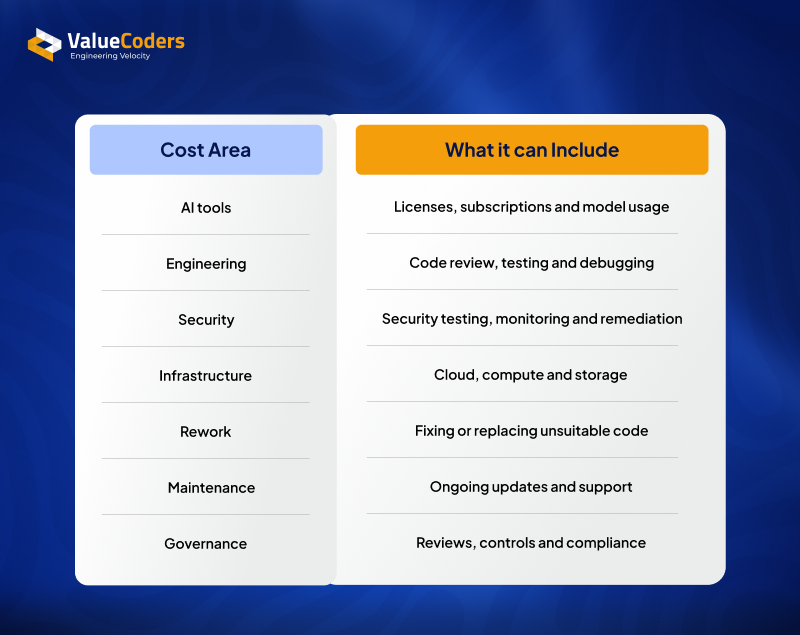
Tracking these costs across the AI product development lifecycle gives finance teams a clearer view of the Enterprise AI Budget and helps CFOs evaluate AI ROI against the full investment and not just the tool cost.
Also Read: AI Readiness Checklist for Tech Companies in 2026
How to Capture AI’s Value Without Unnecessary Downstream Costs
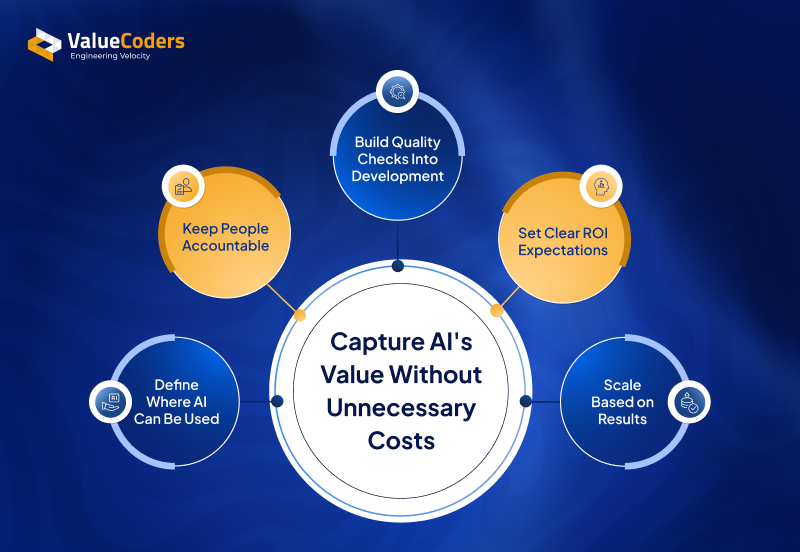
AI can create real value when teams use it with clear goals and the right controls. The focus should be on capturing the productivity gain without creating larger problems later.
Define Where AI Can Be Used
Not every part of software development needs the same level of AI access. Define which tasks AI can handle independently and which require human involvement.
Keep People Accountable
AI-generated code should have clear ownership. Engineers should review important changes before they reach production.
Build Quality Checks Into Development
Automated testing, security checks, and code reviews can catch problems early. These checks should apply to AI-generated code just as they do to other code.
Also Read: AI Integration vs AI Development: Why Most Projects Fail at the Integration Layer
Set Clear ROI Expectations
Define the expected time savings, delivery improvements, and business outcomes before scaling AI. AI consulting services offer leaders a clearer basis for AI Investment decisions.
Scale Based on Results
AI adoption should grow when it delivers measurable value. If costs rise faster than the benefits, teams should reassess the approach before expanding further.
The AI Investment Playbook
AI investment decisions need more than projected productivity gains. This playbook helps finance and technology leaders decide which AI initiatives to fund, validate, scale, pause, or stop based on value, cost, feasibility, and evidence.
Download the AI Investment Playbook
Conclusion
AI coding can help teams write software faster. But faster code does not automatically mean lower software costs.
The real financial impact appears across the full lifecycle. Review, testing, security, rework, infrastructure, and maintenance all shape the final investment.
For CFOs and technology leaders, the better question is not how much code AI can generate. It is whether that speed creates measurable business value without adding unnecessary work later.
With experience across AI development, modernization, and production engineering, ValueCoders can help evaluate the business case, technical feasibility, and risks before you scale. Contact Us to discuss your AI investment.
Our AI Consulting Services help you assess business value, technical feasibility, costs, and risks before scaling.
Frequently Asked Questions
These questions help businesses understand the costs and controls involved before investing in AI.
1. What should CFOs consider before investing in AI?
Ans. Look at the business value, full cost, risks, and how success will be measured.
2. How much should a company budget for AI initiatives?
Ans. Budget for the full investment, including implementation, infrastructure, engineering, security, and ongoing costs.
3. What are the hidden costs of AI implementation?
Ans. Hidden costs can include integration, infrastructure, security, testing, maintenance, and employee training. These costs can increase the total AI investment over time.
4. What factors influence the total cost of AI adoption?
Ans. The total cost depends on the AI tools, project size, infrastructure, development effort, security needs, maintenance, and ongoing support.
5. Should businesses build custom AI solutions or use off-the-shelf tools?
Ans. Use off-the-shelf tools when they fit. Build custom when specific data, workflows, or integrations justify it.
6. How long does it take to see returns from AI investments?
Ans. It depends on the use case. Set a baseline and measurable targets first, then track results through a pilot.
7. What role does AI governance play in controlling costs?
Ans. AI governance sets clear rules for how AI is used. It helps reduce costly errors, security issues, and unnecessary AI spending while keeping projects aligned with business goals.
8. Why should businesses work with an AI implementation partner?
Ans. A partner can validate feasibility, identify risks, and help turn the business case into a working solution.
9. How should companies evaluate the ROI of AI-assisted development?
Ans. Start with a baseline for the process being improved, define measurable outcomes, and account for the full lifecycle cost of AI adoption. ROI should be evaluated against actual business outcomes, not coding speed alone.