


Why Traditional Hiring Can Limit SaaS Engineering Capacity
SaaS products often outpace internal engineering capacity. Roadmaps expand, while existing teams handle more competing priorities.
This creates several common delivery challenges.
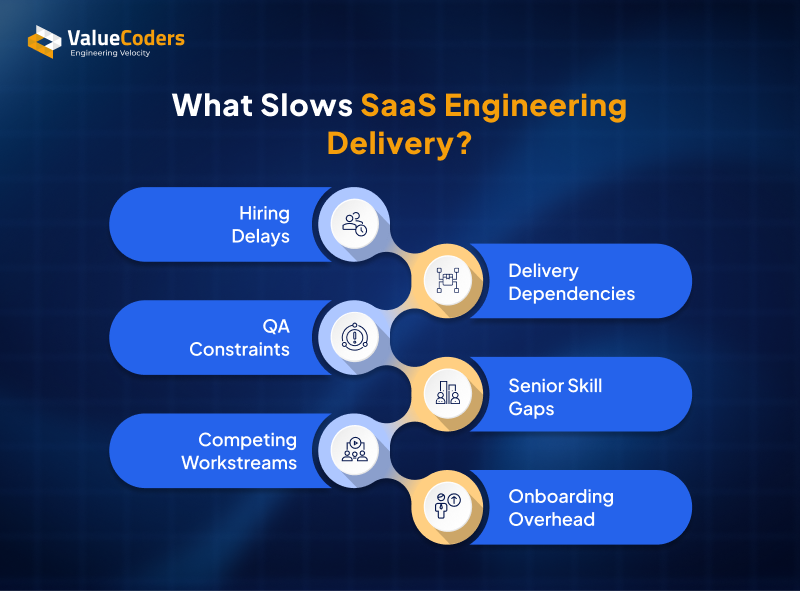
1. Hiring Takes Time
Hiring permanent engineers can take weeks or months. New hires also need product context, tooling access, and onboarding. This can delay delivery when roadmap pressure is already high.
2. Growing Dependencies Slow Delivery
Growing products create more dependencies across engineering and delivery teams. These dependencies can slow releases when ownership is unclear.
3. Limited QA Capacity Affects Engineering Velocity
When QA capacity falls behind development, testing can move later in the cycle. Defects may surface closer to release. This can increase rework and reduce engineering velocity.
4. Senior Engineering Expertise Becomes Critical
SaaS growth creates architectural and technical challenges beyond feature development. Teams may need deeper experience with system design, integrations, performance, and technical debt.
5. Too Many Priorities Reduce Parallel Execution
One engineering team may support several roadmap priorities at once. Feature work can compete with integrations, maintenance, and modernisation. This limits how many workstreams the team can advance together.
6. Onboarding Reduces Short-Term Capacity
New engineers need time to understand the product and codebase. They also need access, documentation, and team context. Existing engineers often provide additional support during this period.
Hiring remains important for building permanent engineering capability. However, it may not solve every short-term capacity constraint. SaaS companies also need to consider team structure, dependencies, and delivery ownership.
Also Read: SaaS Development Secrets for Modern Business Products
Engineering Capacity Planning for Growing SaaS Teams
SaaS roadmaps rarely stay fixed. New features, integrations, maintenance, and technical debt compete for the same engineering capacity.
Engineering capacity planning helps leaders match available team capacity with upcoming roadmap demand. A practical approach should consider:
1. Roadmap Demand
Map planned features, integrations, and technical initiatives against available engineering capacity.
2. Planned and Unplanned Work
Production issues, support requests, maintenance, and technical debt can reduce capacity for planned work.
3. Skills and Specialisation
Review whether the team has the skills needed for architecture, integrations, cloud infrastructure, QA, and other specialised work.
4. Dependencies Across Teams
Identify dependencies between product, engineering, QA, DevOps, and other teams. These dependencies can affect delivery timelines.
5. Capacity Gaps
Compare roadmap demand with available capacity. A persistent gap may indicate a need for additional engineering capacity.
6. Delivery Ownership
Define ownership for each workstream, along with priorities and expected outcomes. Clear ownership makes capacity decisions easier.
Engineering capacity planning does not always mean hiring more engineers. It helps leaders decide where additional capacity or specialised skills are needed.
Use senior engineering pods to support defined workstreams and increase delivery capacity.
The Modern Solution: Flexible Engineering Pods
SaaS teams now need scalable engineering processes that can adapt to changing roadmap demands. Flexible engineering pods provide a senior, cross-functional unit for defined workstreams. They can help teams increase engineering capacity without adding permanent headcount.
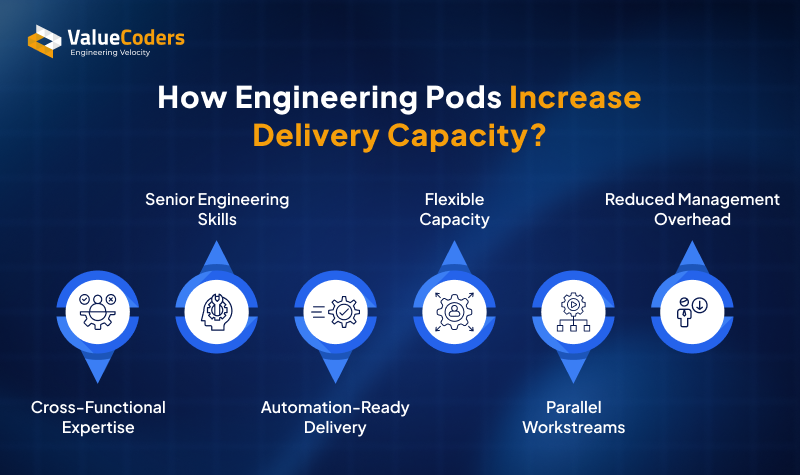
1. Cross-Functional Delivery
- A pod can include developers, QA, DevOps, and a delivery lead.
- The team works around shared goals and defined delivery responsibilities.
- This can reduce handoffs and dependency delays across workstreams.
2. Senior Engineering Expertise
- Senior engineers bring deeper experience to complex product work.
- They can support architecture, integrations, performance, and technical debt.
- This can reduce rework and support more consistent delivery.
3. Automation-Ready Delivery
- Pods can work with CI/CD, automated testing, coding standards, and deployment practices.
- These practices can reduce repetitive work and support consistent releases.
- The exact tools depend on the product and engagement scope.
4. Flexible Capacity Scaling
- Pod capacity can be adjusted as roadmap priorities change.
- This can help SaaS teams respond to changing workstream demands.
- It also reduces reliance on repeated recruitment and onboarding cycles.
Also Read: How to Bootstrap a SaaS Startup in 2026?
5. Parallel Workstream Execution
- Pods can support core development, integrations, modernisation, and maintenance in parallel.
- This helps teams allocate capacity across multiple priorities.
- It can also reduce the pressure on one internal team handling every workstream.
6. Reduced Engineering Management Overhead
- The pod handles agreed delivery responsibilities within the engagement scope.
- This can reduce recruitment and day-to-day team management overhead.
- SaaS leaders can stay focused on product priorities while the pod manages its delivery responsibilities.
This model gives SaaS teams additional engineering capacity without requiring immediate expansion of the internal team. It can support defined workstreams while keeping product priorities with the client team.
Add cross-functional capacity for defined workstreams and keep delivery moving.
When Should SaaS Leaders Consider a Delivery Pod?
Not every SaaS company needs a pod. The model makes sense when roadmap demand exceeds available engineering capacity.
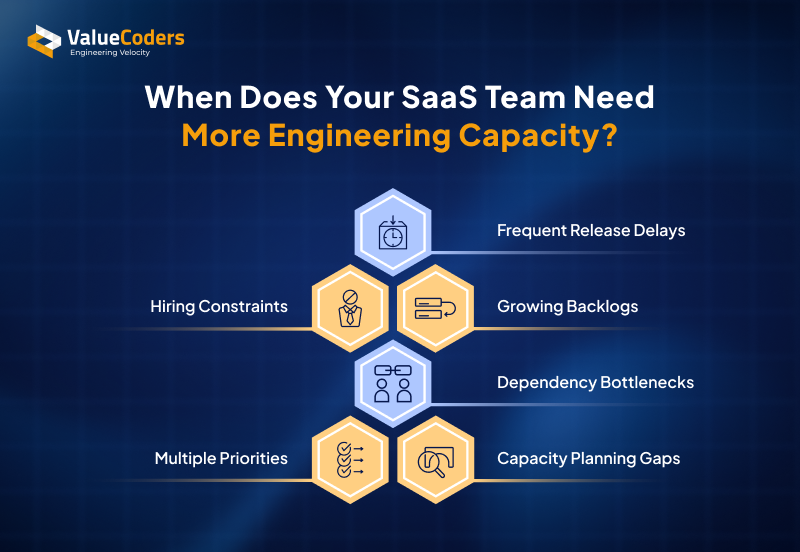
1. Frequent Release Delays
If releases keep slipping, your team may lack enough delivery capacity. A pod can add cross-functional capacity for a defined workstream.
2. Limited Hiring Capacity
Hiring freezes, recruitment delays, or skill shortages can limit team growth. A pod can provide additional engineering capacity without waiting for another hiring cycle.
3. Growing Delivery Backlogs
A growing backlog can signal a capacity gap. Pods can help teams move multiple priorities forward in parallel.
Also Read: How to Launch Your SaaS MVP in 90 Days or Less
4. Persistent Dependency Blocks
Tasks can slow down when several teams own different delivery stages. A cross-functional pod can bring relevant skills together around one workstream.
5. Multiple Priority Streams
SaaS teams often manage features, integrations, maintenance, and modernisation together. Pods can provide dedicated capacity for selected workstreams without disrupting every internal priority.
6. Engineering Capacity Planning Challenges
Roadmap demand can change faster than internal capacity. Engineering capacity planning helps leaders identify where additional skills or delivery capacity may be needed.
A Delivery Pod is most useful when the workstream has clear goals, ownership, and measurable delivery outcomes.
Also Read: How to Ensure SaaS App Security with DevOps?
Engineering Productivity and Software Engineering Efficiency
Adding engineers does not automatically improve delivery. Engineering productivity depends on how teams spend their capacity and how effectively work moves through the delivery process.
SaaS leaders can improve engineering efficiency by looking beyond individual developer output.
1. Reduce Unnecessary Handoffs
Clear ownership can reduce delays between development, QA, DevOps, and product teams.
2. Protect Engineering Focus
Frequent context switching can reduce the time available for meaningful development work. Teams need clear priorities across competing workstreams.
3. Automate Repetitive Work
Testing, builds, deployments, and other repetitive tasks can consume engineering capacity. AI coding assistants can also reduce manual development effort when used with appropriate engineering controls.
4. Track Delivery Signals
Useful engineering productivity measures can include cycle time, release frequency, rework, escaped defects, and blocked work.
5. Improve Team Structure
Developer productivity strategies should also consider team dependencies, ownership, tooling, and delivery processes. Adding people without addressing these constraints can increase coordination overhead.
Software engineering efficiency comes from improving how engineering capacity is used, not simply increasing the number of engineers.
For SaaS teams, the goal is simple: remove delivery friction so engineers can spend more time moving priority work forward.
Also Read: Engineering Team Capacity Planning: How to Keep Sprint Velocity on Track
Which Engineering Model Fits Your SaaS Team?
Additional engineering capacity can take different forms. The right model depends on your roadmap, internal governance, and the type of work that needs support.
| Model | Best fit | How it works |
| Internal Hiring | Permanent capability | Build and manage the engineering capability internally. |
| Team Extension | Existing team needs additional engineers | Engineers work within the client’s existing stack, tools, processes, and cadence. |
| Delivery Pod | Defined workstreams | A cross-functional team takes responsibility for agreed delivery outcomes. |
What ValueCoders Offers SaaS Companies
ValueCoders helps SaaS companies add engineering capacity for defined product workstreams. Our pod-based delivery model brings senior engineering, QA, and DevOps capabilities together around shared delivery goals. Pods can integrate with existing product teams and workflows while supporting roadmap priorities.
1. Senior Pod Expertise
Each pod brings senior engineers with experience across complex product environments. They can support architecture, integrations, performance, and technical debt alongside feature development.
2. Ready-Made Engineering Capacity
Pods provide an alternative to building an internal team from scratch. SaaS companies can add defined engineering capacity without repeating the full recruitment and onboarding process.
3. Structured Delivery Visibility
Pods can operate through structured sprints with defined capacity, clear ownership, and delivery metrics. This gives SaaS leaders visibility into progress, priorities, and delivery outcomes.
Also Read: What Makes a Development Partner Actually Reliable Beyond Clutch Ratings?
4. Integrated QA and DevOps
Pods can include QA and DevOps capabilities alongside engineering. This helps teams bring testing and deployment activities closer to the development workflow.
5. Flexible Roadmap Scaling
Pod capacity can be adjusted as roadmap priorities change. SaaS companies can add capacity for peak demand or reduce capacity when a workstream winds down.
6. Client-Aligned Execution
Pods work within the client’s product priorities, processes, and delivery workflows. The client retains control over product direction and priorities while the pod manages its agreed delivery responsibilities.
Need additional engineering capacity for your roadmap? Talk to our team about a Delivery Pod for your specific workstream.
Your roadmap may need more engineering capacity than your internal team can provide.
Conclusion
SaaS companies do not always need a larger internal engineering team to handle growing demand. They need the right capacity for the right priorities.
Hiring remains valuable when you need permanent engineering capability. But flexible delivery models can help when hiring cannot keep pace with roadmap demands.
Engineering pods provide cross-functional capacity for defined workstreams. They can support feature development, integrations, modernisation, and maintenance without requiring your internal team to handle every priority at once.
The right approach depends on your roadmap, engineering capacity, and delivery goals.
Frequently Asked Questions
1. How do SaaS companies scale without hiring?
Ans. SaaS companies can scale through automation, better processes, and platform engineering best practices. They can also extend capacity without adding full-time employees.
2. What is engineering capacity?
Ans. Engineering capacity is the amount of work a team can complete in a given period. Automation and AI-assisted software development can increase capacity without adding headcount.
3. What is engineering productivity?
Ans. Engineering productivity measures how effectively teams deliver quality software. It includes delivery speed, quality, and efficient use of engineering resources.
4. How can AI improve software development?
Ans. AI can speed up coding, testing, debugging, and documentation. AI-assisted software development also helps engineers spend more time on higher-value work.
5. Should startups hire or outsource?
Ans. Startups can hire for core roles and outsource specialized skills or extra capacity. The right engineering operating model depends on their goals, budget, and workload.