


An Oracle survey states that More than 80% of data migration projects run over time or over budget, with average cost overruns of around 30%.
Many organizations begin a data migration project with a clear budget and timeline. Yet, once the work starts, unexpected challenges begin to appear. Poor data quality, hidden system dependencies, integration issues, and business disruptions often increase both project costs and delivery time.
The biggest expense is rarely moving the data itself. It comes from everything that wasn’t identified before the migration began. That’s why data migration planning is just as important as the migration itself.
In this blog, you’ll explore why data migration projects often cost more than expected, the hidden factors that drive those costs, common estimation mistakes, and how structured planning helps reduce risk and improve project outcomes.
Why Data Migration Projects Go Over Budget
Many organizations assume that data migration simply involves transferring information from one system to another. In reality, it is a business transformation initiative that affects applications, users, workflows, integrations, and operations.
When these factors are overlooked during planning, budgets increase quickly, and delivery timelines become difficult to manage.
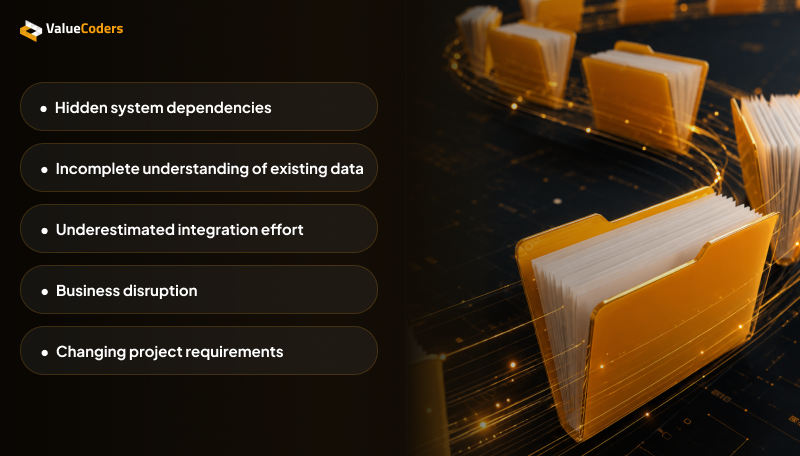
Some of the most common reasons projects go over budget include:
Hidden system dependencies
Many enterprise applications are connected through APIs, databases, reporting platforms, and third-party tools. Migrating one system often affects several others.
Incomplete understanding of existing data
Organizations frequently discover duplicate records, outdated information, inconsistent formats, or missing data after migration begins.
Underestimated integration effort
Enterprise applications rarely work in isolation. Existing integrations often require redesign, testing, or redevelopment before migration is complete.
Business disruption
Migration activities can interrupt daily operations if downtime, user adoption, and operational continuity are not planned properly.
Changing project requirements
Business priorities often evolve during long migration projects. Without clear governance, additional requirements increase both costs and timelines.
Successful migrations begin with understanding the complete business environment rather than focusing only on the technology.
Reduce hidden costs, minimize risks, and migrate with confidence from day one.
The Real Cost Drivers Behind Enterprise Data Migration
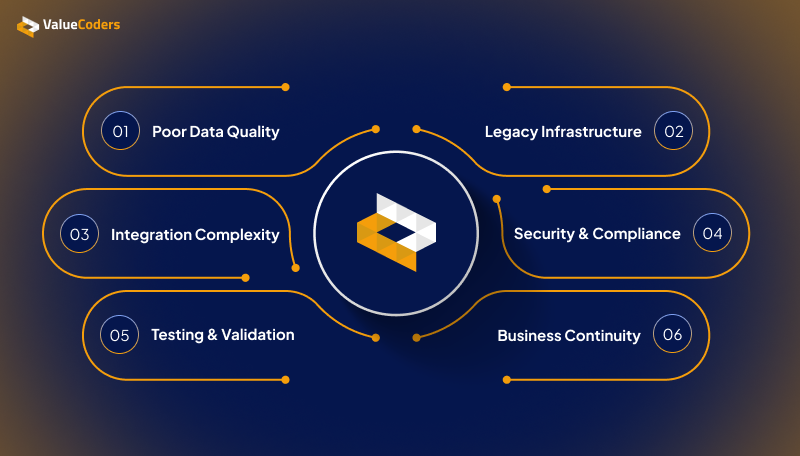
Most organizations estimate migration budgets based on infrastructure and engineering effort. However, the biggest data migration costs often come from hidden challenges that surface during execution.
Poor Data Quality
- Duplicate and inconsistent records require cleanup
- Missing or outdated data affects migration accuracy
- 25%+ organizations lose over USD 5 million annually
Legacy Infrastructure
- Older systems contain undocumented business logic
- Custom configurations increase migration effort
- Legacy dependencies require additional assessment
Integration Complexity
- Enterprise systems exchange data continuously
- Existing APIs and integrations need validation
- Connected applications may require updates
Security & Compliance
- Sensitive data must remain protected
- Compliance requirements increase governance activities
- Access controls and audits require careful planning
Testing & Validation
- Every migrated dataset needs verification
- Business workflows must function correctly after migration
- Performance testing ensures production readiness
Business Continuity
- Downtime should be minimized during migration
- Rollback plans reduce operational risks
- User readiness supports a smoother transition
A successful enterprise data migration strategy addresses these cost drivers before implementation begins. Early planning helps organizations reduce risks, control budgets, and deliver a smoother migration.
Also Read: How Big Data Analytics In Retail Industry Is Transforming The World
Why Traditional Migration Estimates Often Fail
Many migration estimates focus only on technical effort, overlooking the business and operational factors that significantly affect project costs and timelines.
- Estimating by Data Volume: Data size alone doesn’t reflect migration complexity.
- Ignoring Business Dependencies: Connected applications, workflows, and integrations increase migration effort.
- Limited Discovery: Skipping early assessments leaves critical risks unidentified.
- Underestimating Testing: Data, applications, and business processes all require validation.
- No Governance Plan: Poor ownership and decision-making often lead to delays and budget overruns.
A strong data analytics service combines technical assessment with business planning to create realistic estimates, reduce risks, and improve project outcomes.
The Business Risks of Underestimating Migration
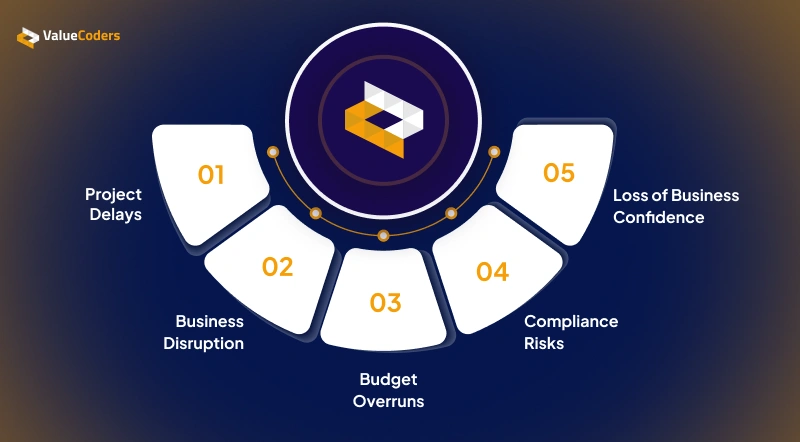
Underestimating migration complexity affects more than your budget. It increases engineering effort, extends delivery timelines, and creates operational costs that were never included in the original estimate.
Project Delays
Unexpected dependencies and rework extend project timelines, increasing engineering effort, vendor costs, and delaying business value.
Business Disruption
Unplanned downtime and workflow interruptions reduce employee productivity and can affect customer experience during migration.
Budget Overruns
Late discovery of data quality issues, integration work, and additional testing often requires extra resources beyond the original budget.
Compliance Risks
Missing governance, audit controls, or data protection measures can result in remediation costs, regulatory exposure, and delayed approvals.
Loss of Business Confidence
Repeated scope changes and missed deadlines reduce stakeholder confidence, making future technology investments harder to approve.
A structured data migration process helps organizations identify these risks early, reduce uncertainty, and complete migrations with greater confidence and control.
Plan smarter with expert guidance that keeps costs, timelines, and risks under control.
How a Structured Discovery Phase Reduces Migration Risk
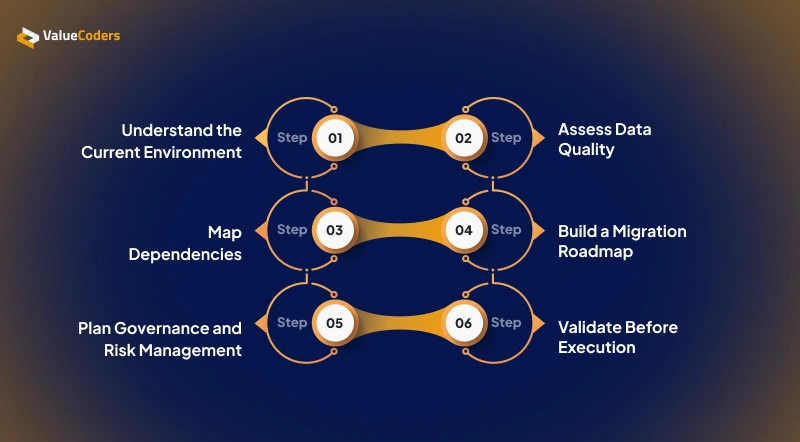
A structured discovery phase helps organizations identify risks before migration begins. Instead of solving problems during implementation, teams can address them early through better planning and governance.
Step 1: Understand the Current Environment
Review your existing applications, databases, integrations, and infrastructure to understand how everything works together.
Step 2: Assess Data Quality
Identify duplicate, incomplete, or outdated data before migration starts to reduce cleanup efforts later.
Step 3: Map Dependencies
Document system integrations, business workflows, and application dependencies to avoid unexpected disruptions.
Step 4: Build a Migration Roadmap
Define the migration scope, timelines, priorities, and rollout approach based on business requirements.
Step 5: Plan Governance and Risk Management
Assign ownership, define validation processes, and prepare rollback plans to keep the migration under control.
Step 6: Validate Before Execution
Review the migration plan with all stakeholders, validate assumptions, and confirm readiness before moving to implementation.
A structured approach supported by data migration consulting helps organizations reduce risks, improve planning accuracy, reduce implementation risk, and avoid costly surprises during migration.
Data Migration Checklist Before You Start
A simple checklist can help you identify gaps before migration begins and reduce unexpected issues later.
- Review Data Quality: Remove duplicate, outdated, and incomplete data.
- Identify System Dependencies: Map connected applications and integrations.
- Define the Migration Scope: Decide what data needs to be migrated.
- Plan for Security & Compliance: Protect sensitive data throughout the migration.
- Prepare a Rollback Plan: Have a recovery strategy if issues occur.
- Validate the Migration Plan: Review timelines, responsibilities, and success criteria.
A structured Data Migration Planning approach helps ensure your migration starts with clarity and ends with fewer risks.
Also Read: What is Rust and Its Role in Machine Learning and Data Science?
When Should You Bring in a Data Engineering Partner?
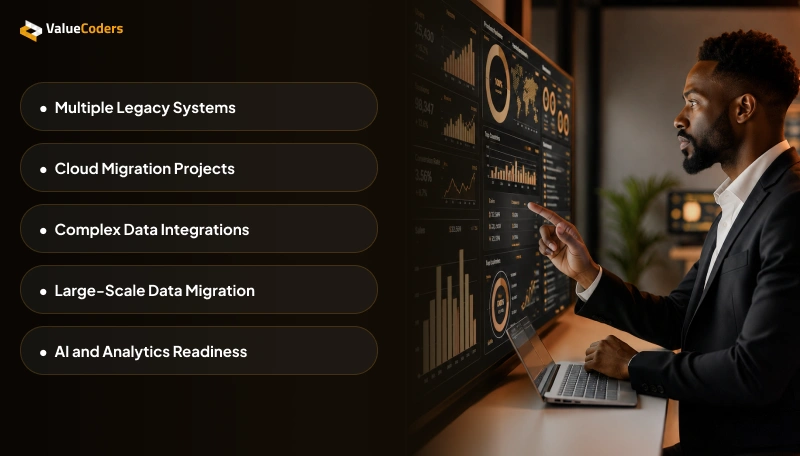
Migration costs increase quickly when technical complexity exceeds internal capacity. Bringing in top data engineers early often costs less than fixing planning mistakes during implementation.
Multiple Legacy Systems
- Modernize outdated platforms
- Simplify complex dependencies
- Reduce migration risks
Cloud Migration Projects
- Plan cloud-ready architectures
- Support phased migrations
- Minimize business disruption
Complex Data Integrations
- Connect multiple data sources
- Validate system integrations
- Ensure consistent data flow
Large-Scale Data Migration
- Manage high-volume datasets
- Improve migration performance
- Support business continuity
AI and Analytics Readiness
- Prepare trusted data foundations
- Improve data quality
- Support future AI initiatives
Early technical expertise helps uncover migration risks, improve estimation accuracy, and reduce costly surprises during delivery.
Build a structured migration plan that ensures secure, predictable, and successful delivery.
Conclusion
Enterprise data migration is about more than moving information from one system to another. It requires careful planning, a clear understanding of business dependencies, and strong governance to avoid unexpected costs and operational risks.
Organizations that invest in structured discovery, accurate estimation, and phased execution are better prepared to deliver successful migrations with minimal disruption.
At ValueCoders, we help businesses plan and execute complex migration projects through structured discovery, governance, and engineering expertise. Our teams work closely with organizations to reduce migration risks, improve delivery predictability, and build scalable data foundations.
Frequently Asked Questions
1. What are the hidden costs of enterprise data migration?
Ans. The biggest hidden costs often come from activities overlooked during planning rather than from the migration itself.
- Data cleanup and validation
- Legacy system dependencies
- Testing and business continuity planning
A structured enterprise data migration approach helps identify these costs before implementation begins.
2. How can businesses reduce data migration risks?
Ans. Reducing migration risks starts with proper planning and governance before any data is moved.
- Assess existing systems and dependencies
- Validate data quality early
- Establish clear ownership and governance
Professional data migration consulting helps organizations minimize risks and improve migration outcomes.
3. Why do data migration projects often cost more than expected?
Ans. Many projects underestimate the effort required beyond moving data, leading to higher costs during execution.
- Incomplete project discovery
- Unexpected integration challenges
- Changes in project scope
A well-defined enterprise data migration strategy provides better cost visibility and realistic project estimates.
4. How can organizations avoid downtime during data migration?
Ans. Business disruption can be reduced through careful planning and phased migration.
- Plan migrations in stages
- Validate systems before go-live
- Prepare rollback procedures
A structured data migration process helps maintain business continuity throughout the migration.
5. How long does an enterprise data migration typically take?
Ans. Migration timelines vary depending on data complexity, system dependencies, and business requirements.
- Size of the migration
- Number of connected systems
- Testing and validation requirements
Experienced top data engineers help create realistic timelines and improve delivery predictability.
6. Why do companies hire data migration consultants?
Ans. Organizations often partner with specialists to reduce complexity and improve migration success.
- Technical expertise and planning
- Risk assessment and governance
- End-to-end migration support
Combining data engineering services with data warehouse services helps organizations deliver secure, scalable, and well-governed migration projects.