

RAG, chatbots, and workflow automation are not interchangeable technologies. Each serves a completely different purpose.
AI cannot compensate for poor system design. If you choose the wrong approach, you increase complexity without improving efficiency.
This guide compares RAG vs Chatbots vs Workflow Automation and explains what each approach actually does, where it fits, and how to avoid expensive implementation mistakes.
How RAG, Chatbots, and Workflow Automation Work
Before we compare them, let us understand what each one actually does. They all fall under AI, but they serve very different purposes.
RAG
RAG pulls answers from your own documents or database. It finds the right information and gives you a clear response based on your data.
When to use:
- Answering questions from internal knowledge bases
- Customer support with company-specific policies
- Any scenario where guessing is not acceptable
Chatbot
A chatbot holds conversations with users. It can be rule-based or powered by LLMs. Its job is to simulate human interaction for simple tasks.
When to use:
- Answering frequently asked questions
- Triaging user requests
- Basic customer support on websites or apps
Workflow Automation
Workflow automation benefits include connecting your essential tools. It moves data from one app to another. It triggers actions like approvals, alerts, or data sync without any manual work.
When to use:
- Automating manual data entry between systems
- Creating approval chains for requests
- Syncing data across CRMs, ERPs, or support tools
Talk to experts who map the right AI approach to your business goals
RAG vs Chatbots vs Workflow Automation: Quick Comparison
Each of these three AI solutions serves a different purpose. One handles conversations. Another retrieves accurate answers from your documents. The third executes tasks across your systems.
Here is how they compare across key technical and functional factors.
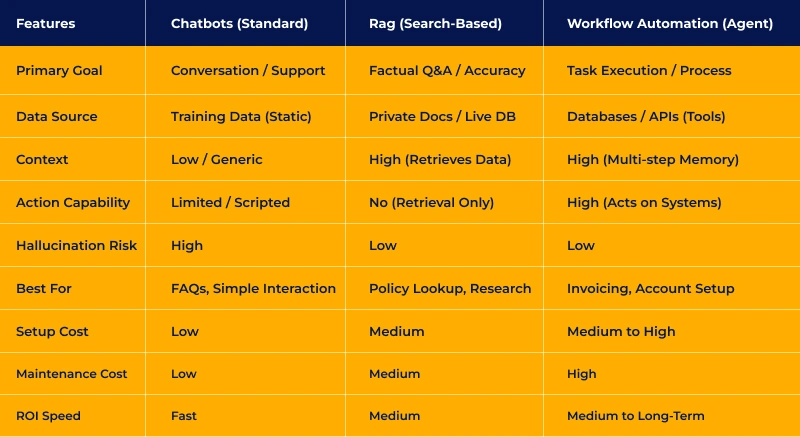
Before you hire chatbot development services or invest in AI workflow automation tools, consider this comparison.
Which One Should You Choose?
The right AI solution depends on your business needs. Some teams need accurate answers, some need better conversations, and others need faster task execution.
RAG
- Accurate answers
- Internal knowledge search
- Private business data
- Policy and document lookup
Chatbots
- User conversations
- FAQs and support
- Lead qualification
- Request routing
Workflow Automation
- Manual task reduction
- Approvals and alerts
- CRM and ERP sync
- Faster operations
Also Read – Chatbots vs. AI Assistants: Which One is Right for Your Business?
Why the Smartest Businesses Use All Three Together
RAG, chatbots, and workflow automation each have strengths. A chatbot alone can talk, but it cannot find answers from your private data. RAG alone can find answers, but it cannot take action. Workflow automation alone can move data, but it cannot hold a conversation.
Think of it as three layers working as one.
| Layer | Role | Tool |
| Front door | Talks to the user | Chatbot |
| Brain | Finds the right information | RAG |
| Hands | Gets the work done | Workflow Automation |
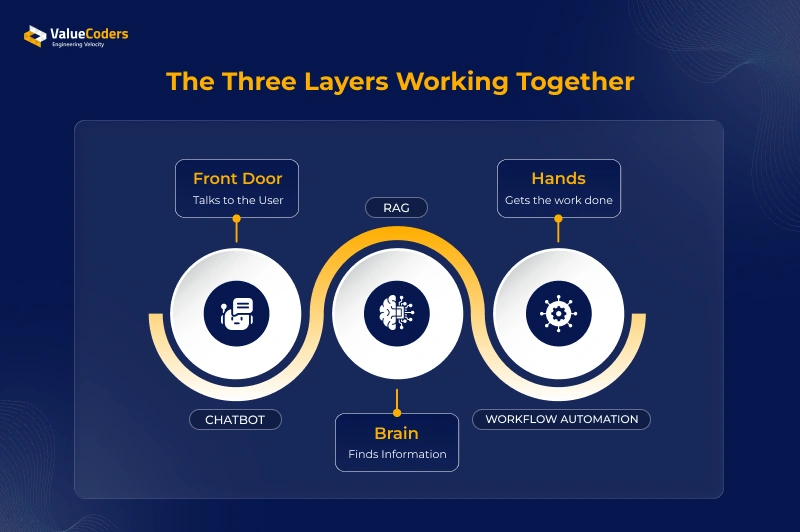
How The Three Layers Work Together
Here is a step-by-step flow of how these three layers work as one system.
Step 1: Chatbot starts the conversation
Here is what the chatbot does:
- The user types a request
- The chatbot understands what the user wants
- It does not guess or act yet
- It simply captures the intent
Step 2: RAG finds the right information
Here is what RAG does:
- The chatbot passes the request to RAG
- RAG goes into your private documents or database
- It pulls the exact information needed to answer or act
- It sends that information back to the chatbot or workflow
Also Read – N8n vs Make vs Zapier vs Agentforce – Which AI Automation Platform Fits Your Business Best?
Step 3: Workflow Automation completes the task
Here is what workflow automation does:
- It takes the information from RAG
- Triggers the right action in your systems
- It sends emails, updates records, or creates tickets
We help you combine chatbot, RAG, and automation into one system
Choosing the Right AI Approach For Your Business
Most AI projects fail because businesses choose the interface first and the workflow later. They start with chatbot interfaces without understanding the real operational problem behind them.
The better approach is to begin with bottlenecks. Identify where work slows down, where errors happen, and where manual effort creates delays. The right AI solution should solve that first.
Not every business needs all three layers. Your choice depends on your objectives, budget, and existing systems.
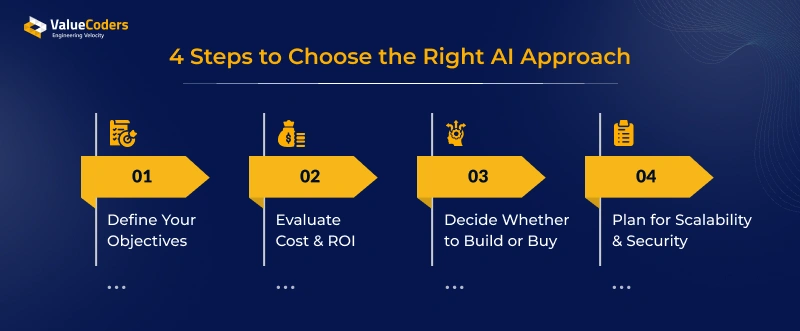
Here are the key factors to consider before you decide.
Define Your Objectives
If you need accurate answers from internal data, start with RAG. If your goal is to handle user conversations at scale, hire top chatbot developers. If you want to automate tasks and reduce manual work, choose workflow automation.
Evaluate Cost & ROI
Focus on long-term value. Choose the option that saves time, reduces effort, and improves consistency. Consider the ongoing effort needed to maintain, update, and scale the system.
Also Read – LLMOps Is the New DevOps – How AI Products Will Be Built & Run in 2026
Plan for Scalability & Security
Make sure the solution can handle growth as usage increases over time. It should support more users, more data, and system connections. At the same time, ensure your data stays secure, and access is properly controlled.
Decide Whether to Build or Buy
Use pre-built tools for simple and quick use cases where setup needs to be fast. Choose custom solutions when workflows are complex or critical to your business. Many teams start small and expand as their needs grow.
How ValueCoders Helps You Build the Right AI Solution
Choosing between RAG, chatbots, and workflow automation is only the beginning. The real value comes from implementing the right solution for your business goals and getting the right AI development services.
At ValueCoders, we help you design and deploy AI solutions tailored to your workflows and operational needs.
Our expertise includes:
- AI Consulting Services to identify the right AI approach
- Custom Development for RAG, chatbots, and workflow automation systems
- Enterprise Integrations with CRMs, ERPs, databases, and internal tools
- Secure, Scalable Deployment built for long-term growth
Whether you need conversational AI, intelligent retrieval, or automated workflows, our team helps you with AI implementation that delivers measurable business value.
Frequently Asked Questions
Que . What is the difference between RAG and a chatbot?
Ans. A chatbot manages conversations, such as FAQs and support chats. RAG improves accuracy by pulling answers from private documents or databases. The chatbot talks to users, while RAG finds the right information behind the response.
Que . Is RAG better than a chatbot?
Ans. RAG is not better than a chatbot because both solve different problems. RAG is best for accurate answers from internal data, while chatbots are better for handling conversations and customer support.
Que . What is AI workflow automation?
Ans. AI workflow automation helps businesses complete tasks automatically across systems. It handles approvals, alerts, ticket creation, and data updates without manual work, saving time and reducing errors.
Que . Can workflow automation work without a chatbot?
Ans. Yes, workflow automation can work without a chatbot. Tasks like invoice approvals, CRM updates, and onboarding can run automatically without any conversation layer.
Que . Should businesses use RAG and chatbots together?
Ans. Yes, many businesses use both together. The chatbot manages the conversation, while RAG pulls accurate answers from internal documents. This improves the quality of support and reduces incorrect responses.
Que . What is the best AI solution for customer support?
Ans. It depends on the support needed. Chatbots handle FAQs, RAG improves answer accuracy, and workflow automation manages actions like tickets and escalations.