AI coding agents are no longer just coding assistants. They can inspect repositories, write code, run tests, and fix issues.
So, when you compare AI coding agents vs. software engineers, what should actually change?
You need to decide which work agents can handle safely and which work needs human judgment.
DORA’s report found tha 90% of developers use AI coding agents at work every week, while 30% report little or no trust in AI-generated code.
Its broader finding is important.
AI can amplify the strengths and weaknesses already present in an engineering organization.
That makes automation a risk and delivery decision, not simply a tooling decision.
The right question is:
What software work can an agent execute safely, what requires engineering review, and what should remain human-led?
AI Coding Agents vs. Software Engineers: What’s the Difference?
AI coding agents and software engineers can both contribute to software delivery, but they operate at different levels of responsibility.
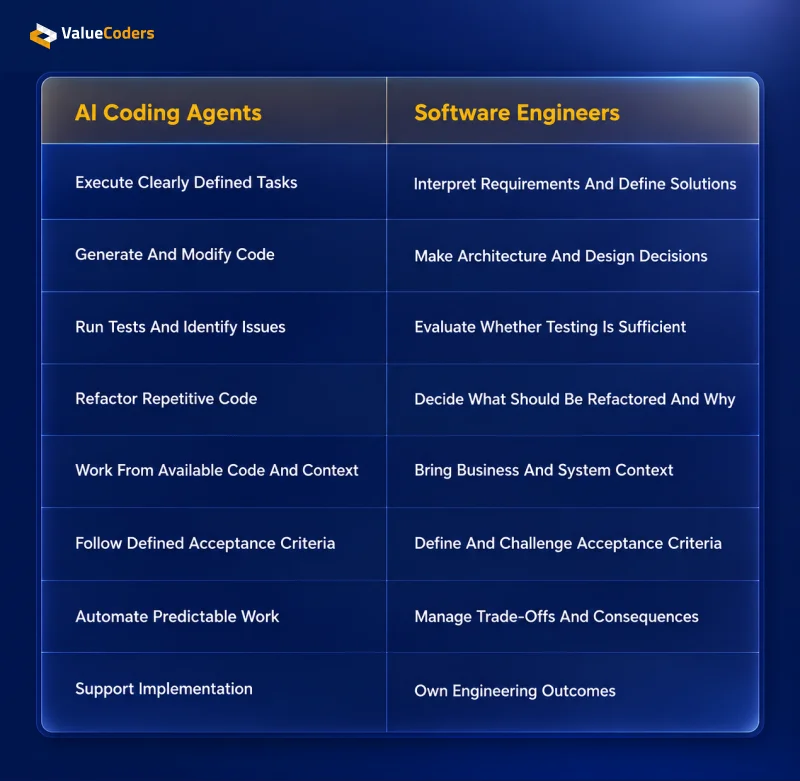
The distinction isn’t that agents can code while engineers cannot. Both can contribute to implementation.
The difference is context, judgment, and accountability.
AI coding agents are most useful when the task is well-defined, the expected outcome is clear, and the result can be validated.
Software engineers remain essential when work requires architectural judgment, business context, security decisions, complex system trade-offs, or accountability for what reaches production.
Combine AI-assisted development with experienced engineering oversight.
When to Use AI Coding Agents vs. Human Oversight
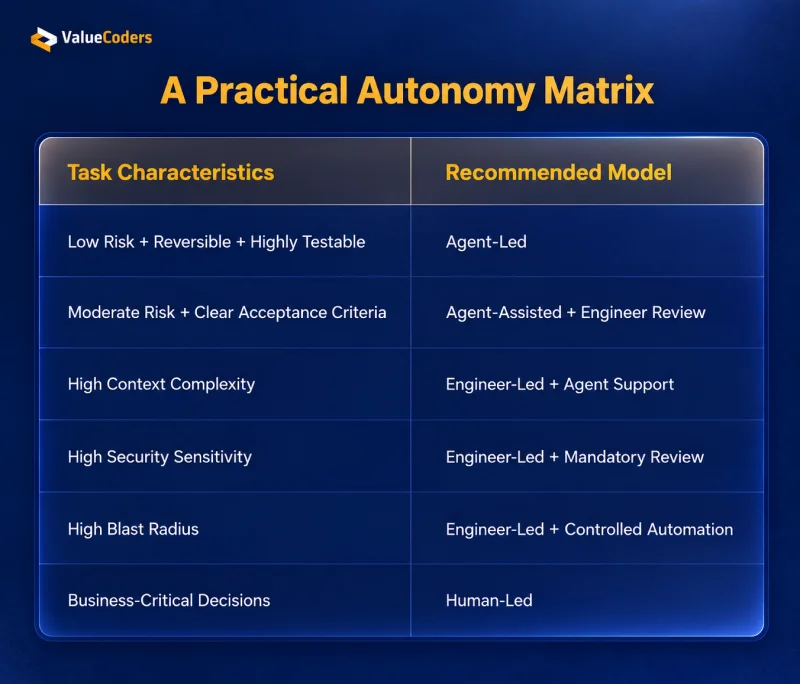
AI coding agents work best when tasks are clearly scoped, low-risk, and easy to validate. For engineering leaders, the goal is to increase team capacity without compromising quality. That means choosing the right work for AI agents for coding.
Agent-Led Execution
Use AI coding agents for repetitive, low-risk, predictable work such as:
- Generating boilerplate code
- Creating test scaffolding
- Updating documentation
- Refactoring repetitive code
- Formatting and code cleanup
- Fixing well-understood, low-risk bugs
These are practical AI coding agent use cases with predictable outcomes. They can reduce manual engineering effort while keeping important decisions with engineers.
AI-Assisted, Engineer-Reviewed
Use agents with human review when changes require more context or broader system awareness, such as:
- Building isolated features
- Updating dependencies
- Implementing standard API integrations
- Refactoring complex modules
- Fixing bugs with unclear or broader impact
Engineers should validate the output, review integration impact and approve changes before production.
Also Read: AI Coding Is Faster. Is It Actually Cheaper?
Engineer-Led Execution
Keep engineers in control of high-impact work, including:
- Architecture changes
- Security-sensitive code
- Changes requiring production access
- High-impact database migrations
- Business-critical logic
The higher the risk, blast radius or business impact, the greater the need for engineering oversight.
The Engineering Automation Boundary
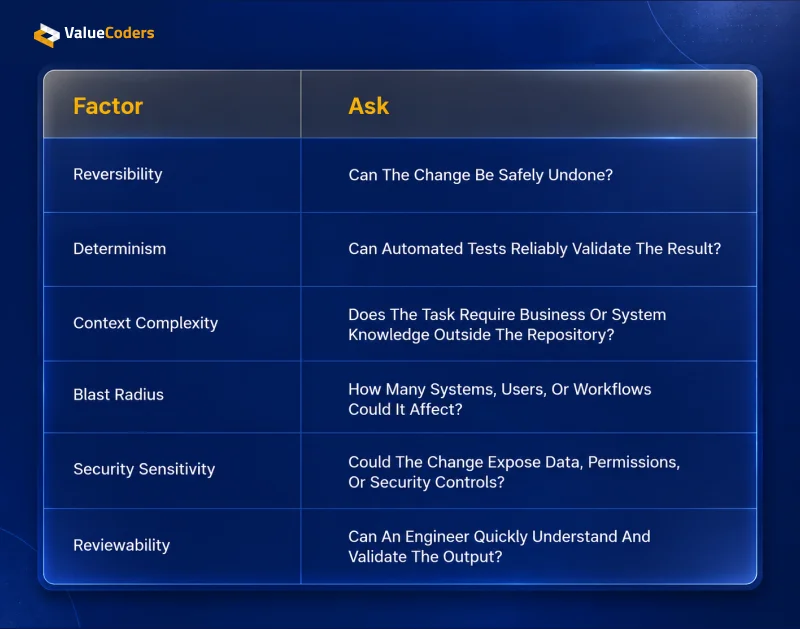
Not every task deserves the same level of agent autonomy. A useful comparison of AI coding agents should examine the task, not just the tool.
Consider these six factors before giving an agent more control.
The higher the risk, the lower the acceptable autonomy should be. This gives teams a practical way to decide where autonomous AI coding agents belong.
Also Read: FinTech’s AI Dilemma: Ship Faster Without Failing the Auditor
Why Production Still Needs Engineering Judgment
AI coding agents can write and test code quickly. But passing tests does not mean production readiness.
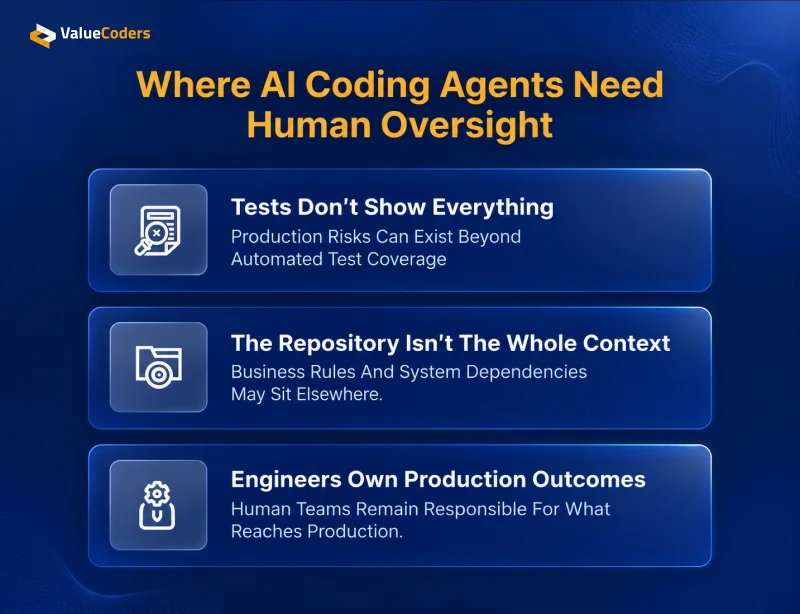
1. Tests Don’t Cover Every Production Risk
- Tests confirm expected behavior under defined conditions.
- They may miss security, performance or operational issues.
- Engineers still need to assess how changes behave in production.
2. Context Extends Beyond the Repository
- Agents can inspect code, dependencies and technical documentation.
- Important business and system context may sit outside the repository.
- Engineers bring that context when reviewing implementation choices.
Also Read: AI in Data Analytics: What It Changes, Where It Breaks, and How to Ship Safely
3. Someone Remains Accountable for the Outcome
- Agents can generate code, run tests and suggest fixes.
- They do not own the result once that code reaches production.
- Engineers remain responsible for quality, security, reliability and production outcomes.
Combine AI-assisted development with human engineering accountability.
How ValueCoders Helps Teams Scale AI-Assisted Engineering
AI can increase development capacity, but engineering oversight still matters. ValueCoders helps teams adopt AI-assisted development within a governed delivery model.
This combines AI-enabled execution with architecture, testing, security, and human engineering ownership.
Depending on the engagement, we can help teams:
- Identify where AI coding agents can safely speed up delivery
- Integrate AI-assisted development into existing engineering workflows
- Strengthen testing and validation for AI-generated changes
- Add specialized engineering capacity when internal teams need support
- Keep architecture and production outcomes clearly owned
Also Read: Why a Successful AI Demo Doesn’t Mean You’re Ready to Launch
Conclusion
AI coding agents can automate more software work than ever before, but not every task should become autonomous.
The right approach is to match autonomy with risk, context and business impact. Automate predictable work, review complex changes and keep high-impact decisions human-led.
This balance can increase engineering capacity without sacrificing quality, security or production reliability. It also gives engineers more time to focus on architecture, complex problems and product-critical decisions.
Need to scale AI-assisted development without losing engineering control?
ValueCoders helps teams introduce AI coding agents into existing workflows with clear review points, engineering ownership and governed delivery.
FAQs
1. What can AI coding agents automate in software development?
Ans. AI coding agents can automate repetitive and predictable development tasks. These include boilerplate generation, test scaffolding, documentation and routine refactoring.
2. Are autonomous AI coding agents better than software engineers?
Ans. Autonomous agents and engineers solve different parts of software development. Agents excel at repeatable execution, while engineers provide judgment, context and accountability.
3. What should software engineers not automate with AI coding agents?
Ans. Engineers should avoid fully automating high-risk architectural and security decisions. Production changes and business-critical logic also need strong human oversight.
4. What are the limitations of AI coding agents?
Ans. AI coding agents can misunderstand context, introduce defects and miss security risks. They also cannot reliably make every architectural or business decision.
5. How can AI coding agents improve developer productivity?
Ans. They can reduce repetitive work and give engineers more time for higher-value tasks. The largest gains come when teams choose suitable AI coding agent use cases.
6. Can AI coding agents replace software engineers?
Ans. AI coding agents can automate parts of engineering work. They do not replace the judgment, ownership and accountability required from experienced engineers.
7. How will AI coding agents affect software engineering in the future?
Ans. Engineers will likely spend less time writing routine code. They will spend more time defining requirements, reviewing outputs, and managing agent workflows.
8. What are the best use cases for AI agents for coding?
Ans. The strongest use cases involve predictable tasks with clear acceptance criteria. Testing, documentation, repetitive refactoring and routine code generation are strong examples.