

A Gartner report states that at least 30% of AI projects are abandoned after the proof-of-concept stage due to poor data quality, inadequate risk controls, rising costs, or unclear business value.
A successful demo proves that an AI solution can work in a controlled environment. Many organizations start this process with an AI readiness assessment before moving into architecture and implementation. Your team must ensure the solution can operate with live business data, integrate with enterprise systems, scale with demand, and meet security, compliance, and governance requirements.
In this blog, you’ll learn why moving from AI prototype to production is often more difficult than building the prototype itself.
AI Prototype vs Production: Why AI Demos Create False Confidence
A successful demo proves that an AI product can solve a defined problem. It does not prove the product is ready for production.
Many organizations assume that once the model delivers accurate results in a prototype, the remaining work is minimal. In reality, AI proof of concept vs production is where most engineering challenges emerge.
Why a successful demo doesn’t mean you’re ready to launch:
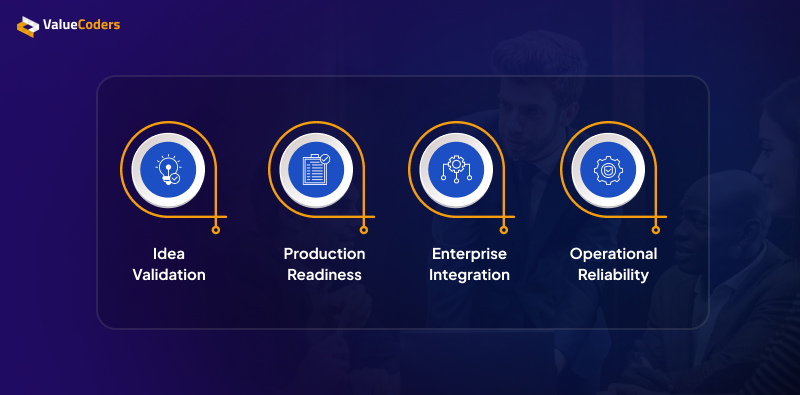
- A demo validates an idea, not a production system. It confirms technical feasibility but doesn’t test how an AI product performs in real business environments.
- Production introduces new requirements. Security, scalability, governance, compliance, and monitoring become essential before deployment.
- Enterprise integrations add complexity. The product must work seamlessly with existing applications, data sources, and business workflows.
- Reliable operations matter more than a working model. An AI product must deliver consistent performance, adapt to changing business needs, and remain reliable long after launch.
A successful demo is an important milestone, but AI readiness requires production engineering, operational readiness, governance, and a clear strategy for moving beyond the prototype.
The Demo Is Not the Product
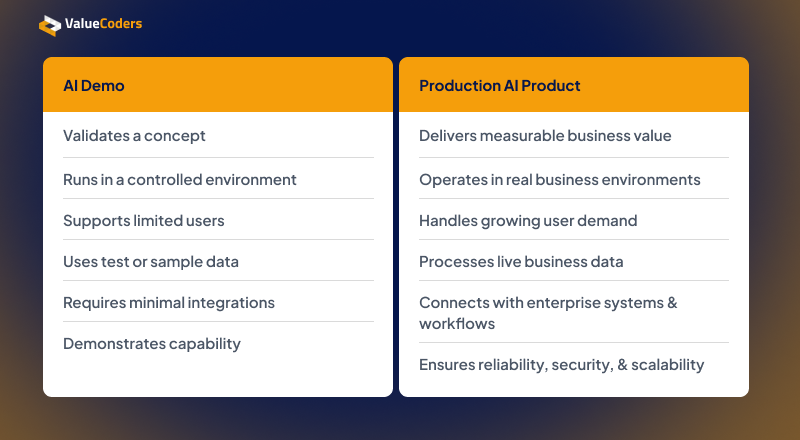
The difference between AI proof of concept and production goes far beyond model accuracy. A demo is designed to validate an idea, while a product is built to deliver reliable business value over time.
Turn promising prototypes into AI products that are ready for real business use.
The Five Readiness Gaps Between a Demo and Production
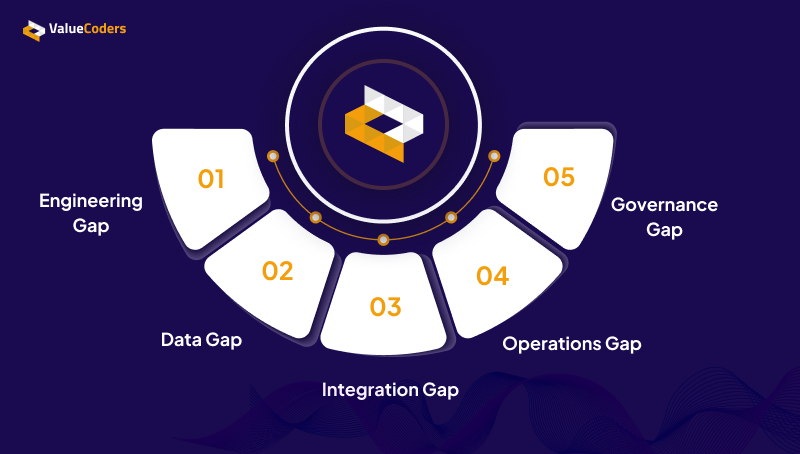
A successful demo proves that an AI product can solve a problem. Production readiness is about proving your organization can deploy, operate, govern, and scale that solution successfully.
As organizations move from prototype to production, they often discover gaps that were never visible during the demo stage. Closing these gaps is essential to building production AI systems that are secure, reliable, and ready to scale.
Engineering Gap
A prototype is built to validate an idea, while a production system is built for reliability. Scalable architecture, deployment infrastructure, performance, and fault tolerance become essential before launch.
Data Gap
A production AI system must work with live business data that changes constantly, comes from multiple sources, and can introduce data drift and changing business conditions.
Integration Gap
AI-powered applications cannot operate in isolation
AI-powered applications must connect seamlessly with enterprise applications, databases, APIs, and existing business workflows to support successful enterprise AI implementation.
Also Read: AI Didn’t Lower the Bar for Engineers. It Raised It
Operations Gap
Production systems require continuous system and model monitoring, performance optimization, cost management, and regular updates to remain effective.
Governance Gap
Most of these challenges remain hidden during a proof of concept because the environment is controlled and the number of users is limited.
A successful AI demo validates the concept. Closing these five readiness gaps prepares your organization to launch, operate, and scale an AI product with confidence.
Prepare your AI product for enterprise deployment with the right architecture and delivery strategy.
Moving from Prototype to Production
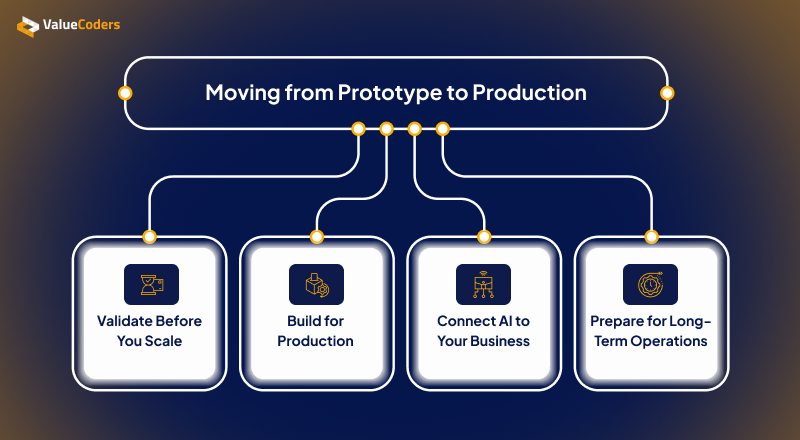
A successful AI prototype validates the concept. A production-ready AI product delivers consistent business value through disciplined AI product development. Bridging the gap requires more than improving the model; it requires preparing the entire product for real-world use through a structured AI deployment strategy.
Validate Before You Scale
Before investing in production, make sure the product solves the right business problem.
- Define clear business objectives.
- Validate the use case with real users.
- Measure success against business outcomes.
Build for Production Readiness
Design the product to perform reliably beyond a controlled demo environment by following AI engineering best practices.
- Create a scalable system architecture.
- Plan for security and performance.
- Support future growth and enhancements.
Prepare for Enterprise Integration
An AI product creates value only when it works within your existing ecosystem.
- Integrate with enterprise applications.
- Connect live data sources securely.
- Automate business workflows where needed.
Also Read: AI Readiness Checklist for Tech Companies in 2026
Prepare for Long-Term Operations
Launching an AI product is the beginning, not the finish line.
- Monitor performance continuously.
- Improve the product using user feedback.
- Maintain governance and compliance as the product evolves.
Moving from prototype to production isn’t a single deployment event. It’s a journey that combines engineering, operations, governance, and business alignment to support reliable AI deployments at scale.
Signs Your AI Project Is Ready for Production
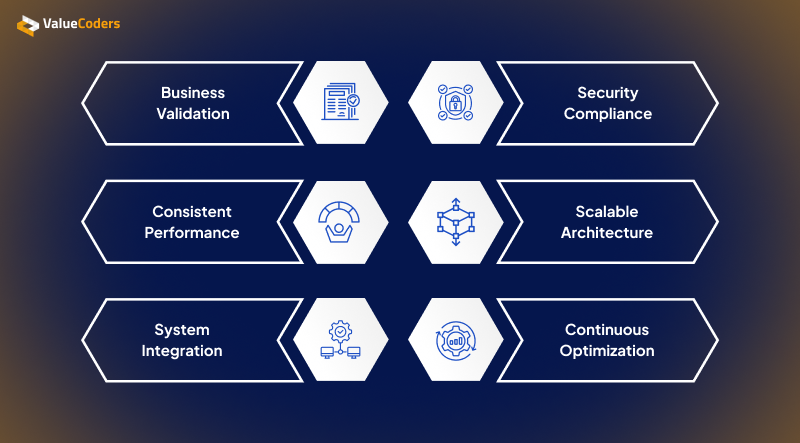
A working demo is just one milestone. The real indicator of success is whether your AI product is prepared to operate reliably in a live business environment. Here are the signs that your project is ready to move beyond the prototype stage.
- You’re solving real business problems, not just showcasing AI capabilities.
- The product performs consistently with live data, real users, and changing business conditions.
- The AI product is fully integrated into your existing applications and business workflows.
- Security, governance, and compliance have been addressed before deployment, not after.
- Your architecture is designed to scale without affecting performance or user experience.
- You have a clear plan to monitor, maintain, and continuously improve the solution after launch.
A successful launch isn’t defined by how well your AI product performs during a demonstration. It’s defined by how reliably it delivers value when real users depend on it every day.
Launch secure, scalable AI products designed for long-term growth and operational reliability.
Conclusion
A successful AI demo proves that an idea works. A production-ready AI product proves your business can rely on it. The difference lies in scalable architecture, enterprise integrations, governance, and operational readiness, not just the AI model.
Organizations that invest in production engineering, governance, and operational readiness build stronger AI readiness and are better prepared to move AI projects from pilot to production. That preparation determines whether an AI project becomes a production system or remains a successful demo.
We at ValueCoders, an enterprise software development company, help you move from prototype to production by combining production engineering with secure, scalable AI products built for real-world deployment.
Ready to move your AI project into production? Talk to our experts.
FAQs
1. Why do many AI prototypes fail to reach production?
Ans. Many AI prototypes fail because they are built to prove an idea, not to support real business operations. Challenges such as system integration, data quality, security, scalability, and governance often appear only when organizations prepare for production.
2. What makes an AI application production-ready?
Ans. A production-ready AI application is secure, scalable, and reliable. It works with live business data, integrates with existing systems, supports real users, and includes monitoring, governance, and ongoing maintenance.
3. How do you move an AI proof of concept (POC) into production?
Ans. The process starts by validating the business case, building a scalable architecture, integrating the AI solution with existing systems, implementing security and governance, and continuously monitoring performance after deployment.
4. Why isn’t a successful AI demo enough for enterprise deployment?
Ans. A successful demo shows that an AI product can solve a problem, but it does not prove the solution can handle real users, live data, enterprise integrations, security requirements, or long-term operations. These capabilities are essential before deployment.
5. What are the biggest challenges in deploying AI systems to production?
Ans. The biggest challenges include integrating AI with existing systems, maintaining data quality, ensuring security and compliance, managing performance at scale, and continuously monitoring and improving the solution after launch.
6. How does software architecture affect AI production readiness?
Ans. Software architecture provides the foundation for a production AI system. A well-designed architecture improves scalability, reliability, security, and performance, making it easier to support business growth and future enhancements.
7. What role does MLOps play in AI product development?
Ans. MLOps helps teams deploy, monitor, update, and maintain AI models throughout their lifecycle. It improves reliability, simplifies model management, and supports continuous improvements after the AI product goes live.
8. How can organizations create an effective AI implementation strategy?
Ans. An effective AI implementation strategy starts with a clear business objective, followed by use case validation, scalable architecture, quality data, enterprise integrations, security planning, and continuous performance monitoring.
9. How do you scale AI applications from pilot projects to enterprise deployment?
Ans. Scaling AI requires more than expanding the model. Organizations need reliable architecture, enterprise integrations, secure data pipelines, governance, monitoring, and a clear plan to support increasing users and workloads.
10. What security and compliance requirements should production AI systems meet?
Ans. Production AI systems should protect sensitive data, enforce access controls, meet industry regulations, maintain audit logs, and follow responsible AI practices based on the organization’s compliance requirements.
11. How can businesses reduce the risks of AI deployment failures?
Ans. Businesses can reduce deployment risks by validating business goals early, designing scalable architecture, integrating AI with existing systems, addressing security and governance before launch, and continuously monitoring performance after deployment.