


Data is often described as one of the most valuable resources a business owns. But simply collecting more data doesn’t make it valuable. According to Gartner, poor data quality costs organizations an average of $12.9 million every year. This highlights why building reliable data foundations matters more than simply collecting more information. If your data is spread across multiple systems or is inconsistent, it creates confusion.
Data engineering changes that. It helps businesses organize, clean, and connect their data. The result?
- Better decisions
- More reliable analytics
- Reliable AI outcomes
With the right enterprise data infrastructure, raw data becomes a trusted business asset.
In this blog, you’ll learn why engineering matters more than collection and how modern data engineering helps businesses unlock the full value of their data.
Build trusted data foundations that improve reporting, analytics, and AI readiness.
Why Do So Many Businesses Struggle to Use Data?
Collecting data is just the beginning. To get real business value, companies need clean data. But as data grows, many businesses find it hard to manage.
Common challenges include:
- Separate systems create duplicate or inconsistent data.
- Limited visibility makes it hard to see the full picture.
- Growing data becomes harder to manage.
- Inconsistent data leads to unreliable reports.
Also Read: Top Data Engineering Companies to Watch in 2026
What Makes Data a True Business Asset?
Not all data creates business value. Simply collecting large amounts of data doesn’t make it useful. For data to become a business asset, it must be accurate.
This is becoming even more important as businesses invest in analytics and AI.
According to a 2026 Gartner survey, organizations with successful AI initiatives invest up to 4X more in data foundations than those with poor AI outcomes.
For data to be a true business asset, it needs to be:
- Accurate: It reflects real business information without duplicates or outdated records.
- Accessible: People can quickly find and use the data they need.
- Consistent: Reports and dashboards show the same information across teams.
- Well-governed: Clear policies define how data is stored and maintained across the organization.
- Ready for analytics: The data is clean, well-organized, and sufficiently structured to support dashboards.
Building these qualities requires effective data asset management. Clear processes help businesses maintain data quality and keep teams aligned.
Turn fragmented data into trusted business-ready information today.
How Data Engineering Turns Data into a Business Asset
Data engineering is the process of collecting, organizing, and preparing data. It creates a reliable data flow from different sources, making it easier to use across the organization.
A modern data engineering framework helps businesses move beyond simply storing data. It improves data quality and creates a trusted foundation.
The process typically involves the following stages:
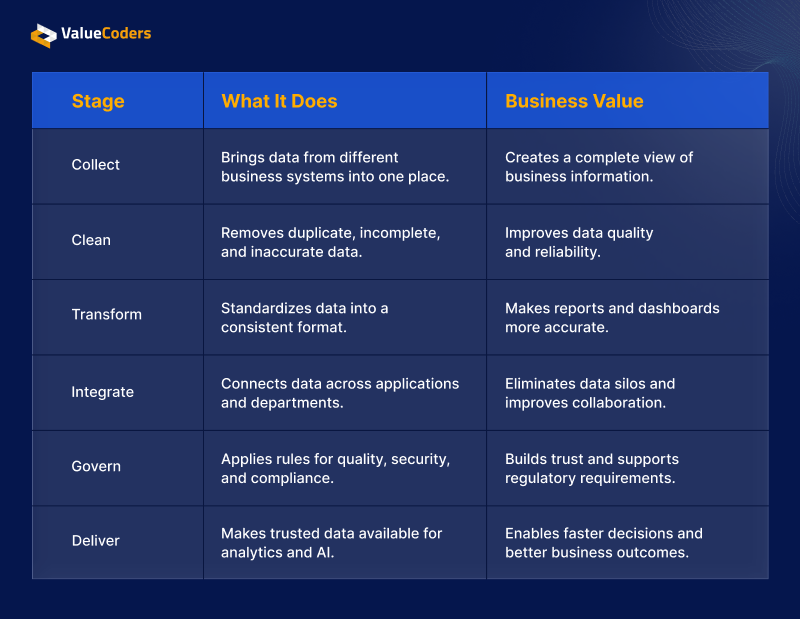
Instead of spending time fixing data issues, teams can focus on finding insights. This is why data engineering plays a critical role in helping organizations treat data as a long-term business asset.
Building Modern Enterprise Data Infrastructure
A strong enterprise data infrastructure helps businesses manage growing volumes of data. Instead of keeping information in separate systems, it brings everything together so teams can easily access, manage, and use trusted data.
A modern data infrastructure includes five key components:
Data Pipelines
Data pipelines automatically move data between different systems. This reduces manual work, saves time, and keeps information up to date across the business.
Centralized Storage
Centralized storage keeps business data in one place. It creates a single source of truth, so every team works with the same, up-to-date information.
Data Quality Checks
Data quality checks identify and fix issues such as duplicate records, missing values, and incorrect formats. This helps ensure reports and dashboards are accurate and reliable.
Data Governance
Data governance sets clear rules for how data is collected, stored, accessed, and protected. It also helps businesses meet security and compliance requirements.
Monitoring and Maintenance
Monitoring tracks the health of data systems and quickly detects issues before they affect business operations. Regular maintenance keeps data reliable and available when teams need it.
When top data engineers use these components together, businesses spend less time fixing data issues and more time using trusted information to improve decision-making, customer experiences, and business growth. They also create a stronger foundation for analytics and AI.
Build data systems that support faster decisions and reliable business intelligence.
How Engineered Data Supports Business Growth
Good data does more than improve reports. It helps businesses make faster decisions, improve customer experiences, and get more value from analytics and AI.
When data is accurate, connected, and easy to access, businesses can:
- Make faster decisions with reliable, up-to-date information.
- Improve reporting by giving every team the same view of the data.
- Deliver better customer experiences through more accurate insights.
- Support analytics and AI with clean, trusted data.
- Reduce manual work by automating data movement and preparation.
- Scale with confidence as data volumes and business needs grow.
Also Read: Top 10 Big Data Analytics Firms in India
Best Practices for Building Data as an Asset
Building data as an asset takes more than collecting information. These best practices help create a reliable foundation for long-term business value.
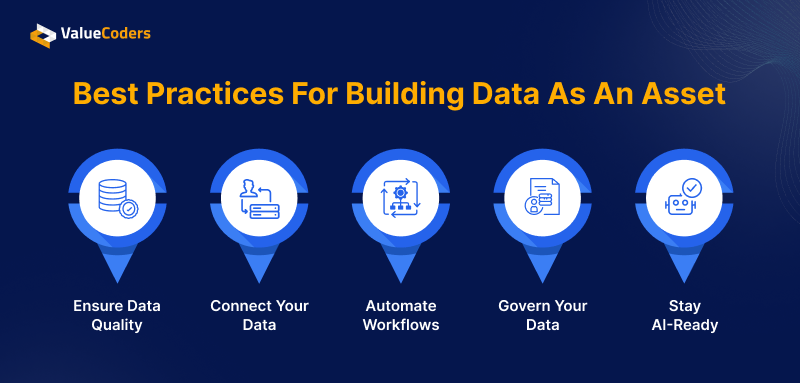
Ensure Data Quality
Keep data accurate, complete, and up to date to support better decisions.
Connect Your Data
Bring data from different systems together so every team works with the same trusted information.
Govern Your Data
Set clear rules for managing, accessing, and protecting business data.
Automate Workflows
Reduce manual work by automating data movement and quality checks.
Stay AI-ready
Organize data so it is ready for analytics, reporting, and AI.
These practices help businesses build trusted data that supports growth and creates long-term value.
Build modern data engineering foundations that transform raw data into trusted insights.
Conclusion
Collecting data is no longer enough. To create real business value, organizations need data that is accurate, connected, and ready to support analytics and AI. That’s what turns data as an asset from an idea into a business advantage.
Modern data engineering provides the foundation for trusted data. It improves quality, removes silos, and helps businesses make faster, more informed decisions. As data continues to grow, investing in the right foundation today will help your business stay ready for tomorrow’s opportunities. Partnering with the right provider of Data Engineering Services can help organizations build a scalable data foundation that supports long-term growth and innovation.
Frequently Asked Questions:
1. How does data engineering create business value from data?
Ans. Data engineering cleans, organizes, and connects data from different sources. This makes data more reliable, easier to access, and ready for analytics and AI, helping businesses make better decisions.
2. What are the key components of a modern data infrastructure?
Ans. A modern data infrastructure includes data pipelines, centralized storage, data quality checks, data governance, and monitoring tools. Together, they help businesses manage and use data more effectively.
3. How do you turn raw data into a business asset?
Ans. Raw data becomes a business asset when it is cleaned, organized, and governed properly. Many businesses also use Asset Management Solutions to keep data accurate, secure, and easy to use.
4. How do data pipelines support analytics and AI?
Ans. Data pipelines automatically move and prepare data for dashboards, reports, and AI models. They ensure businesses always have accurate and up-to-date data for better insights.
5. How much does it cost to implement a modern data engineering strategy?
Ans. The cost depends on your business size, data volume, existing systems, and project requirements. A detailed assessment helps determine the right solution and budget.
6. What challenges do companies face when managing large volumes of data?
Ans. Common challenges include data silos, poor data quality, duplicate records, growing data volumes, and security concerns. These issues make reporting and decision-making more difficult.
7. How can businesses eliminate data silos and fragmented systems?
Ans. Businesses can eliminate data silos by integrating data into a centralized platform and following strong Data asset governance practices. This creates a single, trusted source of data across the organization.
8. What are the best practices for building enterprise data pipelines?
Ans. Automate data movement, validate data quality, monitor pipeline performance, and build pipelines that can scale as your business grows. Regular maintenance also keeps data reliable.
9. How does engineered data improve business intelligence and reporting?
Ans. Engineered data is clean and consistent, making reports more accurate and dashboards more reliable. This helps businesses make faster and more informed decisions.
10. Why do many businesses fail to get value from their data?
Ans. Many businesses struggle because their data is scattered, inconsistent, or poorly managed. Investing in Data Analytics Services and strong data engineering helps turn data into a valuable business asset.