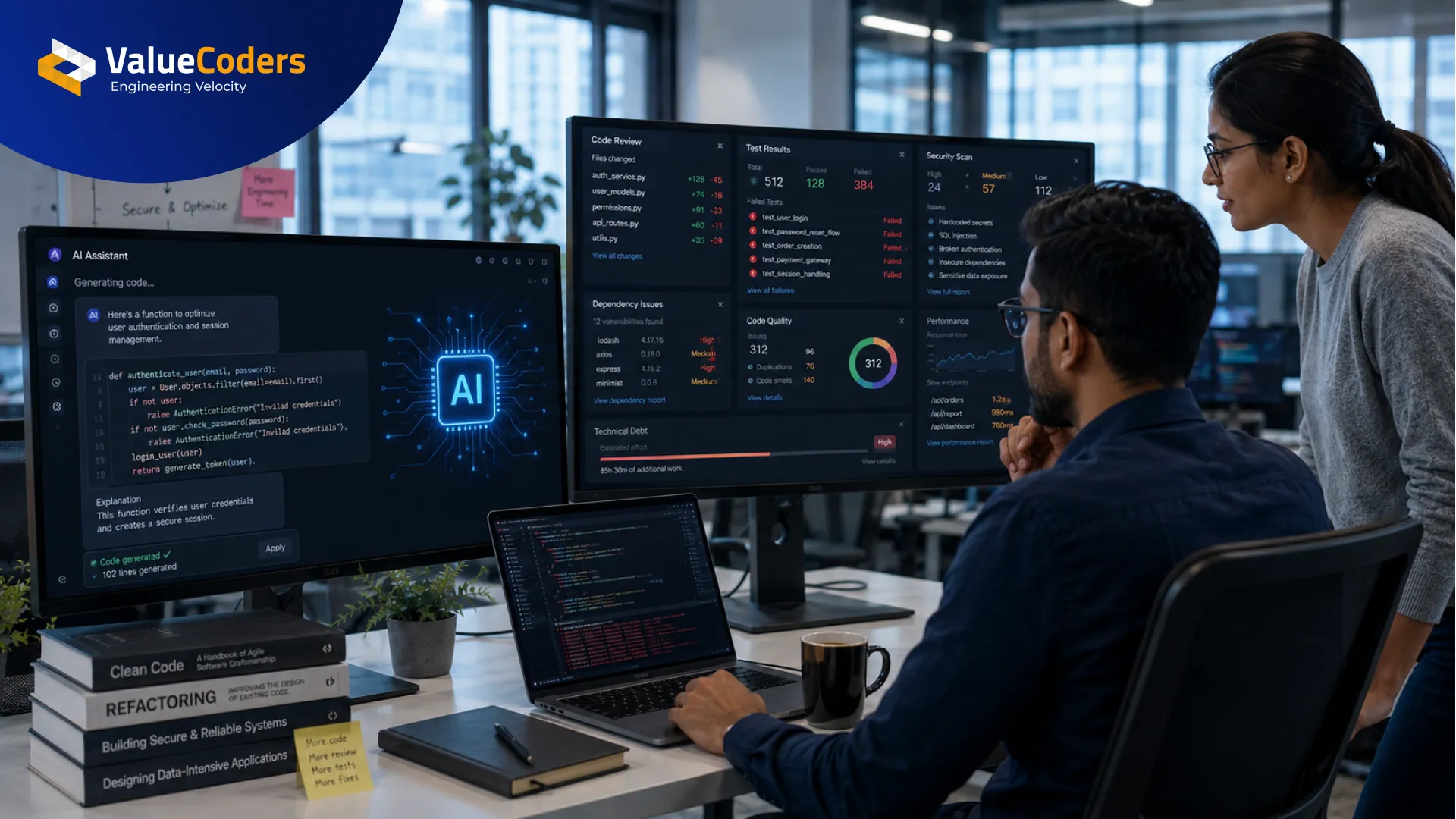
AI coding has moved far beyond experiments and weekend prototypes. In JetBrains’ Developer Ecosystem Survey 2026, 90% of professional developers said they use AI coding agents at work at least weekly, and 68% use them daily.
That adoption is changing how software gets built, reviewed, tested, and maintained. Early results can look impressive as features ship faster and development friction drops sharply.
The challenge begins when AI-generated code becomes the foundation of a growing product. Users increase, more developers contribute, and integrations introduce new dependencies. That is where the vibe coding hangover begins.
The software still works. But maintaining, debugging, and extending it becomes increasingly difficult. The real question is no longer whether AI can generate code. It is whether engineering teams can safely own that code as systems scale, and when it’s time to bring in AI-built rescue support.
Why AI-Generated Software Works So Well at First
AI-generated software is highly effective during rapid product development because it removes much of the initial implementation friction.
Teams can:
- Build features quickly
- Test product assumptions earlier
- Automate repetitive development work
- Connect APIs and services faster
- Put an MVP in front of users sooner
For a funded founder or small product team, this speed is valuable. It can be the difference between finding product-market fit and running out of runway.
The problem starts when prototype success is mistaken for scalability. As the product grows, shortcuts become costly. Architecture, testing, security, and governance matter more than they did when the only goal was to get something working. This is where top AI engineers make the difference.
Also Read: Navigating the World of AI Development: Opportunities & Challenges
What the First 6 Months Can Look Like After Launch
The first few months after launch can feel very different from the development phase. As real usage increases, issues that were not visible in the MVP can start affecting the product.
Months 1–2: Early Growth
Teams focus on fixing bugs, responding to users, and shipping new features quickly. The codebase may still feel manageable, even when early shortcuts were taken.
Months 3–4: More Complexity
More users, data, integrations, and features begin creating dependencies across the product. Duplicated logic, inconsistent patterns, and testing gaps may start slowing changes.
Months 5–6: Engineering Friction
Changes become harder to make safely as the product and codebase grow more complex. Developers may spend more time debugging, fixing regressions, and working around architectural limitations.
The timeline varies by product, but the shift is similar: the focus moves from building quickly to maintaining and changing the product safely.
Our engineers can review your codebase and show you where the risk sits.
5 Risks That Can Surface as AI-Generated Software Scales
AI-generated software can speed up delivery, but scaling it brings new challenges. The tools help your team move faster. The engineering discipline around them has to scale too.
Here are the five risks teams need to watch as AI-generated software grows.
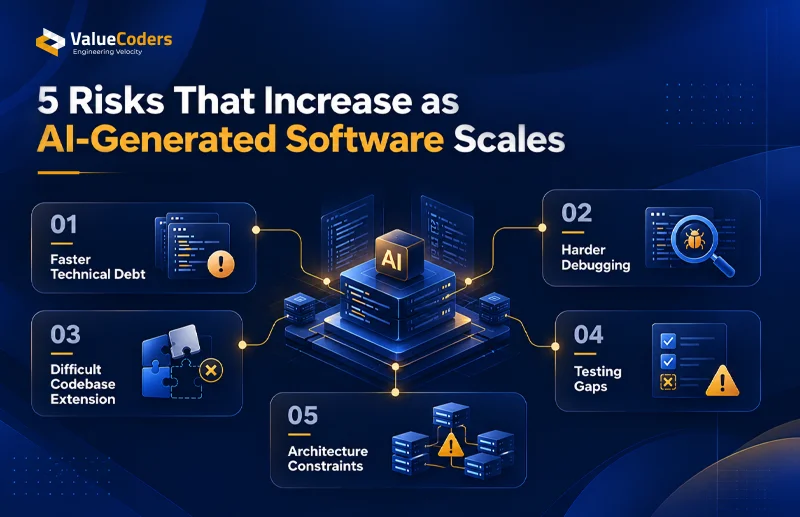
1. Technical Debt Accumulates Faster
AI can increase development speed without automatically improving architectural quality. Generated features may introduce duplicated logic, unnecessary dependencies, inconsistent patterns, or shortcuts. These decisions are easy to overlook when the priority is getting an MVP working.
Technical debt becomes harder to manage when:
- Similar features follow different patterns
- Dependencies grow without clear ownership
- Business logic becomes duplicated
- Quick fixes become permanent
- Refactoring keeps getting postponed
What helps: agree a small set of coding conventions, review every generated change against them, and schedule refactoring as roadmap work rather than spare-time work.
2. AI-Generated Code Becomes Harder to Debug
AI-generated code can appear correct while remaining difficult to understand. This becomes more challenging when generated code interacts with databases, authentication, third-party APIs, or business-critical workflows. Developers need to understand both what the code does and why it works.
Debugging becomes harder when:
- Code contains unclear assumptions
- Errors span multiple generated components
- Business logic lacks context
- Fixes create unexpected side effects
- Developers cannot explain why a fix works
What helps: require a human to review and understand every change that reaches production, and invest in logging and observability before you need them in an incident.
3. The AI-Generated Codebase Becomes Difficult to Extend
A product may initially be built successfully by one founder or developer using AI coding tools. Then another engineer joins. If architectural decisions, conventions, and business logic are unclear, new developers cannot contribute confidently without extensive context.
An AI-generated codebase becomes a liability when:
- Documentation is incomplete
- Similar features use different patterns
- Business logic is scattered
- Tests provide little context
- Architectural boundaries are unclear
What helps: document the architecture and key decisions while the original builder is still around, and give new engineers a clear map of where business logic lives.
4. Testing Doesn’t Keep Pace With Code Generation
AI can generate implementation faster than teams can validate it. More code does not automatically mean more meaningful test coverage.
Testing gaps become costly when:
- Critical workflows lack coverage
- AI-generated tests check the wrong behavior
- Integration scenarios are overlooked
- Regression testing remains manual
- Developers lack confidence in production changes
What helps: start with automated tests for the workflows that would hurt most if they broke, such as sign-up, payments and core data changes, and run them on every release.
5. Architecture Starts Breaking Under Real-World Scale
Prototype architecture proves that something works. Production architecture must keep working as users, data, integrations, and feature complexity increase. AI-built applications can struggle when early architectural shortcuts meet real production demands.
Architecture becomes a growing constraint when:
- Database performance starts degrading
- API bottlenecks become frequent
- Infrastructure costs increase
- Integrations become fragile
- New features require complex workarounds
What helps: find the two or three constraints that limit growth most, fix those first, and avoid a full rebuild unless the foundation genuinely can’t be saved.
Also Read: AI Coding Is Faster. Is It Actually Cheaper?
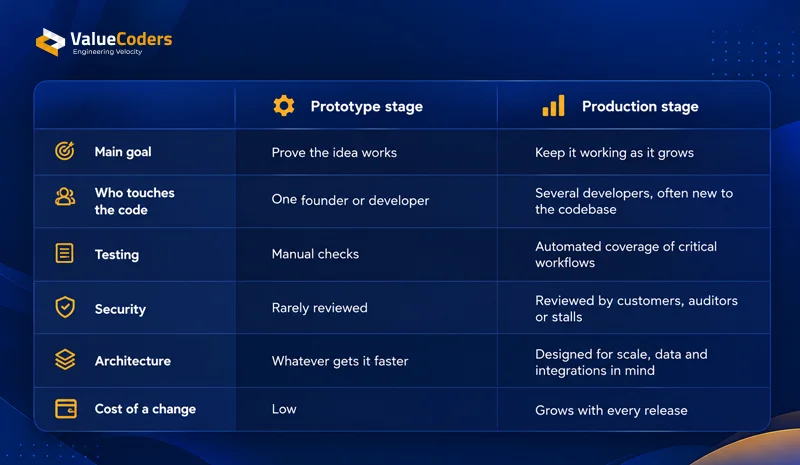
The Vibe Coding Hangover: When Prototype Speed Meets Production Reality
The vibe coding hangover starts when a team moves from “Can we build this?” to “Can we keep building this reliably?”
Real customers introduce pressure that prototypes can avoid:
- Production reliability
- Security reviews
- Multiple developers
- Existing data
- Growing integrations
- Performance expectations
- Increasing roadmap complexity
If developers spend more time investigating generated code, fixing regressions, or avoiding fragile areas, the product may have reached an engineering scaling wall.
When an AI-Built Product Needs Engineering Intervention
If your AI-built product has moved beyond the MVP stage and now has real customers, growing usage, or a larger engineering team, these five problems are strong signals that the codebase needs engineering intervention:
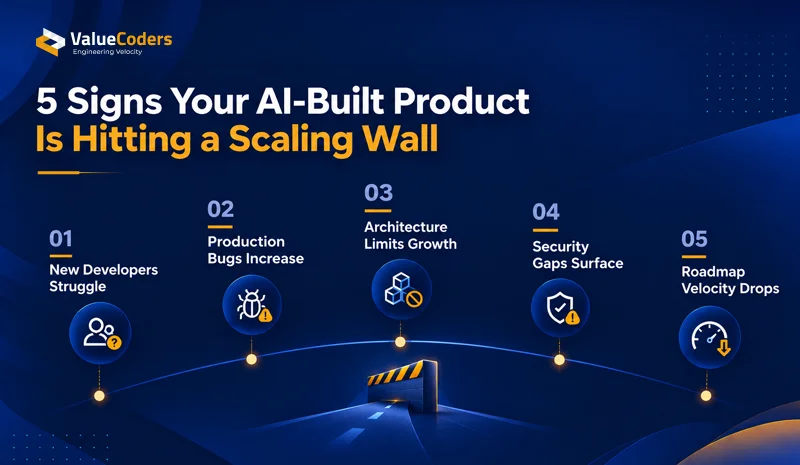
- New developers cannot contribute independently: The original AI-generated implementation lacks the structure, documentation, or architectural context needed for another engineer to work confidently.
- Production bugs are increasing: AI-generated features that worked during prototyping begin creating regressions, integration issues, or difficult-to-debug behaviour as the product becomes more complex.
- Architecture is limiting growth: Performance bottlenecks, database constraints, fragile integrations, or accumulated technical debt start slowing new feature development.
- Security requirements are exposing gaps: Enterprise customers, security reviews, or compliance requirements reveal weaknesses that were not critical during the MVP stage.
- Roadmap velocity is falling: Engineers spend more time understanding, fixing, and working around the existing codebase than delivering new product capabilities.
One of these on its own may be manageable. Two or more at the same time? It usually means the problem is structural, and more AI-generated code won’t fix it.
Should You Fix or Rebuild an AI-Built Product?
When the friction builds up, a full rebuild can look like the cleanest answer. In most cases, it isn’t the first one to reach for. A rebuild pauses your roadmap, puts working features at risk and can recreate the same problems if the underlying discipline doesn’t change.
A better first step is to understand what you actually have. Three questions usually settle it:
- Is the data model sound? If your core data structures are reasonable, most other problems can be fixed in place.
- Are the problems concentrated or everywhere? Debt in a few modules calls for targeted refactoring. Problems in every layer point to a deeper rework.
- Can the critical workflows be tested? If you can wrap them in tests, you can change the code around them safely.
If the answers lean towards fixing, a staged remediation lets you keep shipping while the foundation improves. If they don’t, you’ll at least be rebuilding with a clear view of what went wrong the first time.
Assess your codebase before committing to a costly rebuild.
Also Read: How AI is Changing the Inventory Management Game?
How ValueCoders Helps You Stabilise AI-Built Products
You do not always need to rebuild an AI-built product. Through our AI-Built Rescue engagement, we help teams identify and fix the areas creating the most risk.
Our engineers focus on:
- Architecture: Address scalability and integration constraints.
- Maintainability: Reduce technical debt and inconsistent code.
- Quality: Strengthen testing for critical workflows.
- Security: Identify and address application and dependency risks.
- Reliability: Improve performance, observability, and production readiness.
The goal is to strengthen the existing product so your team can keep building on it safely.
AI-Generated Code Is an Input, Not a Decision
AI-generated software can significantly accelerate AI product development. But speed at the prototype stage does not guarantee maintainability at scale. As customers, developers, integrations and security expectations increase, the engineering foundation needs to evolve with the product.
That means treating AI-generated code as an engineering input, not an engineering decision. Architecture still needs ownership. Code still needs review. Production systems still need testing and security. Developers still need enough context to extend the software confidently.
The goal is not to stop using AI. It is to make AI-generated software reliable enough to support the next stage of your business.
Our engineers will review your codebase and show you what to fix first.
Frequently Asked Questions
AI-generated software can move development faster, but it still needs strong engineering oversight.
Here are the key questions companies should consider before and after production.
1. What happens to AI-generated code after it goes into production?
Ans. It becomes part of the system’s long-term maintenance responsibility. Teams must monitor, test, document, secure, and modify it over time.
2. What are the biggest risks of AI-generated software?
Ans. The biggest risks include technical debt, debugging complexity, architecture drift, testing gaps, security weaknesses, and governance problems.
3. Does AI-generated code create technical debt?
Ans. It can create debt when teams prioritize rapid implementation over maintainability. Repeated shortcuts become increasingly expensive as systems grow.
4. How can companies maintain AI-generated code in production?
Ans. Companies need clear ownership, testing standards, architecture reviews, security controls, and continuous monitoring. Important technical decisions should also remain documented.
5. Is AI-generated code safe for production?
Ans. It can be safe when teams apply appropriate engineering controls. Generated code still requires testing, review, security validation, and human accountability.
6. When should a company consider refactoring AI-generated software?
Ans. Refactoring becomes important when technical debt starts slowing delivery or increasing production risk. Repeated regressions and unclear architecture are strong warning signs.
7. How does AI-generated code affect software security?
Ans. Generated code can introduce insecure patterns, weak authorization, unsafe dependencies, or poor data handling. Security controls should operate throughout development.
8. Can AI-generated software scale to enterprise workloads?
Ans. Yes, but generation speed alone does not guarantee scalability. Enterprise systems require sound architecture, observability, security, testing, governance, and operational ownership.