Every team that plans an AI agent faces one early question. Should you build it or buy it? The quote you get on day one rarely shows the full cost. Many costs appear only after launch.
Gartner predicts that over 40% of agentic AI projects will be canceled by the end of 2027. The citing factors include rising costs, unclear business value, and inadequate risk controls.
This highlights why you should assess cost and ROI before committing to a full implementation.
Calculating the total AI Agent development cost helps you compare both paths with real numbers.
This guide explains what sits behind each number. It also shows you how to read the results and avoid the most common estimate mistakes.
Build vs. Buy AI Agents
Building an agent usually means building the application and workflow layer around existing models. It usually involves business logic, enterprise integrations, data retrieval, interfaces, security controls, evaluation, and monitoring. You own the system and control how it behaves.
Whether you choose to build or buy an AI agent, the first and foremost thing to consider is the total cost of ownership.
Total cost of ownership (TCO) refers to the full cost of an AI agent over its life. It covers the cost incurred in launching the agent, the running cost, and the cost of change.
Compare building and buying over the same period. A two- to three-year view can reveal costs that a one-year estimate misses. However, longer forecasts may become less reliable as AI technology changes.
Also Read – The Real Cost of AI Development: Is It Worth the Investment?
AI Agent Development Cost Breakdown (Upfront Build)
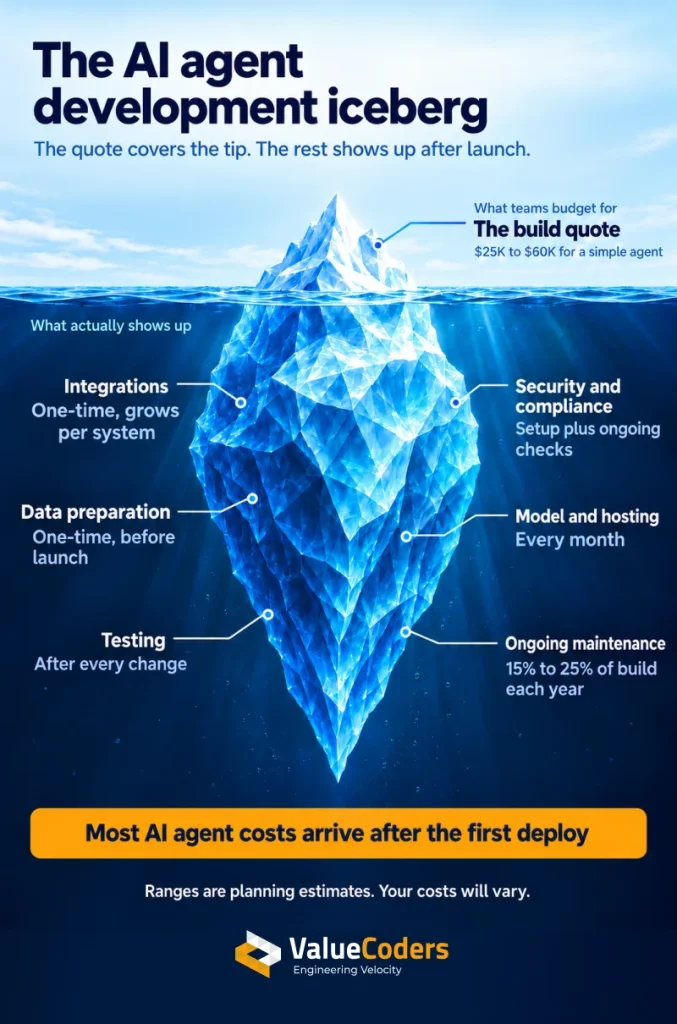
A custom AI agent gives you more control. But you also pay for every part of its development and upkeep.
The following cost ranges are indicative estimates for planning purposes. Actual costs for custom AI agent development depend on project scope, integration complexity, data readiness, security requirements, and the development team’s rates.
AI Agent Development Cost Breakdown (Upfront Build)
| Agent Type / Complexity | Estimated Upfront Cost | Core Capabilities |
| Model-Based / Single-Task Agent | $25,000 – $75,000 | Document processing, lead qualification, single API tool use |
| RAG Knowledge Agent | $80,000 – $180,000 | Vector search, enterprise knowledge base integration, citation tracking |
| Learning / Multi-Step Orchestration | $50,000 – $150,000+ | Autonomous task planning, multi-system action execution |
| Enterprise Multi-Agent Systems | $80,000 – $300,000+ | Deep legacy software integration, strict compliance/security, heavy orchestration |
These categories can overlap. The cost of a project depends on its actual requirements, not just its agent type.
Key Cost Drivers
- Integrations: Connecting CRM, ERP, or internal databases scales effort quickly.
- Compliance & Security: Healthcare privacy requirements, financial-sector controls, audit trails, and data retention policies can increase costs.
- Location of Talent: Development rates vary by location, experience, specialization, and engagement model. For example, Talent in India costs $25 – $60/hr, compared to $120 – $200/hr in the US.
Ongoing Monthly Operational Costs (Run Spend)
Once deployed, expect recurring monthly costs that many teams overlook:
- LLM API Tokens & Inference: $50 to $5,000+/month depending on request volume and model routing.
- Vector Database & Hosting: $20 to $1,000+/month for cloud compute, vector indexing, and RAG retrieval.
- Maintenance & Prompt Tuning: $1,000–7,000 per month for monitoring, security scans, prompt updates, and other maintenance work.
Also Read – AI Coding Is Faster. Is It Actually Cheaper?
What It Really Costs to Buy an AI Agent
A ready-made agent helps you go live faster. But the subscription is only part of the bill. You also need to consider other expenses.
Here is what buying a ready-made agent usually includes:
- Subscription fees: Such fees are usually paid per user or per month.
- Usage fees: Many platforms charge for every task or conversation.
- Setup and integration: Your team still connects the platform to your systems.
- Customization: Special workflows usually need a higher plan or extra work.
- Training: Your staff learns to use and manage the new tool.
- Switching cost: Moving away later can mean rebuilding your setup.
Usage fees deserve a close look. A small fee per task feels cheap at 500 tasks a month. It can become a large bill at 10,000 tasks.
Buying does offer a real benefit. It often gets you results sooner.
MIT’s study found that companies that bought AI tools from specialized vendors or built with partners succeeded about 67% of the time. Internal builds succeeded only one-third as often.
This does not mean you should always buy. It means you should not build alone without the right skills. A partner offering custom AI agent development services can fill that skills gap.
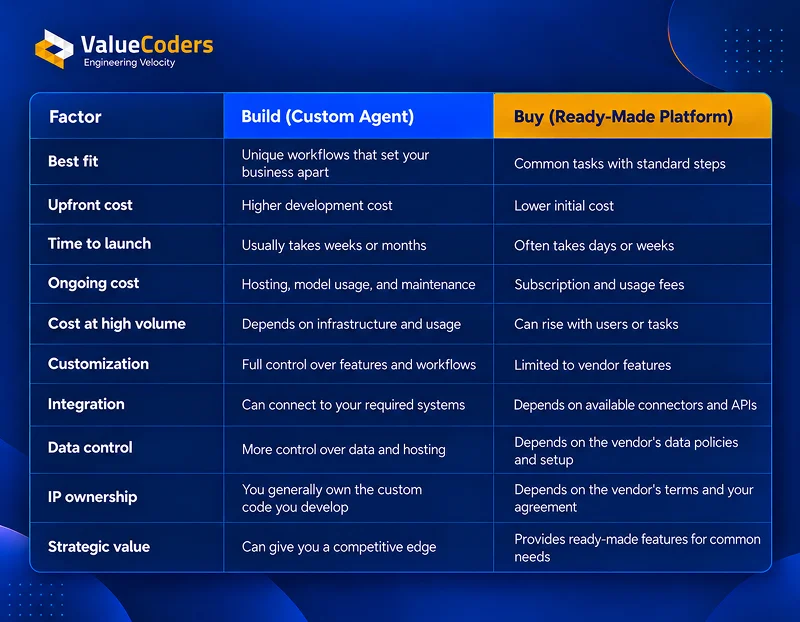
Build vs. Buy at a Glance
How to Calculate AI Agent ROI
An AI agent ROI calculator can be used to estimate whether the financial benefits justify the full cost of implementation and operation. It should distinguish measurable cash savings from capacity released for other work.
Use three calculations to know AI agent ROI:
1. Net benefit
Net Benefit = Total Benefits − Total Cost of Ownership (TCO)
2. ROI
Return on Investment (ROI) is evaluated using the standard formula:
ROI (%) = [(Total Benefits − TCO) / TCO] × 100
TCO = Initial Investment + Operating Costs Over the Period + Other Costs
Use the same time period for costs and benefits. If you’re looking at three years, count the upfront cost plus all 36 months of running costs.
3. Payback period
Payback Period (months) = Initial Investment / Monthly Net Benefit
(Where Monthly Net Benefit = Monthly Benefit − Monthly Operating Costs.)
Most projects pay back somewhere between 6 and 24 months. Scale and volume make the biggest difference.
The payback formula is a simplified estimate. It assumes a reasonably stable monthly benefit and cost after launch. Keep in mind this formula is a shortcut. It assumes your monthly costs and benefits stay steady. If benefits grow slowly or costs jump around, track your cash flow month by month instead.
Also Read – How to Measure the ROI of Generative AI Projects
AI Agent ROI Calculation: A Practical Example
Plan an AI agent around measurable business outcomes, realistic automation rates, and long-term operating costs.
Step 1: Measure the Benefit
Start with the work the agent will take off your team’s plate. Then turn that into money.
- Time saved: Tasks handled × minutes saved per task × hourly cost of staff.
- Fewer errors: Count the rework and refunds you avoid.
- Faster replies: Estimate extra revenue from answering leads and customers sooner.
- Room to grow: Note the hires you won’t need as volume goes up.
Step 2: Count the Full Cost
Use the TCO items from the section above. Include running costs, not just the build or setup fee.
Step 3: Run Both Paths
Let’s take a support team as an example. These are sample numbers.
- The team handles 4,000 tickets a month.
- The agent resolves 40% of them without a human.
- Each ticket takes 8 minutes.
- The loaded cost is $30 an hour.
That releases about 213 employee hours a month.
At $30 an hour, the modeled value of that capacity is approximately $6,400 a month or $76,800 a year.
These figures assume the business realizes the full $6,400 monthly value of released capacity from the start and sustains it for 36 months. This is a modeled benefit, not guaranteed cash savings.
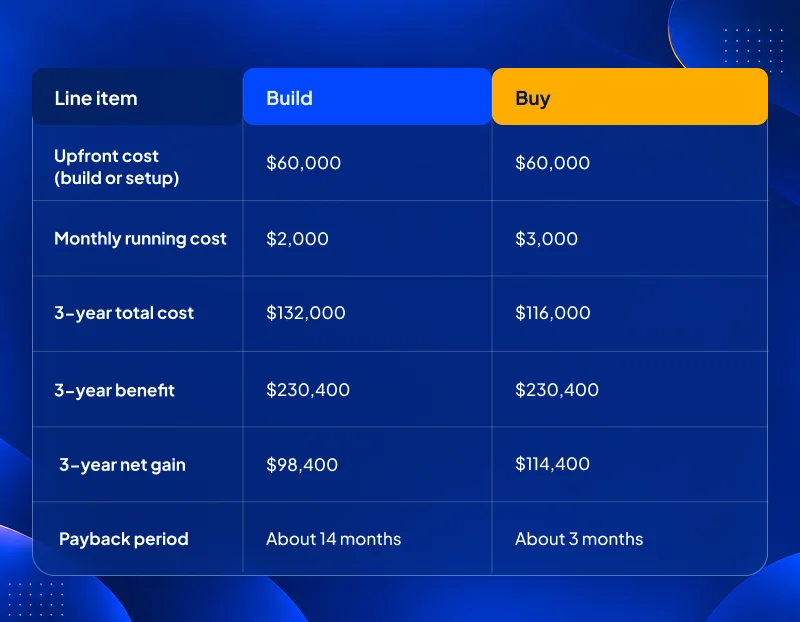
These estimates assume the full modeled capacity value is realized from the start and remains stable over three years. Actual returns depend on whether that capacity translates into measurable business value.
Scenario 1: When Buying Wins
In the above case, buying wins. The task is standard, and the tool fits well.
Scenario 2: When Building Wins
Now change one input. Say the agent must work across five internal systems. The vendor tool connects to only two.
The bought agent now resolves only 20% of tickets. Its 3-year benefit drops to $115,200. That is less than its $116,000 cost.
The built agent still delivers its modeled $98,400 net gain, assuming its resolution rate and costs remain unchanged. Here, building wins because fit drives ROI more than price does.
If you use an AI automation ROI calculator, make sure it lets you change resolution rates and integration needs. A fixed formula hides the real trade-off.
Common Mistakes in AI Agent Cost and ROI Estimates
Most bad estimates come from a few repeat errors. Each one makes a project look cheaper or faster than it is.
The gap between pilot and production shows this clearly. McKinsey reports that 62% of organizations are at least experimenting with AI agents. Only 23% are scaling an agent anywhere in the business.
Here are the mistakes that keep teams stuck in that gap:
- Counting only the build or setup fee. Running costs like tokens and monitoring add up every month.
- Assuming the agent handles 100% of tasks. Real agents pass hard cases to humans. Use a realistic resolution rate.
- Underpricing integrations. Connecting to older internal systems often takes more effort than the agent itself.
- Skipping evaluation and guardrails. Testing for wrong answers costs money. Skipping it costs more after launch.
- Pricing production with pilot volume. Usage-based fees can multiply when traffic grows.
- Ignoring adoption. An agent saves nothing if your team does not use it. Budget for training and process change.
- Forgetting exit costs. Leaving a vendor later means moving data and rebuilding logic.
- Counting hours saved as cash saved. Saved time has value only when people use it for other work.
AI Agent Build vs. Buy Decision Checklist
Use this checklist before you choose a path. Tick each line that is true for your use case.
When Buying Makes More Sense
- The task is common across many companies.
- A vendor tool covers at least 80% of your workflow today.
- You need the agent live within a few weeks.
- Your volume is low or steady.
- Your data can sit on a third-party platform.
- You have no in-house team to own the agent after launch.
When Building Makes More Sense
- The workflow sets your business apart from competitors.
- The agent must connect to several internal systems.
- Your volume will grow fast, and per-task fees will climb.
- You handle regulated or sensitive data.
- You want to own the IP and the roadmap.
- You have access to a top AI engineer or a partner team to own design and evaluation.
Check These for Both Paths:
- You have a named owner who can approve work every week.
- You defined success metrics before you compared costs.
- You priced three years, not one.
- You know your realistic resolution rate.
Most ticks in one group point you toward that path. A close split often means a hybrid works best. You can buy for standard tasks and build for core workflows.
Also Read – How Can Generative AI Help in Building Cost Reduction Strategies?
Conclusion: Make the Choice With Real Numbers
Should you build or buy an AI agent? It depends on your workflow and your volume. It also depends on how well a ready-made tool fits.
Buying suits standard tasks. Building suits unique workflows and agents that need to connect to many systems.
Don’t judge by the first quote alone. Look at three years of costs. Count the setup and the monthly bills. Add upkeep too.
Then be honest about the benefit. Use a real resolution rate. Saved hours only matter when your team puts them to good use.
Still unsure? Start with one workflow and test it. One real project will teach you more than any forecast.
Some teams buy. Some build. Many do both.
Our AI development services team can help you take that first step. We study your workflow and your systems. Then we help you pick the path that pays back.
Turn your numbers into a scoped project with clear milestones.
Frequently Asked Questions
1. How much does AI agent development cost?
Ans. It depends on what you want the agent to do. A simple agent that handles one task costs far less than one that runs across your whole business. The number of systems it connects to matters most. So do your security needs and the team you hire.
2. What does an AI Agent Development Cost Calculator do?
Ans. It gives you a starting point. You share what you want the agent to do. It shows you a rough cost to build or buy. It also tells you when you might earn your money back.
3. How accurate are calculator estimates?
Ans. Good enough to plan with. Not good enough to sign a contract with. You get the real number once someone studies your data and systems.
4. When does building an AI agent beat buying one?
Ans. When no tool on the market does what you need. Or when you run so many tasks that per-task fees drain your budget. If the agent must connect to many internal systems, building usually wins too.
5. How long does it take to see ROI from an AI agent?
Ans. A bought tool can pay off fast if it fits your work well. A custom agent often takes longer. But it can do things a bought tool simply can’t. That slower payback is often worth it.
6. What ongoing costs should I expect after launch?
Ans. More than most teams expect. You pay for model usage and hosting every month. Someone also has to watch the agent and keep it up to date. Plan for these costs from day one, not after launch.
7. Can I start with a bought agent and build later?
Ans. Yes, and it’s often a smart move. Buy a tool first and see if your team uses it. Build your own once you know exactly what you need.