An AI product idea can look promising on paper. The challenge is proving that people need it, that the technology can deliver useful results, and that the product is worth investing in.
An AI minimum viable product (MVP) helps you test these assumptions before committing to a full-scale product. Instead of building every planned feature, you develop a working version that solves one specific problem.
This guide explains what to include in an AI MVP, how to estimate development costs, which expenses to plan for after launch, and how to decide when your product is ready to scale.
What Should You Build in Your AI MVP?
Your first version should focus on one problem rather than a long list of features.
Start by answering three questions:
Who will use the product?
Define your primary users and the task they need to complete.
What problem will it solve?
Identify a specific pain point that an AI-powered solution can address.
What result would prove its value?
Decide how you’ll measure success, such as task completion, response accuracy, time saved, or user adoption.
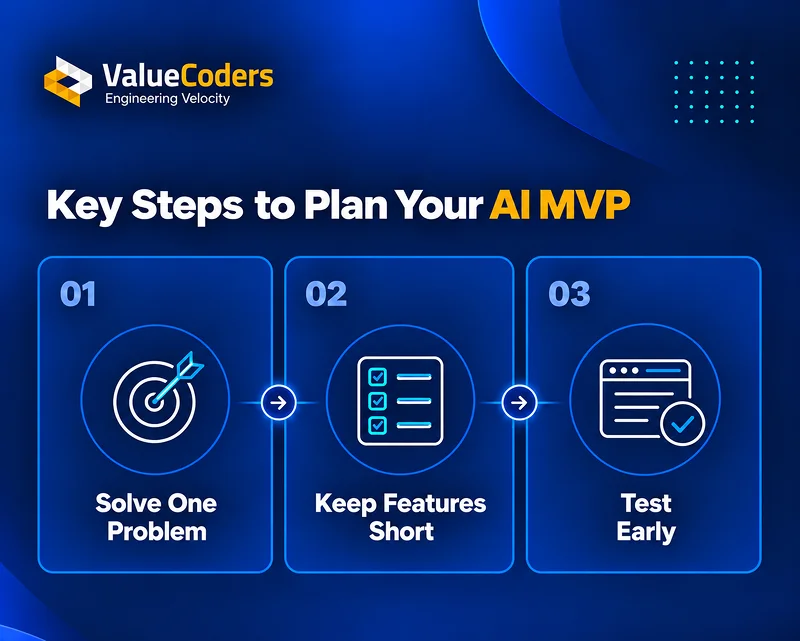
Use these answers to define the smallest feature set that can test your idea.
Define the Core Features Before Development
Once you’ve identified the problem, separate essential features from later enhancements.
Your MVP may need:
- A simple interface for users to submit requests and view results
- An AI model or API that performs the core task
- Access to relevant business data, where required
- Basic authentication and access controls
- Evaluation tests to check output quality
- Logging and monitoring to identify errors and usage patterns
The exact requirements depend on the product. For example, an AI document assistant may need different data-handling and retrieval capabilities than an AI tool that classifies incoming customer requests.
The goal is to build enough to test the core assumption without paying for functionality that hasn’t yet proven its value.
Also Read: AI Coding Agents vs. Software Engineers: What Should Be Automated?
Choose the Right Tech Stack for Your AI MVP
Your tech stack depends on what you are building. You do not need a complex setup, just one that fits your product and can grow later.
Common components include:
| Component | Common options | What it does |
| AI model or API | OpenAI, Anthropic, Google Gemini | Generates responses, classifies information, or performs other AI tasks |
| Frontend | React, Next.js | Provides the user interface |
| Backend | FastAPI, Node.js | Handles application logic, requests, and integrations |
| Database | PostgreSQL or another suitable database | Stores application data and user information |
| Knowledge retrieval | Keyword search, vector search, hybrid search | Finds relevant information from documents or knowledge bases. |
| Hosting and monitoring | Cloud platforms and observability tools | Runs the application and helps track performance and reliability |
For products that answer questions using private documents or business data, retrieval-augmented generation (RAG) lets an AI model use relevant information retrieved from a knowledge base to generate responses.
Choose your model based on output quality, response time, privacy requirements, and operating cost. Using an existing model API can reduce initial development effort. If a standard model doesn’t meet your requirements, first evaluate whether better prompts, improved data retrieval, or changes to the workflow can address the problem. Fine-tuning may help when you need more consistent behavior for a specific task and have suitable training data.
Also plan how the application will handle incorrect outputs, sensitive information, and requests the model cannot answer reliably.
Also Read: What Happens 6 Months After You Ship AI-Generated Software
How Much Does AI MVP Development Cost?
AI MVP development costs depend on features, integrations, data requirements, and technical complexity. The following ranges offer a starting point for budgeting an AI MVP built primarily with existing models or APIs.
| AI MVP type | Estimated cost (USD) | Example |
| Simple | 15,000–30,000 | AI chatbot for customer questions |
| Medium | 30,000–100,000 | AI tool connected to a CRM |
| Complex | 100,000–300,000+ | AI platform with custom workflows and strict data controls |
These are indicative estimates, not fixed quotes. Actual costs depend on project scope, development effort, and security requirements. Hosting, AI usage, and ongoing maintenance may cost extra.
What Goes Into an AI MVP Development Budget?
Building an AI MVP costs more than just writing code. Your budget may include:
- Planning: Deciding what to build and checking if the idea will work.
- Design: Deciding how the app will look and work.
- Development: Building the app and adding AI features.
- Data and connections: Getting the data ready and connecting the app to other tools.
- Testing and launch: Validating AI outputs, checking security and performance, fixing errors, and preparing the application for release.
Planning these steps early helps you understand the costs. It also helps you decide which features to build first and which ones can wait.
Let’s discuss your project scope, key features, and budget to help you plan your next steps.
What Affects AI API and Ongoing Maintenance Costs?
Your expenses don’t stop when the MVP launches. You may continue paying for AI model usage, hosting, data storage, monitoring, security updates, and maintenance.
Several factors influence these costs:
AI usage: The number of requests, the amount of text processed, and the model you choose can affect API expenses.
Data volume: Applications that process thousands of long documents may require more processing and storage than those that answer short questions.
User growth: More users can increase demand on your infrastructure and AI services.
Reliability requirements: Monitoring, error handling, security controls, and ongoing testing all require resources.
Third-party services: Databases, search tools, external APIs, and other subscriptions may add recurring expenses.
You can manage costs by tracking usage, selecting models that fit each task, avoiding unnecessary AI calls, and monitoring the cost per completed task. Set aside a separate budget for maintenance and security rather than treating launch as the end of development.
Also Read: AI Coding Is Faster. Is It Actually Cheaper?
How to Scale Your AI MVP After Launch?
Scaling should follow evidence that the product works for its intended users. More features or higher traffic do not automatically mean the product is ready for expansion.
Use the following checks to decide what to do next.
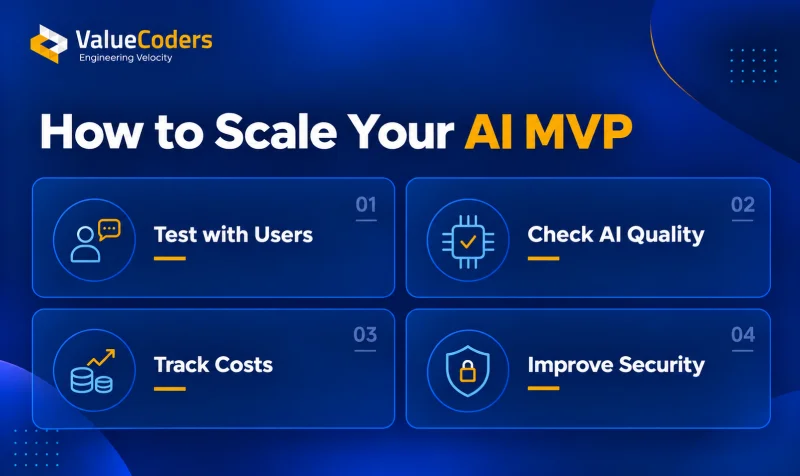
Test with real users: Start with a small group of target users. Observe where they get value, where they struggle, and which tasks they return to complete.
Measure AI quality: Track relevant measures such as answer accuracy, task completion, failure rates, and response time. Review incorrect or unsupported answers to identify what needs improvement.
Monitor operating costs: Measure the cost of completing a useful task, not just the number of API calls. Check whether costs remain sustainable as usage increases.
Improve reliability: Address recurring errors, strengthen access controls, and improve monitoring before expanding usage.
Expand based on evidence: Add features, integrations, or infrastructure when user feedback and performance data justify the investment.
Before scaling, look for consistent user demand, acceptable output quality, reliable performance, and sustainable operating costs. If the MVP isn’t meeting these goals, improve the product and retest rather than simply adding more features.
Also Read: How to Launch Your SaaS MVP in 90 Days or Less
How ValueCoders Helps Founders Build an AI MVP
Having an idea is one thing. Turning it into a working product is another. You need to know what to build, which tools to use and how much work the project will take.
ValueCoders can help you plan and build your AI MVP. The first step is to understand your idea and the problem you want to solve.
The team can help you with:
- Validate the idea and technical feasibility
- Prioritize features for the first release
- Select suitable models and technologies
- Plan development scope and requirements
- Evaluate results and guide improvements
A focused first release helps you test the product with real users. Their feedback and performance data can then guide your next development priorities.
Explore our AI MVP development services to learn how we can help turn your idea into a working product. You can also learn more about working with top AI engineers for your project.
Schedule a call with our team to discuss your goals, project scope, and development options.
Conclusion
Building an AI MVP starts with a clear problem, not a long feature list. Choose the essential features, select technology that fits your needs, and budget for development, testing, and ongoing operation.
Once the product is live, use real user feedback and performance data to decide what to improve. Scale when demand, output quality, reliability, and costs support the next step.
A focused MVP gives you a way to test your assumptions before committing to a larger product investment.