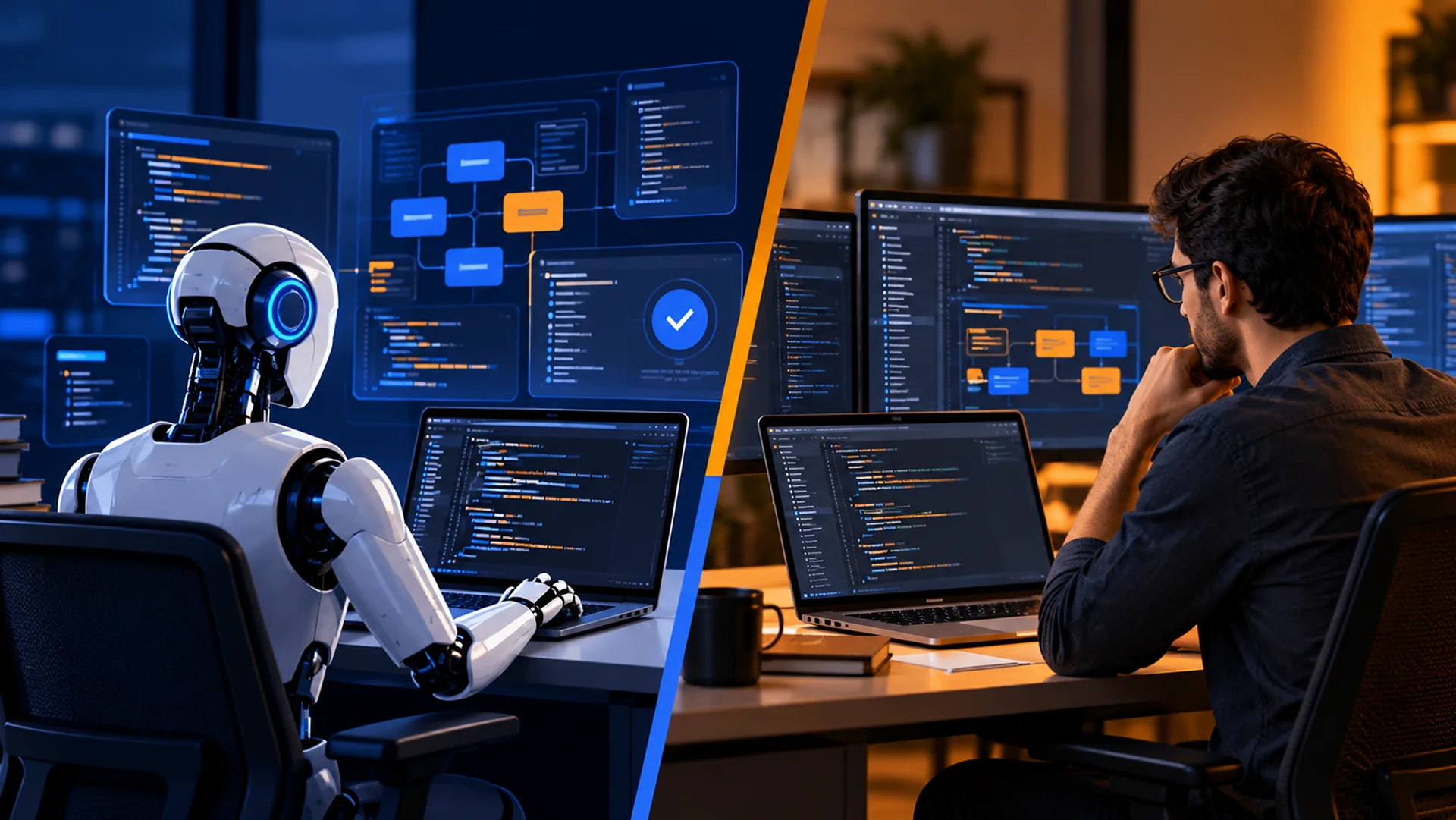


An in-house team gives you more control, but adds hiring and management overhead. External AI engineering capacity can add specialised expertise and capacity without building the entire team first.
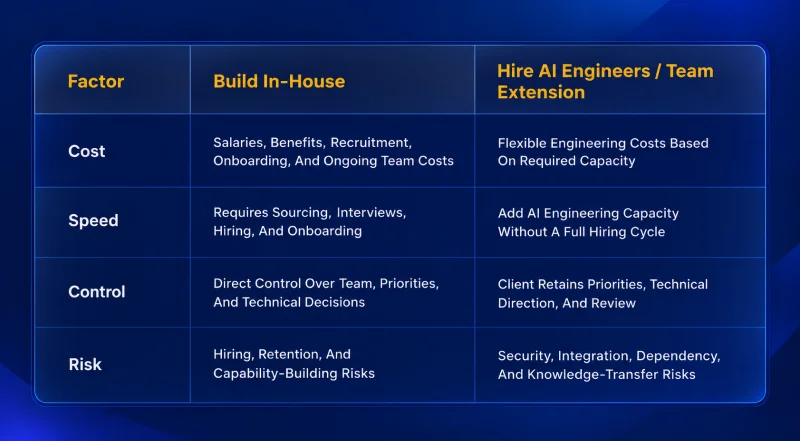
The trade-off comes down to four factors:
- Cost.
- Speed.
- Control.
- Risk.
The right hire: AI engineers vs. building an in-house model depends on your hiring capacity, delivery pressure, and technical ownership needs.
This guide helps you compare both approaches across AI development cost comparison, hiring effort, delivery speed, technical ownership, scalability, and AI project risks, so you can determine which model fits your AI roadmap.
Build In-House vs. Hire AI Engineers
The choice between building an in-house AI team and adding external engineering capacity depends on the capability your roadmap requires and the constraints your existing team is facing.
Cost
Build In-House: The total cost includes salaries, benefits, recruitment, onboarding, management, infrastructure and ongoing skills development. These costs continue even when AI project demand changes.
Hire AI Engineers: External engineering capacity lets you add specialised skills without expanding your permanent headcount. Costs can align more closely with the capacity your roadmap requires.
What to compare: Look at the total cost of building and maintaining the required AI capability. Do not compare hourly rates alone.
Speed
Build In-House: Building an AI team takes time. Sourcing, technical interviews, offers, notice periods and onboarding all affect when new engineers become productive.
Hire AI Engineers: External engineers can add specialised AI skills without waiting for a full-time hiring cycle. This can help when an existing team has a near-term delivery gap.
What to consider: External capacity is most relevant when your existing team owns the product and architecture but needs additional AI expertise or engineering capacity.
Control
Build In-House: Your organisation has direct control over hiring, priorities, architecture, technical decisions and engineering practices.
Hire AI Engineers: Team Extension can add external engineers to an existing delivery team while internal technical leaders retain control over priorities, architecture and code review.
What to define: Establish ownership for architecture, priorities, code review, repository access, IP, documentation and production decisions before development begins.
Risk
Build In-House: The main risks include hiring delays, retention, capability gaps and the time required to develop specialised AI expertise internally.
Hire AI Engineers: External capacity introduces different risks, including security, access management, integration, vendor dependency and knowledge transfer.
What to manage: Use defined access controls, security requirements, code review, documentation, contractual protections and knowledge-transfer processes to manage external delivery risks.
The choice is not simply between internal and external engineering. It depends on whether your immediate need is building permanent AI capability or adding specialised capacity to an existing team.
Also Read – AI Didn’t Lower the Bar for Engineers. It Raised It
Which Model Fits Your Situation?
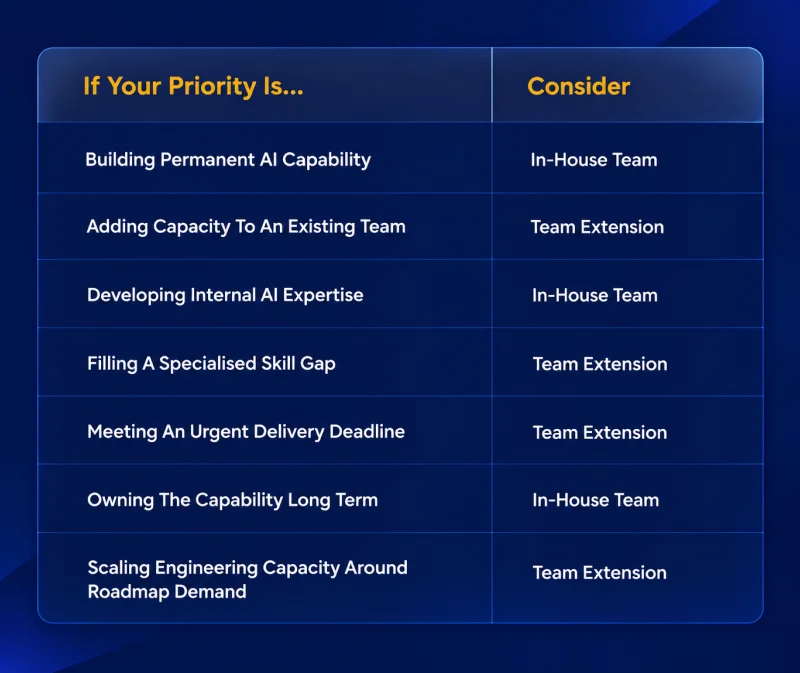
The right model depends on whether you need to build permanent AI capability or add specialised engineering capacity to an existing team.
When to Build an In-House AI Team
Build in-house when AI capability needs to remain a long-term part of your organisation.
- Permanent capability: AI is central to your product or long-term technology roadmap.
- Long-term ownership: You need internal ownership of architecture, hiring, technical decisions, and engineering practices.
- Dedicated investment: You have the budget and hiring capacity to build and retain the required team.
- Stable roadmap: Your AI workload is expected to continue beyond a specific project or delivery phase.
- Internal expertise: You want to develop AI knowledge and leadership within the organisation.
- Hiring capacity: Your organisation can manage sourcing, interviewing, onboarding, and retention.
When to Hire AI Engineers
Use Team Extension when your existing engineering organisation has technical ownership but needs additional AI capacity or specialised skills.
- Immediate capacity gap: Your roadmap has more AI work than the existing team can deliver.
- Hiring lag: Full-time recruitment would delay an important product milestone.
- Specific skill gap: You need AI/ML expertise that is not currently available internally.
- Existing technical owner: Your CTO, engineering lead, or technical team can manage priorities, architecture, and code review.
- Flexible scaling: You need to increase or reduce engineering capacity as roadmap requirements change.
- Established workflows: Your team already has the tools, processes, and delivery cadence for external engineers to integrate into.
AI Team Augmentation vs In-House Hiring: A Simple Decision Framework
Estimate AI integration and scalability costs with the AI Integration & Scalability Cost Calculator.
When Hiring AI Engineers Makes More Sense
The hire AI developers vs. in-house team decision depends on your roadmap and engineering constraints. Hiring makes more sense when AI is becoming a core product capability.
It can also work when your internal team has specific AI skill gaps. Consider adding external capacity when:
- You need specialised AI skills for an existing product.
- Your internal team lacks specific AI expertise.
- You need to start development before building a full team.
- Your engineering capacity needs to change with project requirements.
This is where AI team augmentation vs. in-house hiring becomes a practical decision. Build internally when you need permanent AI capability and long-term ownership. Extend your team when specialised capacity is the immediate constraint.
Also Read – AI Coding Is Faster. Is It Actually Cheaper?
How to Work With External AI Engineers
External engineering does not mean giving up technical control.
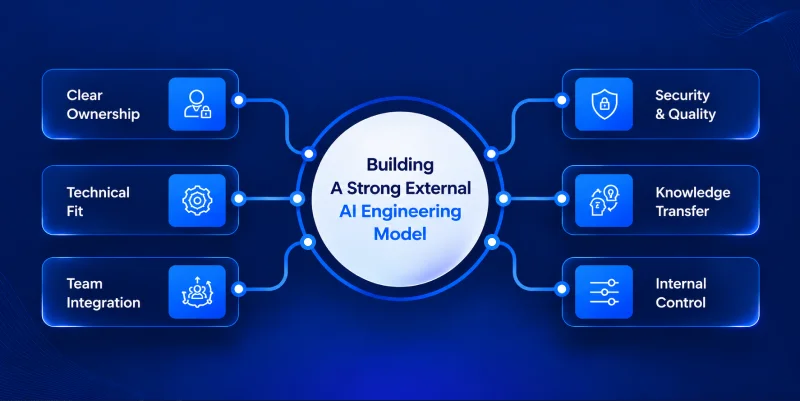
Define ownership upfront
- Assign ownership for architecture, priorities, code review, access, IP, and documentation.
- Keep decision-making responsibilities clear between internal and external teams.
Match engineers to your technical needs
- Assess experience across your technology stack.
- Check relevant AI workloads and production experience.
- Prioritise engineers who can work within your existing architecture.
Integrate with your existing workflow
- Use your existing development tools and processes where possible.
- Align external engineers with your delivery cadence and engineering standards.
- Define security controls and code review requirements from the start.
Also Read – FinTech’s AI Dilemma: Ship Faster Without Failing the Auditor
Document technical decisions
- Record architecture changes and implementation decisions.
- Maintain clear documentation for systems, integrations, and operational requirements.
Plan knowledge transfer
- Make sure your internal team understands the architecture.
- Document key implementation decisions and dependencies.
- Transfer operational knowledge before the engagement ends.
Manage the in-house vs outsourced AI development trade-off
- External engineers can add specialised capacity.
- Internal teams should retain appropriate technical ownership.
- Clear governance helps prevent unnecessary coordination overhead.
The goal is to add capacity without losing technical control.
Add specialised engineers while retaining technical ownership.
How ValueCoders Helps You Build Your AI Team
When AI becomes a core product capability, the engineering model needs to support the roadmap. ValueCoders provides AI and ML engineering expertise for product teams building, integrating, and scaling AI capabilities.
Our AI Application Development Services support:
- AI/ML workloads
- LLM integrations
- Production AI environments
- AI feature development and integration
Add top AI engineers to your existing development team without rebuilding your entire engineering organisation.
With AI-Augmented. Human-Governed, you can:
- Add specialised AI engineering capacity
- Retain control over technical priorities
- Keep architecture and code review with your team
- Maintain accountability for quality, security, and production decisions
- Scale engineering capacity around your roadmap
If you are evaluating an AI development company, the delivery model matters as much as technical capability.
ValueCoders provides specialised AI engineering capacity that works within your existing team, processes, and technical direction.
Frequently Asked Questions
Choosing between AI team augmentation vs. in-house hiring depends on your roadmap, internal skills, and delivery needs.
1. Should you hire artificial intelligence engineers or build an in-house team?
And. Build in-house when you need permanent AI capability and long-term ownership. Hire external engineers when you need specialised skills or additional capacity sooner.
2. How much does it cost to hire AI engineers?
Ans. The cost depends on experience, location, skills, and engagement model. You should compare the full engineering cost, not just the hourly rate.
3. Is it cheaper to hire AI engineers or build an in-house team?
Ans. In-house teams carry salaries, benefits, recruitment, infrastructure, and management costs. External teams usually use a more flexible cost structure.
4. What are the benefits of hiring AI engineers?
Ans. You can add specialised skills without expanding your permanent team. It can also help address capacity gaps and keep AI projects moving.
5. What are the risks of outsourcing AI development?
Ans. Common risks include security, vendor dependency, integration issues, and knowledge transfer. Clear ownership, access controls, code reviews, and documentation can reduce these risks.
6. How do you build an in-house AI development team?
Ans. Start with the skills your roadmap actually requires. Then hire for those roles, define technical ownership, and establish your development standards.
7. Can outsourced AI engineers work alongside an existing in-house development team?
Ans. Yes. With Team Extension, external engineers can work within your existing tools, processes, and development workflow. Your team can retain control over priorities, technical direction, and code review.
8. How do companies manage data security when hiring external AI engineers?
Ans. Start with role-based access and clear security requirements. Limit access to what engineers need. Use code reviews, audit controls, secure environments, and defined data-handling policies. Document security responsibilities before development begins.